Yes, They’ve Been Done, But They’re Still Fun

I’ll admit I haven’t been up on movie watching over the last few years for one reason or another.  It could be my tastes have morphed somewhat, being that we’ve mainly been hitting documentaries, Studio Ghibli movies, and imports.  I haven’t gone to see a good throwaway popcorn movie in ages.

That said, I’ve been hearing reviews on the Wachowskis’ Jupiter Ascending, and the takeaway so far has been “oh god it’s a hot mess but go see it!”  Here’s the trailer:

I finally got around to watching said trailer about a half hour ago, and found myself both concerned and amused that I saw a parallel between it and my Bridgetown Trilogy.  Both contain an alien Origin Story (i.e., where did humans come from?), a female Chosen One character (some kind of savior to keep Earth from going kaboom), and a War for World Control.

When you’re a writer who’s trying to sell a novel you’ve carefully crafted for years that you’re currently trying to sell, and you see a Hollywood movie with parallels like that, you tend to have a moment of oh crap, someone beat me to it!

And then I realize–those three points are everywhere.  I’m not the first, nor the last, to use the alien Origin Story, a Chosen One and/or a World Control plot.  Time to calm down a bit.

I mean, much of the Mendaihu Universe in its early days was influenced by 80s and 90s SF movies and anime anyway: the Gall Force series, Until the End of the World, Strange Days, The Fifth Element, Johnny MnemonicThe Matrix and its sequels, Akira, and so on.  They might not be for everyone–some people see these kinds of stories as over the top and ridiculous.  Sure, there’s an element of the fantastical in the Mendaihu Universe, but that’s often what these kinds of stories are about.  And besides–Jupiter Ascending might be over the top, but that doesn’t mean that it’s not entertaining.  Pacific Rim is ridiculous, but it’s also a hell of a lot of fun.

So that’s why I’m not exactly worried that Jupiter Ascending is getting sort-of-panned by the critics and the public.  I’m not going to pretend my Mendaihu Universe stories are superior or better executed…I’m pretty sure parts of my universe are a hot mess as well.  But my aim wasn’t to write a perfect story–it was to write an entertaining and thoughtful one.  That aim is more important to me.

Of course, now that I’ve seen the trailer for this movie, I definitely want to go see it. 🙂

On Writing Again: Getting Back On the Horse

I’m my own worst critic when it comes to writing, and especially when it involves failure to keep to a writing schedule.  I made a joke of it late last year by calling it “Best Laid Plans”…mainly for the reason that whenever I went online to excitedly reveal what I’m currently working on, those plans would crash and burn spectacularly.  More to the point though, I’m constantly putting guilt on myself when I’m not writing.  I get that nagging itch that feels very much like Sunday night at 8pm, when I’ve realized I’ve left three classes’ worth of major homework undone until that point.  I yell at myself for being an idiot for not doing it earlier.  I gripe and moan and do half-assed work because I’m rushing it at the last minute.  And worst of all, there’s that one tiny voice in there, almost inaudible, that says you know, if you keep this up, you ain’t gonna get shit-all published in your lifetime.  Gods how I LOATHE that one voice…because it speaks a very bitter truth.

So after I get over the guilt and the shame and the irritation, I shut myself up and get back on the horse.

I haven’t exactly been lazy this past week, when it comes to writing.  One of my coworkers was out the latter half of the week and ended up with double-duty for those three days, so I realized I probably would not be running on full power.  I decided to let myself slack on the daily words, as they weren’t time-sensitive or the main project, and skipped on a few whiteboard points as well.  This left me with just enough brainpower to kick out some new words for Walk in Silence as well as decide how I was going to integrate them into the manuscript.  All told, I averaged about 500 words daily, and I’m happy with that result.

So now that everything’s back to normal, what am I going to do now?  Get back on the horse, of course of course.  I’m already doing so now by writing this entry, and starting tomorrow I’ll be hitting the daily words again.  I’ll even be able to hit the whiteboard points again.  Yes, I know, Best Laid Plans…but I’ll take it a day at a time, get done what needs being done, and be happy that I’d made forward progress.  Sometimes that’s the only thing you can do.

Now, if only I’d been this proactive with my homework back in high school…

Writing Stats: January

I’ll keep this short, but here’s the tally I got from my writing stats notebook:

— Daily words at 750 Words:   22,149 words over the course of 27 days; most being 1022, least being 750

— Daily journal: 19 total entries (word count not taken)

–Writing & Music Blogs: 11 total entries (word count not taken)

–Main Project Work: missed counting a few days, but on average about 4 out of 5 weekdays.  It’s been a mix of rereading, some revision, and new words.

Summary Comments:

The daily words are okay, but I’m a bit frustrated with the main project work output.  That’s to be expected, though, as I was doing a lot of refreshing: rereading what I had so far, making mental notes of things to be changed, and planning on where to go next.  At the same time the daily words haven’t been exactly throwaway; I’ve been working on a slightly different and much lighter project there.  The first half of the month started out strong, but petered out near the end.  This was partly due to social engagements, however.

Suggested Adjustment:

Stronger focus on the main project work output from here on in.  I’m well aware of a few problem sections that can either be rewritten or deleted altogether, as well as a second run-through for the ‘second side’ of the book.  Focus more on getting those daily words earlier in the day.  Continue with the habit of ‘getting it done early’ in regards to scheduled projects and whatnot; continue backing away from distractions.

Score:

Meets expectations, but could be better.

On Writing: Reference Books

I’ll admit, I have a lot of writing reference books that have a nice sheen of dust on them.  It’s an embarrassing admittance, but I have to put it out there.  I’d like to think I have a pretty decent grasp of grammar and style in my writing, even if my blog entries and novel first drafts leave William Strunk and EB White twitching in their graves at times.  I’ve cracked a few book spines here and there when need be (usually my copy of Webster’s Collegiate or the ever-helpful Flip Dictionary), but I think it’s high time I started utilizing them more.  Here’s a few that I find helpful, and you might too.

Ray Bradbury, Zen in the Art of Writing.  I picked this one up right about the time the first seeds of the Mendaihu Universe were sown in 1993.  I’d always been a big Bradbury fan (Dandelion Wine is one of my top favorite books ever), and always resonated with his style and method of writing.  His essays on writing inspired me to get out there and do it instead of just talking about it.  I reread this every other year or so, just to bring things into perspective again.

University of Chicago Press, The Chicago Manual of Style.  Seriously, I don’t know why I ignored these kinds of books for so long.  I may have a decent grasp of style and grammar, but I’m pretty sure I screw up the nitpicky stuff more than I wish to admit.  Everyone should have at least one manual of style kicking around, even if it is just to check if the period should go inside or outside the quotation mark at the end of a sentence.

Barbara Ann Kipfer, Flip Dictionary.  A. has often been at the receiving end of that writer’s question, “What’s the word for…?” when I’m having a brainfart, and this one’s great for fixing that.  It’s a reverse-lookup dictionary for the most part, but it also has short sections of related “type of” words (one being a list of hairstyle descriptions and their names afterwards).

Angela Ackerman & Becca Puglisi, The Positive Trait Thesaurus, The Negative Trait Thesaurusand The Emotion Thesaurus.  Someone on Twitter suggested these to me at some point (I forgot who and when), but I picked them up soon after, and they get a lot more use than I expected.  I do tend to overuse certain expressions without thinking — a rough draft of The Persistence of Memories had nearly all the characters sighing in frustration at some point — and these books give me excellent alternatives.

Robert Lee Brewer, 2014 Guide to Self-Publishing. I’m excited that publishing is now at the point where DIY is viable and not frowned upon nearly as much anymore.  I’m even more fascinated by the fact that WD Books has finally released a self-pub version of their annual Writer’s Market book.  It’s set up pretty much the same way, giving a section to editorial services, writers’ conferences to look for, and other items of interest.  There are also quite a few interesting essays in there as well regarding the business of self-publishing that are worth a look.

Joel Friedlander & Betty Kelly Sargent, The Self-Publisher’s Ultimate Resource Guide.  This one popped out at the end of the year and is a nice and lean ebook on par with Brewer’s Guide.  Quite slim at 141 pages, it dispenses with any essays, how-to’s and so on, and instead just offers the online listings of a number of companies, artists and aggregators that can help you get your self-published book out and noticed.  If you know exactly what you need…say, an editing service to fix your typos, a specific image for your cover, and an aggregator to get the book out to multiple platforms?  This is a list of possible candidates for you, without the distraction of everything else you don’t need.  [Okay, I freely admit this one was a shameless plug, as I got a free ARC out of it if I gave it a review on my blog.  Still, I found it exactly what I need for my recent possible self-pubbing endeavors.  Plus, Joel is an excellent resource on the self-pub business, and Betty writes some great self-pub articles in Publisher’s Weekly that are worth searching out.]

Publisher’s Weekly.  I wouldn’t suggest this magazine for the beginner writers (I’d suggest The WriterPoets & Writers and Writer’s Digest instead), but if you’re a professional writer or just about getting there, this one’s well worth the price.  It gives you weekly news on what’s going on in the publishing world, book and conference info, weekly sales charts, and quite the extensive (and very diverse!) review section that’s contributed to my TBR pile.  This magazine focuses on the non-writing end of things–what goes on once your book is out in the wild.  It’s eye-opening, and definitely puts things into perspective.


What are some of your favorite reference books?  Come and share!

On Not Writing: Trying Not to Feel Guilty for Taking Days Off

DSC02114b
In which I am the 1,459,476,874,686th person to take this picture in San Francisco.

After so many years at my day jobs, I was finally able to take my birthday off (January 22nd), so I decided to give myself a nice long four-day weekend.  We both had that Thursday off, so we decided to go out and about and have fun.  We hit a few of our favorite spots (bookstores, a yarn store, our local sushi boat restaurant) as well as visit a few new ones (Alamo Square, Bi-Rite Creamery and Brenda’s Meat & Three on Divisadero).  We even watched some anime that evening.  All in all it was a nice relaxing day, and the weather was perfect for it.  I spent most of Friday afternoon in the dusty dollar bins of Amoeba Records as a birthday present to myself. Yesterday we went to see a Tom Stoppard play (one of my favorite writers) and went out for dinner afterwards.  And today has been for cleaning and shopping.  Only now, at 3pm on Sunday, am I finally making an attempt to get some writing done.

Aside from a few blog posts and one day of daily words, my output these past few days has been pathetic.

Thing is, I hardly made an attempt.  There were a few moments there where I felt the pull of my daily words or my personal journal, but I chose against it.  It wasn’t a decision made out of being lazy–it was one made on purpose.  This was a way for me to remind myself that it’s okay to take a day off every now and again.  Even if there’s work to be done, sometimes it’s better to stop and smell the roses instead.

We writers often pride ourselves on being able to write whenever and wherever and for ridiculously long bursts at that, but we’re also our own worst enemies when it comes to deciding not to write.  Sometimes we must because of deadlines, or because it’s the only way to get any work done at all, but other times we don’t know when to quit for the day.  Yes, we could be out there watching a football game or walking around the neighborhood, or even sitting on our butts for six hours playing video games, but too often we deny ourselves that moment of entertainment.  Every moment without pen in hand or fingers on keyboard is a moment wasted.

That bit of guilt is still there, days later.  I only managed the daily words on Friday, breaking a 23-day streak, and I haven’t written in my journal since Wednesday.  I didn’t write any new words for Walk in Silence, but I did reread a few passages just to remind myself where I was.  The only thing I’ve done that remotely involves writing lately is read Steven Pinker’s The Sense of Style as part of my self-assigned homework.  After years of avoiding active study of style manuals and books on how to write well (caused by a tenth grade English teacher who tried to teach me how to analyze prose within an inch of its life), I thought it was high time to face that demon once and for all.

I know I’m still going to feel guilty that I squandered all these days off and broke that streak, but life goes on.  I truly enjoyed the days off.  I got errands done that needed doing.  I let myself spend a bit of coin on one of my favorite hobbies.  I shot some pretty decent photos of the local scenery.  And I got to spend some serious facetime with my wife, who usually finds me hiding up back in Spare Oom instead, nose at the grindstone.

Besides, my writing time will be back to normal come tomorrow.

On Writing: Stealth Mode

I had another crazy idea the other day.  You know how it is…when I really should be working on my main project (in this case, the book Walk in Silence), my brain decides it wants to try writing a new, exciting story idea.  Equal parts Ooh Shiny and No I’m Not Procrastinating Really I’m Not, to be honest.

This crazy idea was to unconsciously write a novel.

Here’s the thing–my daily non-project words as of late usually end up being 750 to 1000-word passages of one ongoing theme or another.  I’d done this previously, last year (it’s the cat-and-crow idea I mentioned in this blog previoiusly), and it’s a good way for me to keep in the practice of figuring out the theme and plot of a story.

So as usual when I’m on the treadmill at the Y, listening to my mp3 player and contemplating my next writing moves (yes, that is really what I do when I’m at the gym), I started doing a bit of math in my head.  If my daily words at 750Words.com are hit every day, and I write something with the same theme each time, I’ll have a full novel of around 70 to 90k words by March.  Sort of like an extended NaNo project, only instead of trying to shoehorn around 2k words in one of the worst months for productivity, it’s a more leisurely three-month workout during the slowest business quarter.

So what is this about writing unconsciously?  Well, it’s not like I’m trying to write something without paying attention…it’s more of an attempt to write something organically, letting it expand on its own.  But more to the point, this would be about writing a novel without really planning to.  Writing a novel just for the hell of it, instead of trying to write my next attempt at publication.  I have no idea if it’ll pan out, or even if it does, whether it’ll be publishable after revision.  I don’t do that all that often–let’s be honest, a lot of writers just don’t have the time to do such a thing in the first place–but considering my daily 750 is non-project, non-serious writing, it would be interesting to see if I can pull this off.  Thus the stealth mode–writing but not paying that much attention to it.

I may fail miserably on this, or it may be my unexpected heartbreaking work of staggering genius.  Won’t know unless I write the damn thing, yes?

On Writing: Dead Letter Office

I know I’m not the only writer who comes up with more ideas than they can possibly work with. Just today I’ve seen at least three Tweets from published writers opining on ideas they would love to work on, but alas time is short and other projects loom. These possible ideas may never come to light. And the thought of orphaned ideas kills us every time.

This popped into my mind the other day while I was doing some playing around with a possible future project. I use my daily practice words as a Word Playground just to give my brain a stretch (and to prime the pump, if need be). I had a peculiar waking dream the other morning that I was part of a musical family band — sort of like the Osmonds, only set in the 80s-90s — and thought I’d riff on that. The practice words turned into a ‘Where Are They Now?’ story, in which each member would tell the same part of their shared history, only their views were vastly different. The words came quick and easy, as did the separate character voices.

So, you’re asking. When the hell are you going to get around to writing that, when you’ve already got a bajillion other things going on? That is a very good question. I may get to it, I may not. I really don’t know. Does that bother me? It used to in the past, a bit. But since I’ve been writing for most of my adult life and have worked on a large number of projects over the years that have seen various states of completion, I’m not too worried about it.

It also got me thinking–what about the ideas I like, that I may not ever get around to working on? The ones that sing to me, but not enough for them to take precedence? Are they going to languish in my PC and Dropbox folders and on various scraps of paper, gathering dust until the end of time? I’m not talking about my trunked ideas and novels, the ones I know aren’t going anywhere anytime soon…I’m talking about the Word Playground ideas, the ideas that have merit and have been plotted out to some extent.

I had this crazy idea that, if I was going to sign off on an idea I knew I’d never get to, why let it die in my own imagination? Why not let someone borrow it? And then I started thinking about it more: what if I created these miniature worlds, laid the barest of rules and outlines, and shared them with other writers? It made sense in an odd way–there are countless fanfic writers out there who love coming up with their own stories based in someone else’s created world. Why not donate these orphaned ideas to someone who’ll give them more love than I could?

Of course reality always sneaks in on crazy ideas like this, bringing me back to earth. I wouldn’t be making a dime. I probably wouldn’t even be getting credit. I’d be building the framework, but the creator would change it into something not even remotely me. And so on.

Sure, it’s a wacky batshit idea that I probably should not entertain, especially at my point in my publishing career (read: yeah, yeah, I’ll get a book out eventually). Still…it’s a thought I’ll keep in the back of my mind anyway, just so I don’t feel too guilty about all those story ideas I have that’ll never get written.

On Writing: A Room of One’s Own

20150111_161009a

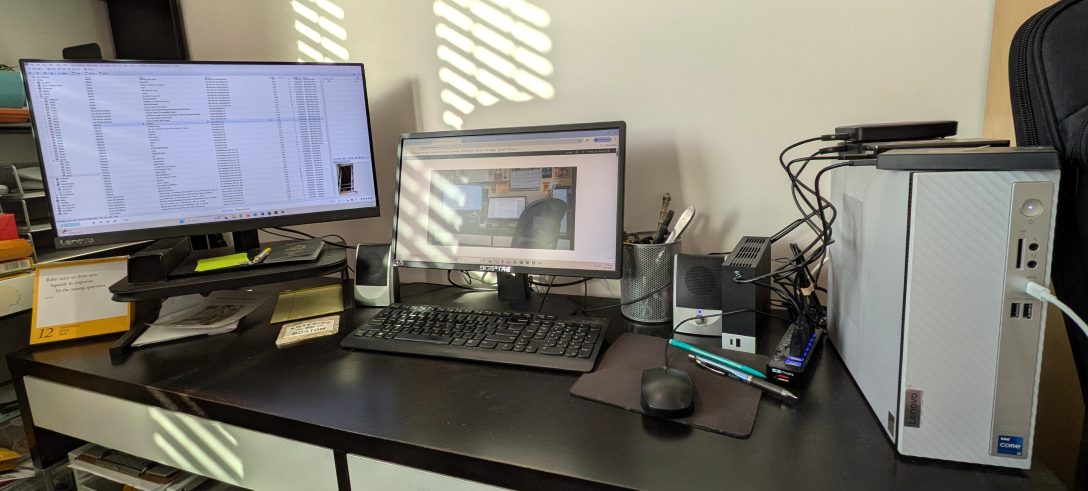
When we moved out here to the Richmond District of San Francisco, we ended up with a second bedroom, which has since been turned into an all purpose room: it’s my day job/writing office, our hardcover and trade fiction library, my music studio, and A’s knitting and canning stashery.  It’s a mite bit crowded in here, but I’m not complaining.  I’ve got my computer for my writing and my mp3 collection to entertain me.

Today was a day for cleaning and rearranging.  I’d just recently bought a new printer–specifically, a three-in-one printer-scanner-copier–and was in need of putting it somewhere central where A. could get at it if necessary.  Which meant getting rid of the old trusty printer I’d had since our last apartment (and still working fine, though the power button’s a bit wonky) and the scanner that for some reason no longer worked.  Which also meant finding a new spot for this new one, because it’s much bigger.  Which means I have to find something stable to put it on.  Which means a filing cabinet.  Which means getting rid of the filing boxes currently on the floor (or repurposing them for other things elsewhere). And the filing cabinet needs to mobile or at least on legs so the heater it’ll partially be blocking will have some place to push the heat directly without blockage.

And so on and so forth.  I had to think about five to ten steps ahead while planning out how to move everything around without cluttering up the room.  This is what happens when you have a finite amount of space to work with.  As you can see above, there’s a lot going in a small area.  A. pointed out last night that a goodly amount of the stuff in this room is indeed mine, and that, sadly, is the truth.  But from past experience I’m quite adept at getting maximum use out of minimum space.

The desk is a long and narrow one acquired from Ikea.  The left side is my home PC and other bits and bots, and the phone and laptop to the right is my Day Job stuff.  This works out perfectly as I get to focus on my job during the day but still get to listen to my music and take an internet break every once in a while.  And in the evening, my focus is on the left side of the desk, where I do all my writing.  And off to the far right of the picture, you can see the new cabinet and printer.  I still need to refile a number of things and move those file boxes in front of the bookshelf, but other than that I’m happy how it looks.  It took a good number of days and a lot of cleaning, but it worked out well, and no extra floor space was taken up.

It’s a small room, but it gets the job done.

On Worldbuilding: Down the Rabbit Hole Willingly

It’s often said that the downside to worldbuilding is that sometimes we writers get caught up in it, to the detriment of the actual writing.  I’ll freely admit that creating a fictitious world is a never-ending source of fun.  The Mendaihu Universe has grown and evolved over the course of two decades, and even as the Bridgetown trilogy enters Submission Phase this year, I’m still coming up with new avenues, new details for it.  Just yesterday I started playing around with another MU story set on Mannaka, an outpost world mentioned on the periphery in the BTown trilogy.  For the love of my own sanity, why am I doing this?

Short and most obvious reason?  More stories!  Ever since the aborted True Faith novel, I’ve always planned on setting a number of books in the same universe.  Not always in the same fixed spot in the timeline, of course…the timeline for yesterday’s brainstorming is up to question, but it would be a few millennia either before or after the BTown events.  This was partially inspired by Anne McCaffrey’s Pern universe–I liked the idea of writing multiple stories in my own created universe.  Each story would stand on its own, but there would always be a reminder somewhere (either up front or in the periphery) of the spiritual evolution story that’s central to the Mendaihu Universe.

And I spent a lot of time between 1994 and 1997, the years before I started The Phoenix Effect, just playing around with the universe, coming up with various story ideas and plot points in the timeline.  I remember a lot of slow afternoons in the ticket booth at the theater (and later at the radio station) where I’d lay the ground rules for my universe, such as major world events, evolutionary steps, and so on.  Just enough to give me anchors for future projects.

I can understand when worldbuilding can be a writer’s downfall, of course; spending too much time on the minutiae and not enough on the prose, focusing too much on the history and not enough on the present.  Or worse, giving into the joy of worldbuilding so completely that doing the actual writing becomes less than exciting.  It becomes like Charles Foster Kane, focusing on building the empire and home, changing it and morphing it as time and whim permits, but never quite finishing it.

The trick is to balance it out…I can have a lush background history, but I have to do something with it.  I can create a sprawling city-province like Bridgetown, but I have to have something happen there in particular.  I can create various characters to act out my story, but I have to have them do something inherently them in the process.   And after all of that, while I’m writing the story, I have a background I can work with–I can put these characters through a historical event that will affect them in one way or another, which will in turn cause them to evolve somehow.

I learned this when I realized I could no longer get away with ‘making it up as I go along’.  I learned it with The Phoenix Effect, when I realized that there were way too many divergent plot points and “I’ll revise it later” moments caused by immediate worldbuilding, all of which caused the story to be full of holes and inconsistencies.  When I restarted with A Division of Souls I forced myself to focus on the created history I had, and if new points of reference came up I would make a concerted effort to ensure they made sense in the overall story.  [A great example of this is in Chapter 2, when Assistant Director Dylan Farraway states “…this certainly isn’t a Second Coming…” to which Alec Poe responds with an offhanded “Ninth, sir.”  It was a complete throwaway line at the time I wrote it, but as I continued writing, the Ninth Coming of the One of All Sacred became the most important plot point of the entire trilogy.]

Working with your worldbuilding is definitely a tricky business.  You have to make copious notes.  You have to have a very sharp memory of what you’ve written.  You have to make sure you don’t get lost in it.  But once you’ve found a way to successfully manage it and make your way through it, it’s quite possibly the most enjoyable part of the writing process.