Perseverance

anime-tired

It’s been a hell of a week.

Day Job system crashes.  Unending emails to work through.  Client fires to put out.  A drive across the Bay for an office visit.  I missed a few writing days.  I’m late in getting this post out.  I’m just about done, and it’s not even noon on Friday yet.

BUT.

I gotta do it.  No way around it.

I gotta write.  I can take a rest day every now and again, but I gotta pick it up again when I’m ready.

Perseverance.  A stubborn will to hit my deadlines.

Even if this post is a half-assed one with yet another anime picture as the header.  Heh.

Still.

Gotta get my work done.

Despite all the roadblocks.  Despite the raving case of the Don’t Wannas.  Despite really needing a beer right now because the Day Job’s been that much of a pain in the ass.

I gotta write.

Because no one else will do it for me.

It’s not a race

kakashi-guy-2

One thing I always need to remind myself is that I’m not in a race with other writers to get my work out.  Sure, I had that feeling way back in the day, back when I as naive enough to think that my manuscripts were good enough to warrant attention.  I thought the turnaround was super-quick, that I’d have my byline and my comp copies in my palms within a few weeks.  [Reality hit me pretty quick and hard, then.]  And I still get that twitch of envy when I see writers I know personally or online, releasing new works while I’m still languishing.

Every writer gets that feeling.  You want to be in the same race as everyone else, wanting to keep up and be One of the Gang.  But everyone in that gang is already miles ahead of you, already known to readers, physical copies of books in hand, doing the signings and the readings at the conventions and book stores.  It’s enough to make you wonder if you’ll ever catch up.

kakashi-guy-1

Well, here’s the thing:  it’s not a race.  Not unless you want it to be.  You might give yourself a hard deadline like I did, to get that book out and away by a specific date, to have that physical copy in your hand  (even if it is a galley or an ARC).  But you’re not racing the other writers.  Far from it.

They’re running just as hard as you are, tripping up at the same points you are, maybe even making it up as they go along like you are.  Their race is not about who gets there first across the finish line, or who gets there the fastest.  Their race is about finishing the race.  To them — and indeed, should be to you as well — this race is a marathon.  Running those twenty-six-point-two miles of hard work, revisions, edits, re-edits, re-revisions, meetings, sales plans, working on other projects in the interim, and aiming for that final goal of completion.

kakashi-guy-3

In the end, the only race in writing and publishing that a writer should be concerned with is a deadline.  I had to remind myself of this for quite a long time, and once I finally got over that, I no longer felt frustrated that I was getting left behind, or annoyed that I was taking far too long to get my own work done.

One of the best ways I learned that is to take part in the writing community.  I’m still a solitary writer that hasn’t joined a local writer’s group (and I kind of feel more comfortable that way — that avenue is completely up to you whether you want to follow it or not)…but I talk with other writers online all the time, I’ve met up and become friends with writers both beginner and pro.  Once I came to the conclusion that we’re all in the same boat, that we’re all slightly frazzled and overworked but still loving what we’re doing, none of us are truly left behind.  A lot of us support each other at all levels, because we know just how hard the job can get.

kakashi-guy-4

We’re all running, but we’re all running together.


[Images courtesy of Naruto, of course!]

Point of No Return

While doing the Big Edits and the galley edits of my trilogy, I noticed that with each book, I set the main plot’s Point of No Return in the exact middle of the story.  Not that it’s necessarily where the one Act ends and another starts; it’s merely a concrete point in the story where enough has happened and the only way out is forward.  It’s the point where one or many of the characters face the No Turning Back Now part of their arc.

I don’t even try to do it consciously.  I’m aware that it’s one spike of many in the story arc, just like they all are, but I don’t always plan it to be the most important one.  Most of the time, it just ends up that way.

The climax of the story is near the end where it should be, of course…but this isn’t the climax I’m talking about.  It’s the point where the characters may pause and finally get their bearings and finally truly see just how deeply they’ve embedded themselves.  [Out of amusement, I’ve sometimes called it the “oh shit we really are screwed aren’t we” moment.]

And this moment can happen at any time, really.  And it can happen numerous times within the span of a book or a series.  But there’s usually one true Point of No Return moment.  And somehow I’ve figured out where to put it exactly in the middle of my stories!


Cover Story

mccleever-street-blues

As I’ve said before…I may have a side job on my hands.

See, this started back in the mid 80s when I was in junior high.  I was more obsessed with music and band discographies than I was in sports.  Even then I could tell you what song what was on which album, if I knew the band well enough.

One summer afternoon, I’d made up a fake band and had a little bit of fun coming up with a fake discography to go along with it.  [I don’t remember the band’s name but the ersatz label I came up with was Plazmattack.  Don’t ask me where that came from.]  I went into detail, coming up with song titles, album names, all the way down to the multiple singles and EPs.

I never actually followed up with writing and recording the songs, as I was fifteen and didn’t have much musical ability.  But I was a true music geek, and I was willing to take this fanciful idea for a spin.  A few years later when a few friends and I started The Flying Bohemians, I actually made a detailed discography for our small but growing batch of songs.  I even did a few cassette covers, taking blurry pictures I and my sisters had taken and pasting them on the insert cards.

*

Thirty years later and I’m about to embark on another fake discography for a future writing project.

And more than that, I’m about to pretend I’m an artist as well.

The above is my first attempt at a book cover for a story that doesn’t exist.  It’s an experiment to see if I can actually pull it off.  If I can, then my Secret Side Project may actually have legs and be worth pursuing.

Background: The title McCleever Street Blues predates the Vigil and the Mendaihu Universe by a year or two but is in the same setting and timeframe.  It was to be a short story about a kid trying to get from one location to another in a sprawling city, and all the boundaries and distractions he had to deal with, as well as all the regular folk he’d see every day.  I’ve never actually written it.

The picture itself was taken by me on my cell phone on Rue des Petits Champs in Paris late in the afternoon a few months ago while on vacation, and filtered through the Prisma app.  I cropped it using Photoshop and added the title and byline using Pic Monkey.  It’s a very rough outtake, of course.  For starters, I’d do a much better job of the matte frames for the title and byline given more time and inclination.

So…what do you think?

Long Long Long

I’m going to state right here and now — I have absolutely no problem with doorstop-length novels, if they’re written well and keep my interest.  I know they’re not for everyone.  Back in the 70s and 80s, doorstoppers were all over the place (I’m looking at you, Robert Jordan and Stephen King), topping over 200,000 words or so.  But by the 90s, books got thinner and more compact — leading to more space on the store shelves for more titles.

Some say this was the publishers’ plan, asking for writers to produce shorter books so they could sell more varying titles.  Others say that it was a change in reader taste, that the doorstopper is passé these days and readers prefer their word count to hover around 120k at the most.  I’m not sure who’s right, but either way, it’s become tough to submit those things to the Big Pros nowadays.  Unless you’re GRRM or Alan Moore.

But now that books are available digitally in a format that takes only a sliver of memory from your reader, the space for All The Books has expanded significantly.  You can fit a surprising number of long tomes on a regular-sized reader, and some e-book providers will even let you store them on a cloud so you can create even more room on your reader.

But what does that mean about long books?  Does this free the writer up to work on their long dreamed-of epic tale they’ve always wanted to write?  Of course, at this time the only real avenue for that is probably the indie/self-pub route, but the question remains: does this mean the restriction for writing long books has loosened?  Does this give the writer more breathing room to experiment?

And the big question: will readers’ tastes for long books change once more?


Self-Publishing: One Year Later

20160903_160555
Two down, one to go

Has it already been one year since I self-released A Division of Souls into the world?  Yes!  And it’s been quite the trip.  I’m far, far from rolling in the dough, of course, but I don’t consider myself a failure.  In fact, I’d like to think that I’ve succeeded far more than I’d ever expected to, and I couldn’t be happier.

Let’s break that down:

–The Bridgetown trilogy contains three books that I wrote early last decade and edited, revised, rewritten, and re-revised countless times since late 2009.  I’ve not only made the prose better, I’ve learned how to write better.  I’ve also learned how to be a ruthless editor with my own work.  I’m quite proud of the results.
–I researched to find the best self-publishing avenues; not only to choose what felt right to me but what felt right for the books.  It’s never been just about making all the money (though that might be nice eventually), it’s been mostly about sharing my stories with everyone.
–I learned how to format for e-book as well as for paper.  The two are mutually exclusive, come to find out, but thanks to a lot of online information, I was able to pull it off.
–I felt my way through various avenues of promotion: making the books available on NoiseTrade, taking part in a Smashwords month-long promotion, and so on.  Kept my eyes open for other avenues that I may take in the future, once Book 3 is out.
–Thought I’d try my hand at creating my own book covers, and to my complete surprise, not only am I pretty good at it, I happen to really enjoy it.
–The responses I’ve gotten, both from friends and readers, have been helpful and informative.  Many have commented quite positively on the unique storyline and are looking forward to more.  This was one of the best payoffs: it means I did it right.
–I’ve come to the conclusion that I also really enjoy self-publishing in general; not as a way to circumvent the Big Pro Publishing machine, but simply as an alternative.  [And you know how I like all things alternative.]  I can definitely see myself doing this as a long-term prospect.
–All this, while holding down a full time Day Job in banking, which has very little to do with my creative writing (unless you count my work emails, which can get quite lyrical in its business-speak sometimes).

Many times I’ve thought that I happened to drift into self-publishing at the perfect moment, when it’s starting to gain respect in the field as a viable and important avenue for writers.  I remember when self-pubbing first crossed my mind, back in 2008 or so, when I was inspired by John Scalzi having done the same thing early in his fiction career.  I knew it wasn’t something I’d jump into blindly; I didn’t want to make too many rookie mistakes and ruin my work and career.  I knew I wasn’t the best writer, that I could be even better if I set my mind to it and took the time to learn.

I also find myself incredibly lucky in that I’d noticed all the unique parallels between writing books to publication and recording music to public release.  The DIY structures of punk that I was familiar with served as a guide for DIY publication.  I also find myself incredibly lucky that there are more avenues than just vanity houses and small presses than there were even ten years ago.  It’s been quite the thrill ride, and I’ve learned a hell of a lot over the last decade or so.

Yeah, I think I’m gonna keep this gig.

I Write the Songs

I don’t think I’ve written more than a dozen or so songs since I moved out here to San Francisco in 2005.  Probably much less than that.  A few clips of melody, maybe a riff or two, but nothing concrete, not like my last songwriting wave in the early 00s when I was jamming with Bruce and Eric in jeb!.  The latest actual song milling about in my head is an instrumental I created using the sound of London’s District Line clacking down the tracks near Earls Court as percussion (which I recorded to my phone); I have not yet had time to lay it down as a demo, though I did get as far as making a very rough loop of the train as a trial run.

Why do I bring this up?  Well, it seems my next writing project involves songwriting.

What’s this, you say?  Has Jon gone off the deep end in a severely misguided attempt to write a multimedia book?  I mean, he’s a pretty decent writer and makes cool covers, but music?  What the hell is he thinking?

Well, I blame Wesley Stace for this.  Formerly known as John Wesley Harding for you 90s alternative rock people, he wrote a fun novel called Wonderkid about a quirky band that, against all odds, became a huge hit in the 90s, primarily due to having an extremely large preteen audience.  It’s a hell of a fun book and worth checking out.

Sometime later, I was chatting online with a friend about the Osmonds (I forget the context), when I came up with an idea of writing a music-based novel myself.  Thus the family band The Lidwells were born!

That said…

Now that I’m at the point of wanting to do some prep for the Lidwells project, I’m not just thinking about making character sheets and a working discography (yes, I’m going that deep), but may be writing a few of the songs mentioned in the text.  All told I’m hoping to write about a dozen or so songs during the course of writing this book.

Added to that, this story takes place in the 90s during the alt.rock boom, so I’m going to have to write music that sounds like it would have fit then.  Will I record them as demos and post them here?  Yeah, there’s a good chance of that happening.

This should be interesting…

Who Are You

One of the many preparatory steps I’m taking for the upcoming New Project (Nothing to Do with the Trilogy, Honest) is thinking about new characters.  Of the two projects I have on deck, I’ve decided that I’d like to know more about the characters ahead of time, before I get any actual writing done.

I’ve done this before with the trilogy, but for the most part they were in my head.  Considering I pretty much knew a lot about them by the time I wrote the three books, I could get away with that.  However, these new projects are different.  I’d rather not wing it this time.  [I mean, I can if I have to…but I’d rather not.]

In this instance I’ll be creating character sheets.  Nothing too detailed or intensive, just enough for me to use as reference.  I’ve seen many webcomic artists do this; they’ll have an image folder or scrapbook that will have the basic character designs, but will also include fashion photograhy and color palettes (personal styles), celebrity casting (what they look like, facial expressions, different angles, etc), unique physical attributes (hair, piercings, etc), and so on.  I did something similar to this for some of my trilogy characters, adding things like their birthdays, current addresses, and so on.  I rarely had to pull them out for reference, but they were good to have on hand just in case I’d erred in description somewhere.

I also usually add a map or two as well.  I drew a basic layout of Bridgetown early on for reference and it came in quite handy multiple times.  I will most likely do the same for one of the two upcoming projects.

It does sound like I’m purposely limiting the amount of pre-work I do.  It’s true, I don’t like to give my outlines all that much detail, at least not on a long-term basis.  Just enough so I know what to write within the next three or four chapters and a vague idea of the direction of the novel as a whole.  The same goes with the characters; the most I’ll do is create a character sheet that will remind me of the basics so I can remain consistent.  Essentially, something I can anchor the character to.

There are numerous books and articles out there suggesting how to create characters with depth, and I’ve read many of them.  They all have great ideas that will help you create a better novel.  I’ve always tended to uses these suggestions as a baseline rather than concrete directions, and that’s worked just fine.  There’s no right way to do it other than whatever works for you.

STFU

not writing

I came up with a mantra in the spring of 1995 when I realized that if I was going to get any serious writing done, I was going to have to stop making excuses not to.  Or more to the point, I was going to have to stop procrastinating.  I had a lot on my mind that summer…a stagnating long-distance relationship; lots of overdue bills; a really horrible diet of cereal, ice cream, concession stand food, soda, and smokes; jobs that weren’t paying enough for me to actually live on.  It’s quite true that life stress is not conducive to the creative mind. At. All.

But I had the use of my girlfriend’s PC that summer, and a hell of a lot of time on my hands when I wasn’t at my theater job.  I had a few projects milling about in the back of my head.  And I had my radio and my music collection to keep me entertained.  All I needed to do was get myself into the groove somehow.  If I was going to finally jumpstart this writing gig with any seriousness, I was going to have to go all in.  I couldn’t do it half-assed.

Which meant that I had to come up with a daily reminder.  And this reminder was written on two index cards in very large letters — one was posted right above my desk, and the other was next to my bed.  That way I’d see them every single day, whether I wanted to or not.

This is what they said:

Just DO it.  Shut the f*** up and START WRITING ALREADY.

Terse?  Maybe.  But it did the trick.  The only reason for not writing at that time was so I could feel sorry for myself and my pathetic social life and post-college career.  I hated feeling that way, and I hated that I knew I was wasting time feeling that way.  I had to break the cycle somehow.

Even if that meant working on the small, inconsequential stuff like transcribing my writing from the past ten years.  Even if that meant making small notes on scrap pieces of paper while at my job.  The main aim here was to create a daily habit out of it.  I’d worry about results at a later time.  As long as I was doing it and not wishing I was.

*

I’ll be honest, that’s still my writing mantra, twenty-one years later in 2016.  It’s for different reasons, of course.  I say that to myself when I’m having a mean case of the Don’t Wannas, or severely distracting myself online, or whatever.  I still have my moments of self-doubt (what writer doesn’t?) and wonder if the current project I’m on is worth finishing.

Procrastination and self-doubt are still two of my bitterest enemies, and the only way I know how to defeat them is via the same mantra:  just shut the f*** up and DO it.

And you know what?  It still works.

Creating Covers

So tonight I decided to play around a bit with the cover for The Balance of Light, even though it’s still quite some time before it’s going to see ebook or print.  This one was tough, because I had an idea of what I wanted, but looking for the right picture was going to be a tough one.  I wanted something to balance out the blue/yellow night view of A Division of Souls, so I knew it would have to be yellow/blue and morning.  I had the color scheme down, but the picture was the tough part.

I’ve said before that I really love this part of the self-publishing process; I mean, really love it.  Like, to the point that I may possibly do this as a side-job in the future.  I love looking for that perfect shot.  Trying to get the perfect crop balance.  Figuring out whether to adjust the color or give it a bit of an effect.  Playing around with fonts and text placement.

I’ll be honest, it’s like I’m making fake album covers.  It’s something I used to do as a teenager with my mixtapes and the Flying Bohemians tapes.

Let’s take a quick look at the three covers I’ve made so far:

ados 100615 nt cover

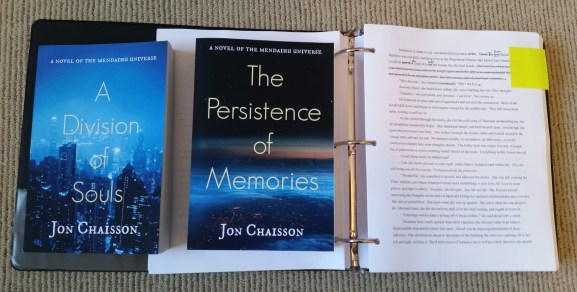
The cover for A Division of Souls was meant to invoke a few things:  the setting (a metropolis, teeming with people), the time (at night), and mood (tense and mysterious).  It’s also to serve as a tie-in to the very first scene.  In short, my aim was to say: this is what the book’s going to make you feel.

The cover was also supposed to tie in with the other two books, which means that I also had to think ahead:  what were the other two going to look like?  I knew I’d have to keep a few visual motifs going…a city would have to be involved in all three, somehow; the images would need to evolve, just like the story itself.  In this case, I created multiple ‘lightboxes’ in my Shutterstock account and started looking for pictures that would do exactly what I needed them to do.

The time it took to throw this one together was surprisingly quick, to be honest.  Looking at it now, I can see a few things I should fix, but for the most part it went smoothly, once I knew exactly what I wanted to do.
tpom 032316 take 2

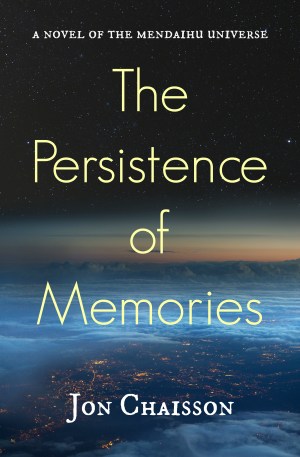
The cover for The Persistence of Memories was a bit trickier, and I think it looks better as an e-book cover than it does as a trade paperback cover, but I do like how it came out.  The same rules applied here…in this case the setting was twofold: it takes place both on Earth and on Trisanda, so I chose to do a ‘satellite’ point of view that shows both the city below and the stars above.  Time seems to be fluid in this shot.  It seems to be late night in the city below, blanketed by the similar blue (not exactly the same but close) of the first book, but in the heavens, time is irrelevant; it’s all light and dark at the same time.  It also creates a dreamlike mood, where you’re not entirely sure what’s reality and what isn’t.

The placement of the title was purely serendipity, to be honest; I did not expect the top two words to be in space and the bottom two to be in the planet’s atmosphere.  It just turned out that way and worked out quite nicely.  Funnily enough, once I’d noticed that, I was torn on exactly where I should place it…the other outtake had the title dropped a tiny bit lower, so the “of” is resting right on top of the gray cloud line instead of hovering over it like it is.


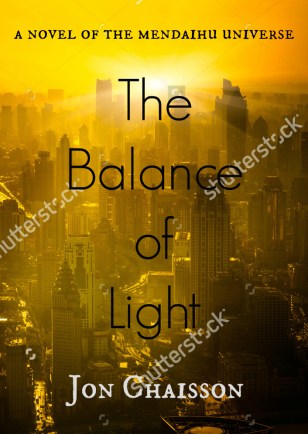
I haven’t made a solid decision yet on what the Book 3 cover will look like but this is what I came up with tonight:
tbol outtake 3b


I’m still playing around with the font color for the title, as well as the placement of the text.  The picture hints at the metropolis of ADoS, but the mood and the time is different: we’ve gotten through the late night of Book 1 and the witching hours of Book 2, and now we’ve come to the morning after of Book 3.  The yellow of the sunlight is supposed to hint at the yellow font of Book 1, and I’m still trying to figure out which bluish hue would be good for the title (to hint at the blue cityscape of ADoS).

True, it does kind of hint at new-agey books, but that’s kind of the point…the characters and the planet itself has gone through a spiritual awakening of sorts.  And like Book 2, it serves a dual purpose: the physical awakening from that dreamlike state, and the spiritual awakening.

*

One thing I learned early during this process was that I shouldn’t merely look for something that ‘looks cool’, no matter how tempting it may be.  The last thing I needed was to look for something shiny, because I didn’t want the casual viewer to say ‘wow, what a flashy cover’ but not completely connect with it or remember it.  I wanted something unique.  Something that stood out from other covers, not because it was the flashiest, but because it was different. Something to catch their attention because it stood out just enough.

These first three are my first attempts at doing book covers, and as you’ve probably noticed, there are no actual people on the cover.  This was a conscious choice; not only is it because of the large cast, but because I also wanted to invoke the idea that it wasn’t just my characters being affected by the story, but planet itself.

My next couple of projects do involve a much smaller cast, so there’s a very good chance I may use people (or silhouettes) on their covers.  I did a brief Shutterstock search for those and found a few ideas to work with, and I’m looking forward to these when I get to that point.  The main drafts of these stories haven’t even been written yet, or at least not completely, so again this was a bit like creating fake album covers!  In the process it’s giving me something fun to look forward to.