I was talking with A. earlier tonight about how often we see characters on American TV shows that don’t seem to evolve all that much. Or if they do, it’s often on an external level instead of an internal one. What I mean by that is that there are some characters who aren’t so much evolving as they’re reacting. A lot of 80s shows fell prey to this, and in the process, when they did evolve for any reason, it was usually forced. A character changed personality due to a death, or a lover leaving them; or on the positive side, they changed because they ‘saw the light’. Sure, I’m super-generalizing here, but you get the point. [And if they didn’t evolve, the show was usually a Perils-of-Pauline drama of the week.]
This has changed a bit over the years, and American TV has had characters evolve on different levels. Spiritually, emotionally, and so on…they were changing and not just because of that episode’s actions.
We noticed this primarily because we don’t watch much network TV at all, preferring to watch British imports on Acorn or Netflix. And I’ve read quite a few non-American novels over the years where character evolution is handled differently. I sometimes think of animes like Ergo Proxy, where the female lead evolves from a stellar but snooty investigator (she’s the daughter of an extremely high-ranking leader and often thinks She’s All That) to a more empathetic hero who realizes her actions affect others. Or AKIRA, where Tetsuo and Kaneda, both violent biker teens with death wishes, evolve to the point where they both achieve their own versions of spiritual enlightenment.
These are the kinds of characters that usually inspire me when I create my own. I try to give them not just a background and a list of actions they must take, but a way for them to evolve somehow. Alec Poe is a good example of this: aloof, somewhat distant and often terse at the start of A Division of Souls to fiercely dedicated and understanding by the end of The Balance of Light. His evolution is not just jumpstarted by the Awakening Ritual in the first book; it’s challenged numerous times throughout from those nearest to him, including friends, coworkers, and family.
It’s one of my favorite things to do when writing novels, to tell the truth. This is a story that’s not part of the main plot, but it’s to be told anyway, through action and emotion. It shows that the character isn’t just reacting to what’s going on, it’s affecting them to the point that they’re consciously aware they need to change in order to move forward. It gives the novel a richer, more realistic life in the process.
Sure, I’ll gladly admit that I’m a procrastinating writer. We all are to some extent. I’m typing this out right now on Sunday evening when I really should be working on Chapter Seven (of forty-four) of the galley edit of The Balance of Light. I should have typed this out earlier instead of cleaning out my email box (which, to be honest, was backed up due to “I’ll look at it later” procrastination).
I’ve always been horrible at things like that. I was always handing in homework and term papers late, or being on time but handing in my less-than-stellar attempt. I was always distracted by music listening or futzing around with my personal creative projects that were always so much more interesting to me. In retrospect I was definitely one of those kids who probably would have benefited from learning from Real Life rather than school.
So why now? Why am I still procrastinating? Well, again — it happens to the best of us. The latest Twitter news and arguments, the unnatural lure of cat gifs, that new episode of that show everyone talks about. For me, I have a terrible habit of saying “I’ll get to it momentarily, I just have to finish doing this first.” Whatever this happens to be, it’s probably not as important as trying to reach a self-assigned publication deadline or wanting to remain loyal to a self-assigned blogging schedule. Amanda calls me on it all the time.
Granted, I’m not nearly as bad as I used to be. Back in my Belfry days, even when I had all the time in the afternoon to goof off (and often did), my writing session schedule would start promptly at 7pm and roll until 9pm. Unfortunately, a good half hour would be wasted doing two things: deciding which music I wanted to listen to that evening, and playing a few games of FreeCell. “Just to get in the mood,” I’d say to myself. Thankfully I grew out of that. Now I’m just goofing off on Twitter! Heh.
Thing is, though: I know that I’m procrastinating. And I’m aware of what I’m doing to add to it. Which means that the only thing I really need to do to combat it? STOP DOING IT ALREADY, JEEZ. Sure, easier said than done sometimes, but it can be done.
And now I’ve got Monday’s blog entry good to go.
GOOD FOR YOU, SELF. NOW GO SCHEDULE IT, CLOSE THE DAMN BROWSERS AND GET TO EDITING ALREADY, YOU GOOBER.
This number’s going out to American Telephone & Telegraph.
So for most of Friday, I was without the internet due to incompetence and aggressive sales bullshit via AT&T. [I’m just gonna come out and say that I’ve had little to no problems with them since 2005, but this past week I’ve gotten what has to be the worst customer service I’ve ever had in my life. We are planning to leave them as soon as it is technically possible.]
I won’t go into too much detail, but I will say that I know exactly what went wrong. Several things, actually, including:
–Lack of smooth transition. One would think that going from DSL to fiber optic lines would consist of making sure the wiring was correct, and that your customer has the needed hardware (in this case, the router) before the transition takes place, yes? In this case, the internet was turned off on Monday morning at 7:30am PT sharp, and the router was not to arrive until late Tuesday afternoon via UPS 2nd Day.
–Call centers with the minimal amount of training possible. I feel for you, call center people. I do. I worked in the same position for a year when I moved out here to San Francisco, and it SUCKED. Not only are you trained minimally, you’re trained to stick to a script (I have no idea how many times I’ve heard the same confirmation questions asked of me verbatim over the course of all those hours). And when you get a situation like mine, where the script is not going to work, you end up stuttering, trying to steer the conversation back to said script, and the customer will only get more pissed off.
–Interdepartmental conversation consisted of calls cold-transferred and work tickets not cancelled. After finally fixing the problem after six hours (and talking to far too many people and explaining my issue from the beginning at least twenty times), I got my DSL internet back.
Until Thursday night, when it was turned off again.
The original work ticket to turn off the DSL, which I’d asked them numerous times to be cancelled, was not, and I was without internet for sixteen hours this time.
–And instead of turning it back on this time, they aggressively stated that they could not do so because DSL was going away and I’d need to go to Uverse whether I wanted to or not. No emergency fix, no admittance of fucking up. The only reason we gave in is because by that time, we’d signed up for a new carrier (which should hopefully become a reality within the month), and that the both of us needed the internet so we could do our Day Jobs.
*
So. Why is this on a writing blog?
Because, dear reader, this is what happens when you force yourself to write passages that are doomed to failure and refuse to admit that the story is Just. Not. Working. The more you try to force a story to conform to flawed logic, the more it’s going to fail. It doesn’t matter if it’s the best prose you’ve ever written…if it sticks out like a flaming tire fire, the reader is sure to see it the same way. And you really don’t want that.
I’m guilty of doing this, I’m sure you are too.
But remember: that doesn’t mean that you’ve failed the entire project. You’ve just failed in one segment of a much larger plot you may be able to save. Sometimes you have to fail that one really incredibly frustrating, aggravating time…but that also means that you can now restart from a much safer, much stronger and stabler foundation, and that means that if you’ve learned your lesson and move in the right direction this time, you’re bound to come up with something that will make your story a hell of a lot better than it already is. Sometimes you need to take that one step back to make the two steps forward.
Lesson learned: Don’t give up completely. You did not fail. And if you can see all the places where you went wrong (just as I can see all the places where AT&T went wrong), then you’ll know exactly what to avoid when you start moving forward again.
Go ahead and get pissed off. Get it out of your system. But get back up on your feet, dust yourself off, and be that damned thorn in the story’s side until it works for you again.
I’ve been watching the miniseries documentary Soundbreaking the last few days, and it’s given me a lot to think about. It’s a wonderful series, focusing more on what it is to create recorded music than it is about telling lurid stories about fame or who knows who.
I knew they were Doing It Right when they decided to dedicate the first episode not to the band or to the music or the industry, but the producer. Often overlooked unless you’re well known like George Martin or Linda Perry, the producer is an extremely vital part of the production…and yet their job is to make their own work on the finished product as invisible as possible. Their job, ultimately, is to make the song be as true as possible.
What do I mean by that? Well, here’s the thing: they’re not aiming for perfection. They might want the musicians and singers to hit all the right notes, but that’s not the main goal. Nor are they solely aiming for the perfect pop hit that will reach number one on all the charts and make everyone involved hell of a lot of money.
What they’re doing is taking the creativity and the ideas of the musicians and the songwriters, as well as the emotional drive behind the song, and maybe even the happy accidents that happen to resonate with the track, and pull it all together. They’re also doing their best to make sure the song reflects the emotions of its creator and not their own.
Sure, there are some producers with signature sounds. Phil Spector, of course, is known for his Wall of Sound (i.e., let’s have forty musicians in the room playing the same thing and drench it reverb until it drowns). Nigel Godrich is known for giving bands a rich and resonant sound. Jeff Lynne likes his drums front and center in the mix. And there are musicians who produce their own work. But the point still remains: they’re aiming for something specific, something that will make the song ring true.
In book speak: they’re your editor. They are not there to put their stamp on it. They are there to make sure this is all your work. Sure, part of their job is to point out grievous spelling and grammar errors, and maybe suggesting that the plot take a gentle curve instead of a neckbreaking hairpin turn. But their job, really, is to figure out what the writer is trying to convey, and help them get there the best way possible.
As a self-published author who’s decided to do the job of the editor as well, I had to keep this in mind when I started the major revision work of the Bridgetown Trilogy a few years back. I knew it was more than just about fixing grammar and cleaning up the prose. I had to connect with the trilogy on a level where I understood what I was aiming for on a deeper level. But I also had to view it on several levels as well: I had to figure out how it flowed, what I was trying to say with it, and how I was saying it. Even as the cover creator I had to keep these things in mind — how was this initial image going to tie in with not just the book but the other two as well? And to top it off: how to produce the end result without making it obvious that I’d done all the work myself?
A lot of moving parts. It’s a hard job, but with time, practice and dedication, it can be done.
I’ve been thinking about this a lot lately, especially with all the different news (both good and bad) being thrust at us willing readers over the past few weeks. It’s easy to get lost in the maelstrom, easy to get frustrated and scared and react the only ways we know how in such situations.
As a writer, I’ve tried to train myself to be a bit distant from it all. Not exactly indifferent, mind you. Just detached enough so I can keep a calm and open mind. Too much information and I get overwhelmed. Too close to the information and I let my emotions get the best of me. But at the same time…being aware of the multiple threads and knowing how to use them in a positive and/or creative way.
The same can be said with writing novels. There are quite a lot of moving parts, so it requires a lot of attention. This is not just about the detail, but how it all interweaves. Plot Point A causes Plot Point B to take place. Character 1 is affected by Plot Point B and has to take action, causing Plot Point C to unfold, which affects Character 2. And so on. However it works for you: index cards, Post-Its, spreadsheets, reams of paper, or your own brain.
Some writers only want to use the barest of detail. Just enough to tell the story. And that’s just fine; not every novel needs all that minutiae. At the same time, there still needs to be attention to detail by the writer. There has to be that continuity of not just the plot but the characters and the setting.
The downside is that writers can often fall into their own hole of that minutiae. Getting too lost in the maelstrom of the world building or the overly convoluted plot. Making every single scene, action or no, the Most Important Event Ever in the story. I’m guilty of all of these, of course. I’ve been known to obsess over sections of my work that really don’t need much detail at all. Sometimes my blog posts go the same way. Heh.
But anyway, my point is that the trick is to find the balance levels that work for you. Pay attention to what needs paying attention to, and remember that there’s rarely need for obsession. Use just enough to create a stable and navigable web where every point has a reason and a destination. And once you’re done?
Then pull back and view it as a whole. If you’ve done it right, you’ll have created that much larger piece of art you were aiming for.
So! Yes. I am currently going through my galley copy of The Persistence of Memories and will be uploading the finished version to CreateSpace to release the official physical version. [I will also be checking the e-book version as well to make any fixes there as well.]
I think I lucked out this time, as there weren’t as many formatting errors I had to fix, nor were there as many grammar or plot issues as there were in the first book. I’m sure I’ve missed one or two things, maybe a misused phrase or missing punctuation, but for now I’m happy with what I’ve done with it. The plus side is that I’m already about halfway through that book already, so this one may even be out before Christmas!
And then starts Book 3. That may take a bit longer, but we shall see. If I remain dedicated to editing and formatting this last book, I should remain on schedule for early 2017. This one’s worth the wait, folks! I know I ended TPoM on a cliffhanger, but to be honest, it was more like the end of Bladerunner (the version where it cuts to black as Deckard closes the elevator door).
The Balance of Light is the culmination of everything that’s happened so far in the previous two books. I did my best to tie up as many loose ends as was needed. I ended it maybe not on a very high note, but an optimistic one. That was one of the main points of the trilogy: doing the right thing, despite outside influence. I hope you enjoy that one too…it was by far the hardest book I’ve ever written, but I’m quite proud of how it turned out.
So. What’s my next writing project?
Good question. I’m still not sure! I’ll let you know when I have a more solid idea!! 🙂
It’s probably obvious by now that I don’t write about politics in my fiction, at least not as a major plot point. [Governmental shenanigans do make a few cameos in the Bridgetown Trilogy, but they’re not used for political intrigue. It’s used to show how bureaucracy and adherence to rules over logic can cause a hell of a lot of headaches.]
That isn’t to say that I haven’t come close to writing a few politically-tinged stories. The close I ever got to doing so was an short story idea I’d called “Noah and the Schoolyard,” in which the titular character witnesses a breakdown of order during recess, in which several cliques are formed and eventually start to fight each other. It’s a too-obvious allegory of the present political weather and I found myself really not wanting to write it after maybe a few hundred words. An interesting idea, but something I know I’d hate writing, let alone reading later on. Lesson learned.
This also ties in with my decision during the last election cycle to disengage myself publicly from the peanut gallery. I’d be contributing little except more white noise to whatever was already out there. I have my opinions (and they’ll still leak out occasionally on Twitter if I’m all het up about something in particular), but for the most part I keep them offline now.
Are there any other subjects I won’t/can’t/would rather not write about? Sure. That’s not to say such things are beneath me, of course. My main reason for not writing about certain subjects is simply a lack of interest in wanting to do so. [This does not include stories or plots about gender or race — I’m interested in them, I just don’t want to write them half-assed. I haven’t used them as plot points, but I have tried to be inclusive to some degree.] I don’t often write what I love reading. I’m fascinated by hard SF like Cixin Liu’s current trilogy, but I can’t write that genre to save my life so I’m not going to try.
I guess what I’m saying here is that I know my boundaries. I’m not beholden to them, and if I so chose, I could figure out how to move beyond them. On the opposite end of the spectrum, I taught myself early on not to hold back, either. There are a few scenes in the Trilogy where I pushed myself past my normal comfort zone, because it was needed in the story. But I wouldn’t do it if there was no reason for it.
Now–on that note, I’ve already voted via early ballot here in San Francisco this past weekend, so all I have to do now is wait out all the damn robocalls that are flooding my answering machine and the fliers that I’m sure even the mailperson hates at this point, and let Tuesday do its thing. I’m not sure if I have the stomach to sit through the coverage tomorrow night (or to read all the live-tweeting for that matter), but we shall see.
[And for the record, if it isn’t already obvious, I’m definitely 100% With Her. I have some…issues with Trump, which I’d rather not go into here.]
Inktober. NaNoWriMo. A to Z Blog Challenge. I keep thinking I can do these month-long or daily memes, but I always stall after about ten days. Why is that?
I mean, it’s not as if I actually get bored with them. I love to write. I love to draw. Give me a subject to blog about and I can probably whip something up by the end of the day.
One reason is that they usually take place at the wrong time for me. Inktober and NaNoWriMo both take place during the last quarter of the year, when my Day Job is usually the busiest and the most stressful. There’s only so much brain power I can provide on any given day. Even something as quick as Inktober can be a chore if I can’t think of anything to draw that day. And if I skip a day, then I feel I’ve already given up. It’s stupid and annoying, yes, but it always happens.
How do I break that?
First of all, I have to remember that everyone of us has off days. Days when we get broadsided by so much Day Job ridiculousness that the last thing we want to do is think when we get home. We just want to have dinner and watch Time Team episodes all evening until it’s time for bed. [At least that was me yesterday.] It’s A-OK to skip a day; the meme will probably forgive you for that.
Second of all, sometimes there’s already a major project going on that needs more attention. I’ve just hit Act III in The Balance of Light so most of my focus has been on its editing. If I can sneak in a half-assed drawing in five minutes that I can post, that’s cool, but I have to remember that I don’t need to hit every single meme goal. If I was more of an artist and not a writer, sure, I probably would nag at myself a bit harder to hit that goal, no matter how ephemeral it might be. But writing has been the major driver here, with everything else riding shotgun. [This is the main reason I can’t do NaNo…I just don’t have the time to dedicate.]
I know what you’re saying right now: it’s just a meme! Don’t take it so seriously! Honestly, I don’t. I don’t beat myself up for missing a day. I may feel frustrated by it, but I won’t feel like a complete failure. But here’s the thing: I do these memes for fun, but I also see them as possible projects as well. Yes, even the maps…I either think of those as my ongoing portfolio, or possible worldbuilding reference. I know, it’s weird, but I’ve never been able to create something without thinking ‘hey, I could use that somewhere’. It’s just how I am.
It’s not as if I don’t know how to have fun on my downtime. As mentioned above, we’ve been watching old episodes of Time Team (the UK version) to relax, and I’ve been burning through my TBR book pile at a furious clip lately. I’ll watch music videos on YouTube and listen to new release streams online. I pick up one of my guitars for a few minutes every day just to noodle around on it. I just don’t always have time to provide to a month-long meme, is all.
Still, it would be nice to be able to dedicate a good block of time for these. Especially NaNoWriMo…I’m curious to see if I can actually write a full novel in a month. Maybe once my slate is finally cleared of all projects, I’ll give it a go.
No, I mean trunking a — you know what, never mind.
Trunking a project is always a weird feeling. You’ve been hoping beyond hope that you could keep this project alive, even as it’s going down in flames. He’s dead, Jim. The heart stopped beating some time ago, and there’s no way to revive it. Time to file away the document, close the notebook covers, and file them away under At Least I Tried (or alternately for me, Seemed Like a Good Idea at the Time). Time to move on.
I’ve trunked a number of story ideas over the years. My first couple of novels, my screenplays, and nearly all the story ideas that never evolved past their initial first couple of days of workshopping. The digital versions are all filed away in a nondescipt ‘etc writing’ folder, and all the printouts are gathering dust on one of my bookshelves.
I don’t think I’ve ever trunked a format before, however.
This past Thursday, I decided I was going to make it official and stop writing poetry. At least until further notice. [The fact that I chose to do so on National Poetry Day was a complete fluke, by the way. I didn’t know about it until after I’d made the decision.] For a bit of closure, yesterday afternoon I wrote a eulogy poem called “30”, and once I was done, I filed that composition notebook away with all the others.
So why did I chose to take this step? Well, partly because over the last five or six years, it started feeling more like a chore and an exercise and less like something I used to enjoy. See, when I started writing poetry semi-seriously, I was a senior in high school. That’s back in 1988, folks. It was primarily a mental and emotional escape for me, and over the years it never really changed.
I think it says something really positive that I no longer need that outlet.
The downside is that any poetry I have written over the past, say, seven or eight years, has felt forced and lifeless. Like I was doing it for homework rather than for any personal or professional reason. There were moments where it was fun, like when I was writing it for my now-closed Dreamwidth account, but I really was beginning to lose interest in it.
So why did it take me so long to make this decision?
Well, a few things, really. Like I said, I’d been writing poetry since 1988. Since before then, really. My first attempts were actually back in 5th grade, which would be seven years earlier in 1981. I’d dabbled with song lyrics and other things since then, but 1988 is when I first started focusing on it as a valid creative and emotional outlet, using one of those Mead composition books with the mottled black and white cardboard cover (you know the ones I’m talking about). I have about twenty of them now, some filled to the ending pages and some with only a small fraction of pages used. So making the decision to put that part of my life away after twenty-eight years was no easy decision. It had become a close confidant.
But the main reason? Simply put: I couldn’t think of anything to write about in that format anymore. I had no need for it. My writing projects and processes have changed significantly over the years — especially over the last five or so years — that I had little to no time to focus on it. It felt a bit frivolous. Poetry was no longer my avenue for self-guided therapy…that’s now hiding in my personal journals, offline and well away from everything else going on. I had nothing to write about anymore in poetry form.
Does that mean I’ll never write another poem again? Hardly. I’m sure I’ll scribble a stanza or two in my journal. And I’m quite sure I still have a few song lyrics in me that have yet to surface. This only means that I’m not going to force myself to write something that no longer works as a viable format for me anymore.
It’s time for me to move on, to continue to evolve as a writer.
Not the one I worked at, but very similar in size and shape.
It occurred to me that twenty years ago as of the 23rd of September, it’s been twenty years since I’d started what would be one of my favorite jobs ever. Never mind that it was a fifty-mile, hour-long commute one way. Never mind that it didn’t pay enough for me to quickly get caught up on all my bills.
Dude: I was working in a record store. That’s all that mattered.
But I’m not going to go into detail about the store too much here; I’ll be doing that over at Walk in Silence tomorrow.
No, instead, I’ll talk a little about the food court, which was across the way from my store.
Solomon Pond Mall food court: where I had my initial interview, where I ate far too much fast food, and where I wrote a novel.
The mall was built around 1995 into 1996, so it was still shiny and new when I started working there. HMV was the first and only music store there at the time –not to mention this was before the file-sharing boom — so in those few years I worked there, we did pretty good business. We were in a good spot as well, so kids were always stopping in on their way to meet their friends elsewhere.
The last time I was at that mall was ten years ago, when we went to visit a few people in the area and had some time to kill. It hadn’t changed in the six years since I’d left the job, other than that the store closed up in 2001 and a Hollister was put in its place. A brief visit to the mall’s website shows that a lot of the original stores are still there.
HMV was the first long-term job I started after I moved back from my ill-fated stay in Boston a year before. After the short-term stay at the Leominster Sony theater, a six-month stay at WCAT, and a temp job at my mother’s bank downtown, I had to get hired somewhere, most likely out of town. I loved my hometown, but I’d long grown out of it. I needed to figure out a way to live in the larger world.
The western wing of the mall, looking east. There was a Waldenbooks just out of shot to the right. My store was to the left of that ‘Food Court’ sign in the distance.
Writingwise, I’d kind of dried up a bit. The process of writing True Faith had stuttered to a halt for personal reasons. I’d given up trying to rewrite the Infamous War Novel by this point, having finally trunked it. The songwriting and the poetry were drying up as well. It definitely wasn’t that I’d given up…it was that I had nothing to write about.
When I started the job at HMV, I wasn’t exactly sure how long it would take me to get there and back (even though I’d timed it during my initial interview in mid-August), so I would make it a point to get there with time to spare. My hours were from opening to late afternoon: somewhere around 9 to 5. Eventually I timed it so I’d get there about an hour to a half-hour early. I’d sit out in the food court with another coffee and relax. No stress when I started the job proper, then.
It didn’t take long for me to realize this was a perfect time to do some writing.
By late 1996-early 1997 I was out there every morning, working on something. My usual spot was the table closest to the store. [In the food court picture above, it would be right in front of that Dunkies at the far right. I chose that one deliberately so I would see the store’s lights go on when whoever opened got there before me, signalling it was time for me to clock in.]
Similar tables and chairs to the ones I used to sit at. I remember that wave pattern well. The zipper of my jacket would always get caught in those damn chair backs somehow.
I started The Phoenix Effect on 9 March 1997 at that table. A number of personal and creative events had taken place between the start of my job and that date, and that morning I chose to start a completely new story. I had no idea where I was going with it at first, other than the fact that it picked up where I’d left off with the spiritual/new age story ideas of True Faith and expanded on them significantly. It would be less dystopian, that was for sure.
Soon I was writing three to five handwritten pages a day before I started the job. I timed it so I’d get those words done, skip out for a quick smoke (a bad habit I’d picked up in college a few years previous), and then head off to my job.
After about a month of that, I realized it would probably be for the best that I start transcribing all this new work so I could start editing and revising it. I’d already moved my computer downstairs to the basement of my parents’ house and was already working on other transcription projects and whatnot. It seemed like the right thing to do.
The Belfry, circa 1998, with the hand-me-down Windows 95 computer (my second one). The writing nook was named so because of a bat problem one evening. Note the various snacks, notebooks, music, and other distractions nearby. Not shown: my addiction to playing FreeCell before I started a writing session.
By late 1997 and into early 1998, I was finishing up the handwritten version of The Phoenix Effect and working on a good solid revision, and by the end of that year I was ready to try my hand at submitting it to agents and publishers. I was also working on a sequel during my morning mall sessions. And I’d kept up with the publishing field as I went along. I knew what I was doing, and what I wanted to do.
This was the first novel since the IWN that I’d completed and submitted back in 1987, so I considered all this a pretty damn good milestone. Even as TPE was rejected left and right (and for good reason), I knew then I had a chance of making this a lifelong career.
I knew I was a writer at that point.
Alas, by early 2000 the job had become unbearable due to the change in management, hierarchy and schedule. I still made it a point to work on my writing on a daily basis, but it had become close to impossible to keep the same writing habits I’d had just a few years earlier. The most I could do is head down to the Belfry every night and work on revisions. I became stubborn about it. I would not give this up.
By autumn 2000, I’d quit that job and started a new one on the other side of the state. It was a shorter commute (thirty miles instead of fifty), the pay was better, and the schedule was a hell of a lot more stable. By early 2001 I’d switched to first shift, which let me out at 2pm. I had the entire afternoon and evening to write.
And write I did. And I’ve never stopped since.
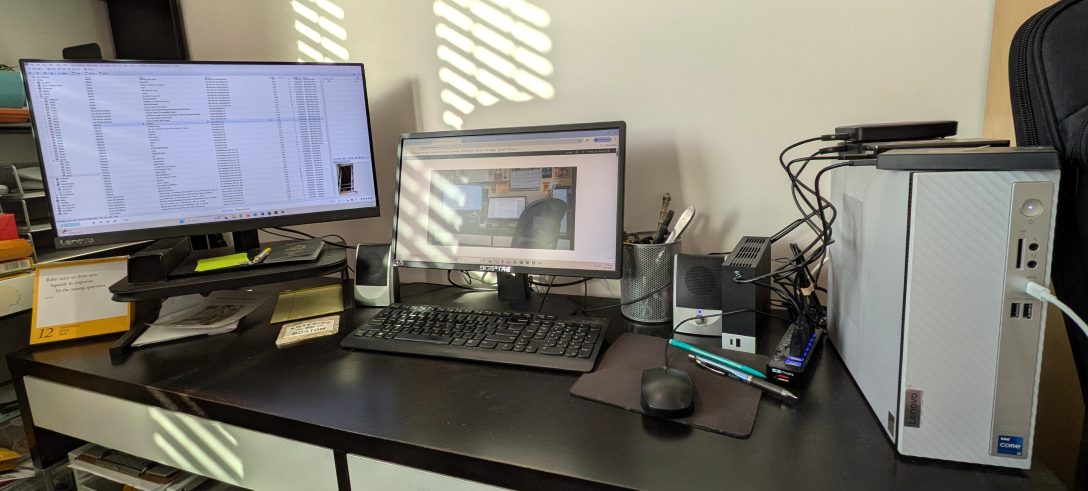
Spare Oom, 25 September 2016 — still writing, still listening to tunage, still snacking, still distracted.
Twenty years later and that novel went through numerous revisions and morphed into a trilogy and an expanded universe. My music now comes to me from streaming radio stations, ripped cds and downloaded mp3s, and is all stored on two tiny external hard drives each about the size of an index card. I work from home and my commute is one room over. I’ve self-published two books of the trilogy, with the third on the way.
I still think about that store from time to time. I still consider it one of my favorite jobs ever, even if it was retail. Even near the end, when my manager and I weren’t getting along. Being surrounded by music all day kept me happy and entertained.
And most importantly, the job helped me create a solid and dependable writing schedule, and it helped me prove to myself that I could balance a Day Job and the Writing Career at the same time with minimal issue.
Without that, I’m not entirely sure where I’d be in my writing career today.








 Welcome to Bridgetown