Computer Blue

bluescreen

I really dislike the fact that my computers never last more than about three years.  I really wish they would last a lot longer.  I don’t mind a bit of a slowdown as it gets older, and I’m okay with what software I have…it’s okay if it’s not up to date, as long as it works correctly.

It’s been just about three years to the week since I bought this PC.  My previous one (another Gateway), which I probably had since…(checks LJ entries)…January of 2010.  Which means I bought that one not long after we moved to our present apartment.  And I know the one before that (a Gateway, natch) was bought sometime late 2006 or so, and that one replaced the Dell I’d bought in 2003 back in the old Belfry days.  [I don’t count the various Hewlett-Packards I had before that, because they were all hand-me-downs and lasted a few years at most.]

So yeah, that averages to about three years.

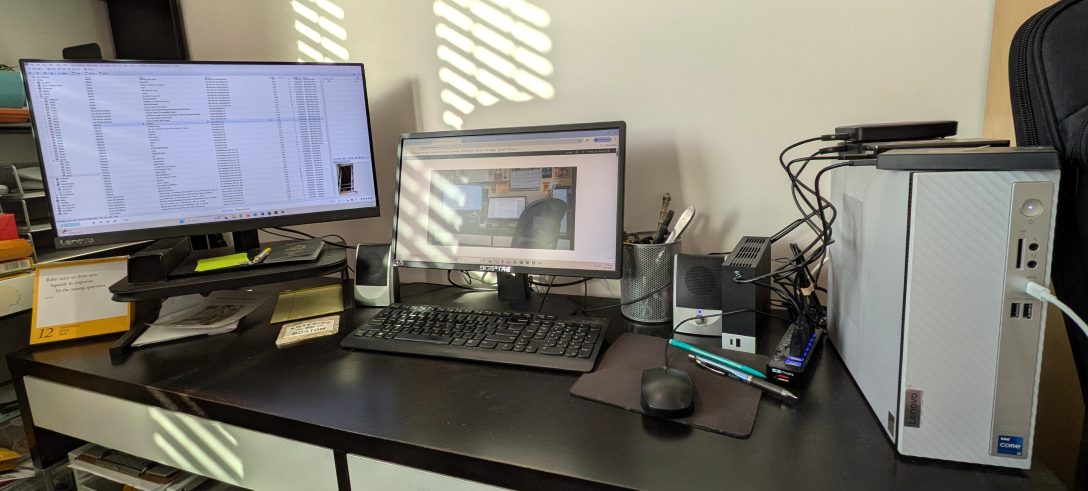
I say this, as it’s May 2016, and this current PC has started acting funky as well.  It hasn’t crashed and burned, at least not like the previous one, but it’s bluescreened at least five or six times over the past two months due to bad overwriting errors.  There’s also been an uptick of sluggishness, especially when I’m multitasking.  It’s also had a few startup issues lately, which is why I’ve been powering down via Hibernate rather than Shut Down.  I’ve already made it a habit of saving everything important on my external drives, and having my documents on Dropbox.

So as you may well imagine, I am grudgingly going computer shopping soon.  Here is my wishlist in terms of what I want it to have or be able to do:

  • High processing speed.  I’m not a gamer or a high-level programmer that needs a crapton of processing power, but I’d like something that will let me have multiple things going without slowdown.  Something that can handle MS Word, Photoshop, Media Monkey, and various art and audio software, sometimes all at the same time.
  • Lots of disk space.  I like having a buffer where I can save things straight to the PC and have the externals as backup.
  • USB slots.  Lots and lots of USB slots.  I don’t mind if they’re USBs, USB2s or USB3s, as long as I got ’em.  I gotta plug my externals and other toys in somewhere!
  • A CD/DVD RW drive.  Yes, even in this day and age, I still want/need this drive, mainly so I can rip new cds, as well as watch DVDs if I so choose.  [Hell, if it has BluRay capability I’m all for that, but I’m okay if it doesn’t.]
  • Wireless keyboard and mouse.  It’s not essential, but it would help clear up clutter and the way I work/sit at my desk.  Quality speakers might be nice too, but those aren’t a necessity either.

I actually do not need a new monitor at this time — I’m actually still using the widescreen monitor from the previous Gateway.  The power button might be a bit wonky and loose, but it works just fine and hasn’t given me any trouble at all.

So I’m thinking, in the next couple of weeks or so, I may be taking a trip to Best Buy on Geary, or Fry’s down in Palo Alto, just to see what’s available.  I’m willing to put some money into this, considering it’s a unit I’ll be using on a daily basis, sometimes for hours at a time.

And if it lasts more than three years before I run it into the ground, all the better!


[Noted: For those of you who give thanks to the iGods, I have no issues with iThingies in general.  I just never got around to getting on board with them, and see no reason to do so now when PCs work just fine for what I want/need them to do.]

On Writing: Who Am I Writing For?

gromit

I’ll admit, that’s not a question I often thought about when I first started writing, because the answer was most likely going to be: well, ME, of course.  What a silly question!

I’ve tried in the past to write for a specific audience, and it never quite panned out the way I wanted it to.  Love Like Blood was me trying to write to the urban fantasy crowd.  Two Thousand was me trying to write for the litfic crowd.  True Faith was me trying to write for the sf/virtual reality crowd of the mid 90s.  All three projects have since been trunked, as I found them to be some of my worst work.  Paved with good intentions, but let’s face it: I was pandering.  I was trying to write for an easy buck.

Recently I’ve been thinking about who I’m writing for, and each time, I’ve come to the conclusion that I’m still writing for who I want to write for:  just your regular blue-collar joe who likes to read.  Yes, I’m still writing for me, but I’ve noticed the biggest response I get from readers is not always the avid science fiction/fantasy reader, but those I know who like to read a little (or a lot) of everything.  Someone who might read the latest George RR Martin but follow it up with, say, a history of 60s counterculture.  Or maybe not even that: someone who just likes reading what they like reading, and don’t necessarily fit into the definition of ‘avid fan’.

That’s not to say I find avid genre fans beneath my stature, far from it.  I just know that I’m not a hard sf writer or a military sf writer or even a high fantasy writer.  I just write what comes to mind, and I try to fill my created worlds with people and ideas that my readers will connect with.

The Mendaihu Universe might be chock full of spirituality, but I try not to write religious/spiritual fiction, which is its own genre.  The characters in this universe of mine have the same issues as readers: frustration, fear, indecision, confusion, irritation.  I put the characters into an everyday situation that just happens to have a supernatual/spiritual setting.  And for the most part, I think I pull it off, because nearly all my readers so far have commented on that as a definite plus to the worldbuilding.

I’ve been thinking about this in part because I’ve been trying to figure out how to sell my trilogy now that two-thirds of it is already out there.  It’s one thing to self-publish and release it, but it’s quite another to get it out there and advertise it.  As much as I dislike sales, I do need to think about who my target audience would be.  I know, I should probably think of this WHILE I’m writing the stories, but that can’t always happen.  Again: if I write to order, I write horribly.   I can only write what I know I can write.

But what about my other projects?  The non-MU stories?  Who am I writing for then?  I probably won’t know until the project starts.  I have some non-genre stories in mind that could easily be quirky litfic.  I have some genre stories that would fit nicely in the urban fantasy mold.

For me, I guess the only way I’ll know is when I start writing the damned things!

Ouch!

Your personal reminder, from one writer to another:

  1. Don’t forget to get up from your chair every now and again to stretch.  Your lower half will thank you.
  2. Try not to slouch in your chair.  Straighten that back as soon as you suddenly find yourself hunkered over like Quasimodo over the keyboard!  Your back will thank you.  And it will surely let you know (as mine did today) if you don’t follow up.
  3. For the love of pie, turn the chair!  Don’t swivel at your waist like that, because your sciatic nerve is going to make some noise soon enough if you keep that up.  Face your whole body in the direction you’re looking in.
  4. Walking is always a good thing.  Even if it’s across the house to check up on your kids/cat/significant other and let them know you’re still one of the living.
  5. And yes, I know it’s tempting to spend all your waking hours writing everything you love to write.  But it’s not that healthy to be sedentary for so long.  Change it up every now and again.  It’s healthy!
  6. And this is mostly for myself: drink a lot of fluids. And by fluids, I mean water, tea, and other healthy things.  A sufficiently hydrated writer is a happy, healthy writer!

This is brought to you by Jonc’s Sciatic Nerve and Its Attending Back Pains.

Thank you and (ouch) good night.

On Editing: When to Murder Your Darlings

Last night, for the first time, I deleted a complete chapter from a manuscript.  Sure, I’ve deleted or cropped whole scenes before, or shuffled them around to different sections of the novel, but never have I just said to hell with it, highlighted the entire chapter and cut the entire thing.  And just to drive the point home, I went through the rest of the manuscript and adjusted the chapter numbers.

I’d always had issues with the beginning of The Balance of Light, I’ll be honest.  There’s a lot of great stuff in Book 3, but it gave me a hell of a lot of trouble.  I think it was partly due to not giving myself a break.  Back in late 2003, I’d gone straight from finishing The Persistence of Memories to starting TBoL without downtime in between.  I was on a roll and didn’t want to stop just yet, and that didn’t give me enough time to fully plan out the book’s main plot.

Chapter One, in retrospect, felt a lot more like an unneeded prologue or pre-credits opening scene than a good novel opening.  It had a few interesting ideas, but not enough for it to hold the reader’s interest. It served very little purpose other than to set a mood, and while that might work with some novels, it certainly did not work here.  The action actually starts in the next chapter — in fact, Chapter Two (now the current Chapter One) starts in medias res.  This works a hell of a lot better for the novel as a whole, because TBoL is all about the tension.

How did it feel to delete an entire ten pages’ worth of work?  Well, me being the writer packrat that I am, I didn’t delete it outright; I cut it from the working file and saved it to a ‘deleted scenes’ document.  I’ve done that numerous times for my various writing projects, for a few reasons: one, because I usually don’t like to completely destroy my work, and two, I never know if I might want to use it in a different context elsewhere.

But it was a move I didn’t take lightly.  In fact, it took me a few days to finally make the final decision.  I wasn’t happy with the prose, either…it’s painfully obvious that I was trying way too damn hard.

There’s two things to question with this kind of decision:

  1. Is it worth keeping?  This is the obvious question, the one everyone arrives at first.  Is there a point to it remaining in the book, or is it just filler?  Even if it’s one of your favorite passages, does it help drive the plot in some way?
  2. Will it affect the rest of the plot if I take it out?  This is the less obvious question, one that isn’t always hit upon, but in a way it’s the more important of the two.  If I take out this scene, will it disrupt the evolution of any other scenes?  Is there pertinent information here that is integral to a scene much later on?

In the case of question 1, no.  Maybe a ‘shot’ or two, a short bit of character interaction that I works well, but it’s not important enough to keep it.  I can always insert those shots somewhere else and achieve the same response.

In the case of question 2, yes, but it’s easily fixable.  The chapter starts out with Denni sensing a recently awakened Mendaihu from across the city, before the action ‘pulls back’ (to continue the film references here) to the Warehouse.  This same Mendaihu shows up again about three-quarters of the way through the book* but their two minor scenes can easily be revised or rewritten.

Even more interesting is how this decision affects the mood of the book.  I knew deleting Chapter 1 was going to affect two future scenes, but I was also conscious of how starting with Chapter 2 would do the same.  Instead of starting on a quiet but tense moment, I’m starting with a punch to the head.  Which is good, because now it’s given me something to aim for in terms of dramatic arcs.

And that, my friends, is my One Weird Trick I use when editing: know your story.  And I mean that in the context of knowing it like you know your own life: inside and out, how everything interconnects, how each event affects other events.  This is precisely why I did about a year’s worth of rereading the three books: so I could know it intimately enough that, if I made a decision on one thing, I’d know how it would affect everything else.


*I will totally admit I was flailing at that point.  I was having some serious writers’ block and thought reintroducing an extremely minor character would shake things up.  I’d thought about having this character join Vigil at one point, but it never panned out.  The end result reads as one would expect: an obvious shoehorning of a character for no other reason than ‘oops, I forgot about them, better squeeze them in somewhere.’

Meme Extra: V is also for Vigil

If the Mendaihu Universe has an actual origin point, it’s Vigil, that jacker group of digital anarchists that form the unseen backbone of the Bridgetown Trilogy.  They’re the earliest characters I’d created, dating all the way back to the original story in 1993.

[Technically they go back further; their 1993 incarnation is a mashup of the original characters in my Infamous War Novel from 1984-86 and an unnamed cast of characters from a short dystopian story I started but never finished in 1988.]

Q: What is Vigil about, anyway?

A: The idea behind Vigil was to create a group of people whose raison d’etre was to influence the actions of others. I always saw them as deliberately removed from everyone else’s reality, by their own choice.  The original soldiers in the IWN were literally drafted into their situation and fell prey to their isolation.  The punkers in the unfinished story deliberately chose to distance themselves from the status quo (as all self-respecting punkers should).  The Vigil of 1993 were a bit of both: living within the construct of mainstream society, yet working outside of it on their own terms.  The Vigil of True Faith expanded on that. They resurfaced as behind-the-scenes characters in The Phoenix Effect and even more so in the trilogy.

Q: What is their origin within the MU?

A: I can’t say too much without giving it away, but let’s just say they’ve been around for quite some time.  This question is answered in The Balance of Light.  I can say that their reason for wanting to influence others is a just cause; they do in fact have a connection to the Mendaihu and Shenaihu, and their main concern is to assist the One of All Sacred — on a nonspiritual level — to ensure the two sects remain balanced.

Q: So, is that why we always see Matthew in a workstation cage, perpetually distracted by whatever’s scrolling by on his multiple screens?

A: Exactly.  He’s a datacruncher of the highest sort and is constantly watching what’s going on so Vigil can act (or react) accordingly.  He’s been doing that every single day for at least fifteen years so he’s got it down to a science.

Q: Who is in Vigil?

A: We meet its leader, Matthew Davison, early on in A Division of Souls.  We know he’s the only son of the former Provincial Senator Gregory Davison, who had been assassinated a decade previous.  Matthew chose not to follow in his father’s political footsteps, instead becoming a software engineer of some renown.  He did, however, follow his father’s wishes to continue his work with the Mendaihu and Shenaihu.

There are other members, who we meet in The Persistence of Memories; in particular is Jenn Underwood, a childhood friend of Matthew’s.  She holds a day job at the Data Research Library and has an amazing memory.   They are essentially the two co-leaders of the group.  Others will show up in Book 2 and 3.

Q: Anything else?

A: Matthew, at least in the trilogy iteration, was partly inspired by Corey Feldman, specifically in his role in the TV show The Crow: Stairway to Heaven; he has both his hoarse voice and his scruffiness.  [He’s the only Vigil member based on anyone in particular.]  Despite all of Vigil’s personal quirks and irritations, they’re quite a close-knit family and look out for each other.  Funding for all their electronic toys is mainly from two places: Matthew’s day job, as well as his inheritance from his father.  Their penchant for constant attention to small details, sometimes to the point of distraction, is partly from my own work ethic in both writing and my day job.  I’ve wanted to change Vigil’s name for years, as it sounds a bit plain and uninspiring, but I just couldn’t come up with anything else that fit them so perfectly!

Meme Extra: F is also for Dylan Farraway

In doing the A to Z Challenge last month, even though I couldn’t come up with anything for X, Y or Z, there were numerous characters and ideas that I didn’t hit, due to something already laying claim to that letter.  So without further ado, here are a few more entries that you may enjoy!

* * *

Dylan Farraway - Kevin Spacey

Q: What is Farraway’s origin?

A: Along with Alec and Caren, Dylan Farraway was one of the newer characters in the Phoenix Effect reboot.  I’d originally pictured him as a takeoff of Chief Aramaki in Ghost in the Shell: bald and kind of weird-looking, bound to blow up at his staff on a daily basis.  I soon backed away from that idea and recreated him as an even-tempered, highly intelligent but extremely overworked boss.

Q: How is he connected to the Mendaihu?

A: Well…it’s kind of complex.  But I can say that he’s quite efficient at obtaining and retaining his various contacts outside of the ARU, so he knows quite a few Mendaihu and Shenaihu.

Q: That’s Kevin Spacey in that picture.  Did you base Farraway on him?

A: Actually, no!  It wasn’t until maybe about a month ago that I realized he’d be good at playing Farraway.  Just like when I chose Kathleen Turner as Madeleine Jakes…I had a general idea of what they looked like and how they acted, but didn’t have anyone in mind until recently.

Q: He has quite a close relationship with Alec and Caren.  Is there a reason for that?

A: In general, yes.  Farraway knew Caren’s parents quite well, having come up through the ranks around the same time they were high-level agents themselves.  He was never their chief, but he would work alongside them on many cases, and got to know Caren personally in the process, while she was at the ARU academy.  He’d become Chief Inspector at the Branden Hill HQ around that time, and had personally put in a request to have her assigned to him when she graduated.  So in the process, whoever Caren has worked with, he has connected with.  He was also the one to decide that Caren and Sheila should remain close workwise, ensuring she remained as part of the Team Two setup.

Q: Anything else?

A: He lives not that far from the HQ, actually…he walks to work.  He has a wife, but she unfortunately never made it into any of the stories.  He’s quite aware of Alec’s connection to Vigil; in fact, he deliberately says nothing because he knows it’s a safe and very lucrative connection for them.  He always plays his cards close…even with his agents, he never reveals everything unless absolutely necessary.  He won’t even reveal who his own outside connections may be.  He does have some psionic strengths (he’s quite good at clairaudience and clairsentience), but refuses to use them as a crutch.  He speaks softly, but he can really raise his voice quite loud when need be.  He drinks way too much coffee.

#atozchallenge: XYZ is for…??

Okay, I admit I’m cheating here, but I actually have nothing to add here for the last three letters of the alphabet!  [Well, that, and I have a busy weekend ahead of me and may not have been able to get to the last two posts.]

So instead, I’ll hand it to you, dear readers:  what would you like to know about the Mendaihu Unvierse that I haven’t touched upon yet?  Any questions on what I have gone over?  Explanations, curiosities?  Anything?  Bueller?

Feel free to drop your comments and/or questions in the comments field below!  🙂

#atozchallenge: W is for Wilderlands

gatlinburg tn
Gatlinburg, TN – pic courtesy Business Insider

There’s a few passing references to the Wilderlands in the trilogy, though I don’t go into too much detail.  Sometimes Sheila will call Nick a Wilderlander…in other words, calling him a hick.  Other times someone will mention that their family used to go on vacations out that way.  But what is the Wilderlands?

When I was writing True Faith, I knew that this story would take place in a big sprawling city.  I briefly expanded on that in the worldbuilding phase, thinking of how the east coast of North America would have evolved over a good five or six hundred years.  In my world, many of the cities expanded, encompassing nearby communities or creating new ones to become megacity sprawls.  Sort of like Los Angeles or New York City and their surrounding boroughs.  This happens with smaller cities as well, including Boston, Phoenix, San Francisco, and so on; their surrounding cities and towns just became part of the bigger province.

Which left all the small towns in between.  I called these “outpost” towns, basically stopovers between the larger provinces.  Rural living never went away, it just became a little more compact.  Many of the supertiny villages are still out there, of course…they’re just part of the nearby outpost towns now.  In essence, not much has changed too much in terms of livability.  Some choose to live in the outpost towns, such as those doing agricultural work, or have specialized jobs that require a bit of distance from civilization for safety’s sake.  And as mentioned above, most of these towns have a brisk tourism business as well.

Originally in TF, the Wilderlands were thought of as the back of the beyond that no one ever traveled to if they could help it; it was pretty much considered where the outcasts and the criminals hid out.  This changed during TPE, having decided to show it as Earth’s homage of sorts to the wilderness of Trisanda instead.  It’s been that way ever since.

There is of course a bit of New England tied to the idea as well.  Having lived in a small town in central Massachusetts for most of my life, I wanted to include a rural setting in this universe that honestly portrayed what small town life looked like.  It doesn’t show up in the Bridgetown Trilogy, but it will show up in future stories, including the new one I’m working on.

#atozchallenge: V is for Versions

You’ve heard me go on about the various versions of the Mendaihu Universe stories, and how long it’s been since I began it.  And since I have no characters or information that starts with V, I figure I’d post a bit of a timeline of writing the trilogy and its numerous versions, iterations and so on.  I know some of you have read this somewhere before (either my LJ or elsewhere), so I won’t go into too much detail!


1993, October: Doing laundry, reading Ray Bradbury’s Zen and the Art of Writing for inspiration, and trying to make sense of my stagnated writing career.  Contemplating writing/drawing a comic zine, writing a novel, or a screenplay.  The Infamous War Novel still burbling away in the back of my brain.  Having watched the first two Gall Force anime OVAs recently, I decide that maybe writing science fiction is the way to go.

1993, 26 November: Vigil is started.  My first attempt at writing SF is promising, and yet doesn’t get too far.  Possibly focusing too much on trying to maintain the mood and my prose is sadly nowhere near what’s unfolding in my head.  Spend a few months working more on the worldbuilding, timelines and possible plot ideas in between my Day Job (register jockey/shipping clerk for Harvard Coop, Longwood branch).  Also noodling around with a non-genre story, Two Thousand, which is my attempt at writing a coming-of-age novel.  Listening to a lot of music, barely getting by on meager paycheck.

1994, July: Still noodling around with various ideas.  Still juggling writing and Day Job (Brigham’s Ice Cream; I can still make you a killer milkshake frappe if you ask nicely).  Hanging out over at my girlfriend’s apartment on South Russell more than my own because it’s got AC and it’s across the street from my job.  She and I have been semi-seriously playing around with various ideas growing out of Vigil.  One hot and muggy evening I take an as-yet-unused idea of a character popping back in from an alternate reality and decide to use that as an opening.  This sparks more conversation about where the story should go, and True Faith is born.

1995, summer: Girlfriend is spending the season back at home with family.  I’m now living in an apartment out in Allston, still juggling my writing and my Day Job (various positions at a Sony Theater).  Start playing around with an extensive worldbuilding idea connected by multiple novels; the Eden Cycle is born.  Decide that during my copious free time and lack of funds I will use my gf’s computer (Windows 3.1!) and transcribe all my writing thus far, in addition to writing new words for TF.  Due to various unfortunate circumstances, I move back home with parents at the end of the summer.

1996, April: Somehow despite my sad state of finances, I manage to get a tax return.  I decide to spend it (and a few extra funds from family) to buy myself a used PC.  It runs on Windows 3.1 and has a monochrome CRT monitor, but that’s all I need.  I continue with the transcription project while juggling day job (local radio station!).  By the end of the summer I move the PC from my bedroom down to my parents’ basement, which becomes my writing nook for the next nine years.  Make various attempts at practice words at least a few times a week to get myself used to daily writing.

1997, 9 March:  No longer speaking to now-ex-gf, True Faith having stalled due to same (and having run out of decent plot ideas anyway), decide to start over from scratch.  Some elements of Vigil and True Faith — and very small dregs of the Infamous War Novel — are saved, reimagined and completely repurposed into a new story.  Make a decision to get to Day Job (HMV Records) an hour early to hang out in the mall food court to write longhand.  Writing finally turns into a daily habit that never goes away.  The Phoenix Effect is born, with nearly all new characters, the Vigil team now hiding in the periphery.

1998, August: Now writing during the daytime and transcribing the new words at night when I get home.  TPE is finished by month end.  Begin my first attempts at submitting to various publishing houses, with no luck whatsoever.  That doesn’t bring me down, though…I decide the best thing to do is to keep writing.  Numerous false starts on a sequel longhand while working on more TPE revision.  New novel beginnings, major worldbuilding changes.

2000, summer: So much revision, so little to show for it.  Feeling frustrated, I decide that a major rewrite of TPE is in order.  I’ve come to the conclusion that the prose is extremely weak and thin, that I hadn’t expanded that much from the longhand original.  Instead I decide to completely rewrite the story, expanding on every single scene and discarding a hell of a lot of chaff.  A Division of Souls begins.

2001, April: A switch in shift at Day Job (Yankee Candle) now gives me a truckload of time to work on writing.  Now dedicating two solid hours to new words on a daily basis.  Major expansion on worldbuilding, new characters, and planning out second and third book in trilogy.  My Day Job has a bit of slow time here and there, enough for me to brainstorm a few scenes or chapters ahead on scrap paper so I’m well prepared by the time I head home to write it.

2002, Summer: Finishing up ADoS first draft and starting on a bit of revision to include a recently created conlang for the universe, Anjshé.

2002, November 11: Begin sequel, The Persistence of Memories, and finish the first draft exactly one year later.  The Balance of Light started a day or so later with its original name, The Process of Belief.  It starts off well…

2003, summer: Worried…TBoL has stalled and I’m starting to lose track of where I want to go with it.  Day Job (still YC) starting to lose its luster due to management and work shakeups.  Still, I soldier on.  Start in on Love Like Blood just to keep myself busy.  Work on TBoL is in fits and starts at this point.

2005, March: Move down to New Jersey, and my writing habits start wavering due to a lot of (quite positive!) personal events.  Day Jobs include office temp work, a significant change from years of physical work.  At this point I think I may have lost the plot, literally.  Can’t quite figure out how to finish up the story.

2005, December: Another big move, this time out to San Francisco!  First apartment on Stockton Street, with my desk facing one of the bay windows.  A few years of dithering between projects like LLB and other ideas, while keeping the trilogy in the back of my mind.

2008 into 2009: I decide to share what I have of the trilogy on a friends-locked blog, partly to share it with a few beta readers and also to give it another serious read-through after far too long. By the time I finish the posts in late 2009, we move to our current place and I know exactly how to finish it.  I return to my old YC habit of plotting out a few chapters/scenes ahead of time and working on them.  At this point it feels like forever since I’ve written anything of import, so I’m quite excited!

2010, January 14: The Balance of Light and thus the trilogy is finally FINISHED!  Yay!

2010 – 2015:  A few years of other projects, but many, many months of reading, rereading rerereading, rererereading, etc, the entire trilogy, to become so familiar with the entire story again.  Much revision, rewriting, adding new scenes, getting rid of some old ones, editing, getting some beta reading commentary.  A hell of a lot of background work.  My writing style and quality finally seems to be going in the right direction again.

2015, summer:  Thinking it might be a good idea to self-publish the series.  I’d done a lot of research on it, weighed the pros and cons, and felt it would be the right step to take.  Immediately started an intensive revision/edit of ADoS with the aim of release on 3 September — the date the first scene of the book takes place.

2016, April 15:  The Persistence of Memories self-published!

2016, April 26: …I spend far too long typing this up for a silly but fun blog challenge, but prove to myself once again that it was so worth sticking with the project after all these years.  🙂
#atozchallenge: U is for Nehalé Usarai

Q: What is his origin?

A: Nehalé Usarai [neh-HAH-ley ooh-SAH-rye] one of the few non-Vigil characters that survived nearly every single iteration of these stories, all the way back to the late 1993 original.  His name and background evolved numerous times over the years, but his role in the entire story remained the same for the most part: a catalyst.  In Vigil he was to be a violent anarchist; in True Faith he was an Edward Snowden-esque whistleblower.  He was a not-so-violent anarchist in The Phoenix Effect.  And finally in the Bridgetown Trilogy, he became the spiritual leader we all know and love.

Q: How is he connected to the Mendaihu Universe?

A: Aside from the obvious connection in the very first chapter of A Division of Souls, he feels he has the role of Reluctant Shepherd.  He’s conflicted; on the one hand he fully believes it’s his responsibility to help usher the newly awakened Mendaihu and Shenaihu towards their own enlightenment…but on the other hand, he doesn’t want them to become blind, passive followers either.  Because of this, he likes to work behind the scenes.  He continues to be a catalyst in this respect, preferring to inspire and instigate changes instead of performing or enforcing them.

Q: He’s an exceptionally strong Mendaihu, given his actions.  What’s that background?

A: I go into it very briefly in ADoS; in his youth he was chosen by Mendaihu Elders to have accelerated training, due to his naturally high spiritual strength.  For a time these Elders would bring the young initiates to a small outpost village west of Bridgetown, where they’d go through various exercises and projects to show how well they could utilize their abilities.  Nehalé not only showed promise, he surpassed all expectations and became one of the youngest awakened Mendaihu of his time.  He chose not to be an Elder, however, instead being a mentor for others who are in the process of awakening.  This is how he met Anando Shalei, and why the two men remain close friends.

Q: Is he based on anyone in particular?

A: Not really, and I think he’d rather like it that way!  His early incarnations had him more talkative and abrasive; I think I may have seen him being played by Denis Leary, who was big box office at the time.  The TPE and Trilogy incarnations are more laid back, more pensive and reserved.  In fact, Nehalé is one of the few characters that I’ve never been able to completely visualize.  I’ve always seen him as a typically tall Meraladian, somewhat gawky; strong but definitely a beanpole sort of guy.  He’s not one to focus on his physical image all that much, so he’d be one of those guys you’d lose in the crowd.  The only reason he doesn’t is that so many others in Bridgetown know him by spirit signature.

Q: Anything else?

A: The ‘i’ at the end of his name denotes that he’s a distant cousin of the Usara clan.  Even the strongest Mendaihu have day jobs; Nehalé, up until the beginning of ADoS, worked for DuaLife as a Re-Gen (reconstructive genetics) Therapist.  He’s a philanthropist who likes to give to local shelters, churches and community centers.  He can be quite stubborn at times, often to his own detriment.  He’s performed quite a few awakening rituals before the one at the beginning of ADoS, but none as strong or as wide-ranging as that, and he’s not even sure if he has the ability to ever do it again…in fact, he feels he may have caused irreparable damage to his spiritual strength after pulling that off.