On Worldbuilding: Fluid History

John: “Hey there, Jeremy, what do you know about holes?”

Jeremy HIllary Boob, PhD: “There are simply no holes in my education.”

–Yellow Submarine

If you’ve ever watched any kind of documentary or series, there’s always some element of “we’re not entirely sure what happened at this point in time, but we can make an educated guess by looking at the following clues” or some such.  The further back we go in time, the harder it is to pinpoint the date of an event; eventually the most we can say is “sometime during the [x] Era.”   Those are extreme examples, though.  Sometimes our view of history changes within a few decades, when we look at the events of a specific time with the eyes of a different generation, maybe even a different culture.

I started thinking about this sometime ago when I started writing the new Mendaihu Universe story.  One of the subplots deals with the events that took place in the original Bridgetown Trilogy, though this new story takes place about seventy years later. Without going into too much detail, our histories of our heroes in that trilogy have become somewhat embellished, even after so short a time.  Denni Johnson, the teenager who had ascended as the earthbound deity the One of All Sacred, is now viewed as a saint, complete with a marble statue that thousands flock to and pray at.  Her sister Caren and Caren’s ARU partner Alec Poe, who never ascended as far as Denni did, are seen as more than human; Caren is believed to be an angelic protector, and Poe is seen as a Mighty Warrior.

And yet, all three were merely human.  Gifted with psionic abilities, just like anyone else in the Mendaihu Universe who have gone through an awakening ritual, but still — they were just as human as the rest of us.

Part of the focus on this new story is how certain people and events in history get changed over the years.  We may have documents, we may have databases and videos, but it still boils down to how the person or event is seen by the viewer.  We put amazing people on pedestals, even if their personalities were less than stellar, because regardless of their infallibility, they changed the world in some way.  The same could be said of horrible people as well; their vileness goes down in history as a grim reminder (even if, on a personal level, they weren’t one hundred percent vile).  We rarely look at these things objectively; we always have some emotional attachment to them, however big or small.

The evolution of historical accuracy fluctuates a lot more than we’d like it to, quite often because of this emotional attachment.  In this new story, the views of the new devout (those who follow the steps of the One of All Sacred — that is, Denni — and hope to find clarity in their lives) have become reasonably established.  However, schisms have already broken out; there are those who see Denni as a savior, and others who see her as an ascended but flawed human.  There are the Elders, the spiritual leaders who have been around for centuries, who are also splitting: those who have embraced the evolution of belief, and those who want to retain the status quo.

It’s a bit of a mess, but that’s the fascinating part of history as it happens.  No one really knows what the hell is going to happen next until it does.


New MU Story Update: Where I Am and Where I’m Going

It’s a silly milestone, but a milestone nonetheless:  I’ve been writing this new story in a wide-ruled three-subject spiral bound notebook, and a short time ago I just hit the first of two subject tabs, which means I’m a third of the way through the notebook already.  With 120 pages in the notebook, this means I’ve used 40 of them so far, which means I’ve written at least 80 pages.  Woo! Go me!

Still no title for it yet, either, which is totally not me.  Usually I give a new project a temporary title soon after starting it — either a borrowed song title or a boring phrase as a placeholder — but at this point it’s still known as “New MU Story.”  And you know what?  I’m okay with that.  It means I’m focusing on the right things.

At this time it’s still longhand as well…I haven’t started with the transcription to Word yet.  I suppose I’ll do that soon, when the time comes for me to expand the initial first draft.  From past experience, that usually ends up being somewhere around halfway through Act II, when things start to get complicated plot-wise.  I do that for two reasons:  one, by that time I have a firmer grasp of the story as a whole and what may need adjustment; and two, the revisiting of the Story So Far gives me a good idea of where I need to go from there.  At this time I’m going to assume that I’ll start on the transcription sometime next month.

Is this going to be a single book, or will it be another trilogy?  That’s a good question, and one I’m not going to answer right away, not even to myself.  It’s definitely one of many in this universe, that’s for sure.  I’m not even sure when I’ll be finished. I’m just happy that it’s still going strong, and that’s good enough for me right now.

On Writing: Point of Viewpoint, Or Different Mindsets for Different Styles

You’ve heard me (and other writers) talk about being ‘in the mood’ or ‘in the right mindset’ to write whatever projects they’re working on.  In the past it’s ended up being a crutch; I’d waste a good twenty minutes digging through my music collection trying to find the perfect album to listen to for a particular writing session.  I used to be really bad with that, but I’ve gotten better.  Most of the time now I listen to whatever newer release I happen to have close at hand, or if a specific album if I want to give that one another listen.

Actually, this post isn’t about that.  It’s about something I was subconsciously aware of for years, but just recently started monitoring, and it’s kind of interesting.  At least to me, anyway.

This one’s about where my mind is while working on whatever project I have in front of me.  At present I’m letting my imagination run rampant within the confines of my created world for the new Mendaihu Universe story…I picture novels as one long story of character evolution, where the the only rules are that nothing remains static and that consequences just as important as the actions.  I tend to let myself get well and truly lost in my created world; that is, ‘lost’ in the sense that if my brain suddenly and unexpectedly comes up with a doozy of a plot twist and I know it’ll work as part of the whole, I’ll let it take center stage and not hold back.  I think of it as writing for an audience of myself, though with full expectation that others will want to read and understand it as well.

Writing nonfiction is somewhat similar, only the boundaries are much tighter…at least that’s been my experience with Walk in Silence.  The focus is on the subject matter’s evolution within the confines of reality…thus imagination is reined in considerably, only given to the prose itself.  This is also true with my blog posts.  Not counting the more personal entries over at my LJ where my writing is more freestyle, I try to give my writing at least a little bit of professionalism.  When I’m writing nonfiction, I’m writing for an audience other than myself.

Poetry and song lyrics are a different beast, where I tend to be more emotional with my style.  I started writing poetry and songs back in my late teens as a release, but also as a playground for words, where I’d let myself come up with odd metaphors and weird imagery.  There’s really no rules here…I just riff it from start to finish.  This stuff is totally a personal indulgence, though I’ve been told by listeners that my Flying Bohemians and jeb! lyrics were pretty cool, so I’m fine with that.

The fascinating thing is that, now that I’m working on the new MU story, writing blog entries and (soon) working on Walk in Silence again, I find myself conscious of how my mind will shift from one style to another.  It can be tricky, especially if you have a lot of disparate writing ideas milling about in your head, but after all these years I’ve managed to make it work.  I think part of it is what I call the ‘going in’ phase of the session.  For instance, if I’m about to write the MU story, even before I put pen to paper I’ll start thinking about the characters, get in their heads and emotions for a few minutes to remember where I was.

[Noted, this is where the writing session soundtrack often comes in, and why I’m often a sucker for a certain mood in the songs.  The music helps me set the tone of the section I’m writing.  This is also true for nonfiction, or at least with Walk in Silence; for that I’m actually listening to the music I’m writing about so I can connect with the subject more clearly and emotionally.]

I think now that I’ve made sense of how my creative mind shifts from project to project, I’ve become better at giving each project a tighter focus.  I know how I’m doing it, so I’m less worried about whether or not I’m doing it right…as long as I’m doing it my own logical way, then that’s all that matters.

On Extremes and Evolution

I’ll note this now: this is not necessarily a post on violent extremism, like the kind we often see in today’s news, but about how far a character will go to hold onto their beliefs, and why.

One of the themes that I’ve been thinking about for this new Mendaihu Universe is extremes.  I used it to some degree in the Bridgetown Trilogy, wherein many characters have their beliefs and emotions tested.  Is what they’ve always felt really the truth?  Is the kind of peace they’re fighting for really what is needed?  And what if what you perceive to be the truth actually is the truth, at least in your own reality?  How far would you go to fight for what you believe to be the right thing to do for everyone?  These were the universal questions, set upon a group of people.  I wanted not only to show how they progressed as their own person, but also as a collective.  Actions do affect everyone involved in one way or another.  It’s not just about the action itself, however…it’s about the consequences.

For the new Mendaihu Universe book, I’m looking at the same themes again, but this time on a personal level.  After the spiritual revolution that took place in the Bridgetown Trilogy, we now see its outcome, some generations down the line.  Without going into too much detail (partly because I’m still pretty much at the beginning of the story anyway), I want to examine how the actions of the past affect the beliefs of the future.  I want to see how these beliefs and rituals have changed, now that they’ve been commonplace for a significant amount of time.

The idea of extremes for this new project came to mind after watching a large number of historical documentaries about Britain, and a lot of Time Team episodes with my wife over the last few months.  Specifically:  today we have believers of various faiths, many of them reinterpretations or reimaginings or revolutionary versions of older ones.  Some faiths raise imagery, idolatry and destination to holy statuses, for instance.  I started pondering about something I’d thought of much earlier in my life, back when I was taking catechism classes.  I started thinking about what life was like when these Biblical stories took place; not just what the stories tell us in description or what’s given to us over the years with tapestries and paintings and whatnot.  This is where the Time Team episodes were coming in:  while watching Phil and Mick and Raksha and all the other Time Teamers troweled their way into the past and tried to reconstruct what ancient buildings may have looked like, I started thinking about the Bridgetown Trilogy from the same point of view.  What we see now, as we’re excavating the past, may be something completely alien from the original idea, changed and mutated by time and evolution.  It’s only when we take the time to not just look but understand what that past moment was about, do we get closer to the truth of that point in history.

First thought of course being: how would Denni Johnson, awakened as the the deity, the One of All Sacred in its last iteration, be viewed by those who follow the One some fifty to a hundred years later?  One of the first mentions of Denni in this new book is when a character sees an eight foot statue of her, complete with angelic wings, hands reaching down to all those who look up at it, near the same corner of the warehouse where she’d ascended to deity status in the first place.  I followed up with a few other ideas: new characters taking the names of those in the trilogy, following in the footsteps of their ancestors.  The human-alien relationship on Earth becoming closer in some respects and more tenuous in others.  And so on.

This is what I think about now when I’m watching a documentary or reading a book about something historic.  I’m not just being told a story about something that happened in the past; I’m also being given an idea of what thoughts, ideas and emotions may have been like as well.  I’m being given context to go with the story.  And this is what’s been going on with this new Mendaihu Universe story; I’m writing about a far future that’s trying to remember what the past was like, in order to learn from it and move forward in the right direction.

Changes in Writing Habit

My writing habits seem to change about every two years.  I’ll find something that fits with what I’m working on perfectly, and I’ll stick with it until it doesn’t work anymore.  Sometimes I’ll retain it for far much longer than I probably should, but I’ll eventually change it up.

I came to the conclusion a few weeks ago that this new change is going to be rather significant.  The whiteboard that I’ve been using for the last few years has suddenly been cleared off, with only the blog post schedules showing.  I’m even putting off continuing the daily 750 Words for the time being (though I may be continuing the ‘secret project’ I’ve been using those words for, using a different format).  In fact, I’m pretty much backing away from the internet for a while, because it’s been a distraction.

It came to me when I first started writing the new Mendaihu Universe project longhand.  I’ve mentioned this over at my LiveJournal, but I’ll mention it here: I felt a need to return to my old writing habits.  And more importantly, I felt a very strong need to back away from the internet, maybe even backing away from writing directly to PC for a while.  I’ll keep the computer on by having some music playing in the background, and I’ll keep it handy for when I need it for research or to check on an older manuscript or something…but I felt the need to create more organically.

I came to this conclusion via many different ways, really.  I think part of it came to me last year when I started writing a personal journal entry almost every day, It also surfaced in October when I’d bought art pens and took part in the Inktober meme.  Interestingly, my ‘secret project’ also had a hand in it, even though I was typing it as part of my daily 750 Words.  The point being:  I was writing swiftly and fluidly, forcing myself not to self-edit, and this included the personal journal.  There’s a few entries here and there in that moleskine where I’ll stop midsentence and write “No, let me reiterate that” instead of crossing it out.

And that’s the key.  In the years working on the Bridgetown Trilogy rewrite/revision, the Walk in Silence project and the aborted Two Thousand, I realized that I’d been stuck in the mode of internal revision as I was writing, and working solely on PC has that effect on me.  That is because it’s always been like that.  I wrote about ninety percent of The Phoenix Effect longhand in two spiral notebooks — no revision, just pantsing it as I go — and transcribing and revising it on the PC in the Belfry in the evenings.  I consider the Bridgetown Trilogy a major revision/rewrite of that same book, even though it contains mostly new passages that were never in TPE.  Pretty much every other project I’ve worked on since then was straight to Word.

I wanted to change that with this new MU story.  I realized that most of those post-trilogy projects were tough slogs because I’d never turned my Internal Editor off.  Plus, now that we’re in the Space Age and can jump online any second of the day if we so choose, that gave me all the reasons to procrastinate.  At first I thought a strict whiteboard schedule would help…and indeed, it has, to some extent.  Because of that schedule I got rid of the ‘out of sight, out of mind’ mentality.  I’m back to the point where I want and need to write something every day, even weekends.  But I felt it wasn’t enough.

That’s why I chose to start this new project completely offline, like I did with TPE.  I wanted to see if I could recapture my old writing habits, without all the distractions and the internal editing.  Just pick up the notebook and the pen and start writing.  No worries if I mess up or make a continuity error; this is not the place to fix it right now.  This is the time to write the story purely as it comes to me.  No focusing on word count or anything else…just let it ramble for however long it would take during that session.  I’ve even taken this “new” old habit to an extreme; instead of writing at my desk, I put some music on my PC and sit across the room on the love seat instead.  It’s a little better for my back (I think?), and I’m able to stretch out a little more.  I can also take it elsewhere: I can write in the living room while A watches a movie.  Or as I did last weekend, I can write at our hotel (both in bed and in one of the chairs) in the middle of New York City, as well as during the flights to and from said city.

Suffice it to say, I was pleasantly surprised when I noticed just how amazingly well this recaptured habit was working out for me over the course of a month.  The story is still evolving and I’m sure I’ll be completely rewriting the beginning at some point (as I always do), but it’s moving at just the speed I like for first drafts.  My average over the last few days has been about two pages in a half hour, which is about right; I used to hit five pages in the hour I used to spend writing TPE back in the late 90s.  Once I become more involved in this new MU story, I’m sure the time spent writing and the page count itself will extend itself.  I haven’t even planned on when I’ll start the transcription, and I’m choosing to leave that wide open.  I’ll start it when I feel I’m ready for it.

Is this for everyone?  Who knows?  Each writer has their own best habits and rituals.  It took me a while to realize it, but I seem to have rediscovered mine.


On Writing: Where Do I Begin?

Begin at the beginning.

Select an idea, any old idea, and riff on it.

Let the idea sit there and marinate for a while; let it solidify into something worth writing about.

Outline, outline, outline!

Let it bleed out of you; don’t stop to fix it, revise it later.

I’ve heard all kinds of suggestions on how and where to begin a new project, and in the back of my mind I’ve been thinking about how and where I’ll be starting up the next Mendaihu Universe story.  I’m still working Walk in Silence as my main project right now.  I’m also creating a story out of my daily words (currently called The Lidwells Story), so it’s not as if I’m hemming and hawing and not getting any work done.  The new MU story isn’t exactly top priority at the moment, but it’s in the back of my mind, poking me like a five year old every now and again, begging for a scrap of attention.

The trouble is that I’m really not sure where to start with it.  I have a few very vague ideas of characters and plot points, but nothing solid.  It’s not severe trouble, though…I have to remember that The Phoenix Effect started out almost completely from scratch as well, and I had maybe five or six scenes tops in my head.  I have to remember that I had two plans when I began it: 1) write a new novel, and 2) use the idea of human spirits coming from somewhere else.  That’s it.  Nearly all of the scenes, plots and subplots, and character evolution I wrote in that book I came up with while writing it.

So really–the trouble is not where to start the story, but where (and when) to begin writing it.  That is: prioritize projects. Don’t worry about the new MU story just yet–don’t worry about the plot or the characters, or even the theme at this point.  Finish WiS and the Blogging the Beatles projects, and continue submitting the Bridgetown trilogy.

It’ll come in time.  I’ll know when I’m ready for it.

An Introduction to the Bridgetown Trilogy

Hi there, and thanks for sticking around!  And hello if you’re a new visitor!  Welcome to Bridgetown!

So…what is The Bridgetown Trilogy, you say? Where is this mythical B-Town?  And why does the banner picture of the city look suspiciously like downtown Los Angeles as seen from the Getty Museum?  What is this trilogy all about anyway?

Well–it’s high time I give you the rundown.  The one-sentence pitch that I’d come up with, which I’m currently using:

Caren Johnson’s younger sister has been forcefully awakened as a powerful and supernatural deity, revered by multiple worlds…and a war has just been declared in her name.

Nice kicker, eh?  I’d like to think so.  [Mind you, that was probably the hardest damn thing to create.  I’m not one for brevity.]

So let me give you the situation:  Caren Johnson is an elite member of a special branch of the Bridgetown Metro Police called the Alien Relations Unit.  With the humanoid Meraladzha living among us, the ARU has been tasked with keeping the peace between aliens and humans.   She’s proud of her work; she’s followed the career paths of her parents, Aram and Celine, both highly revered and decorated ARU agents.  They were both killed in the line of duty five years before the events that take place in the trilogy.  She’s become the legal guardian of her younger sister Denni, a precocious and very intelligent fifteen year-old, and she loves her dearly.  Caren does her best to balance life and work, but because of her parents’ history, they sometimes blur…

Aram and Celine were also a part of an elite force called the Mendaihu–a collection of supernaturally strong and highly spiritual people whose primary goal is to protect the planet…not just the humans and the aliens, but their souls within as well.  The reasons for their deaths had never been officially released publicly, but Caren knows why; they were protecting their daughters from a potential evil that had come to kill them.

Caren fears she will become Mendaihu as well, for it’s in her soul and in her blood.  But what she fears most is when Denni ‘awakens’ to her own Mendaihu powers.   Her one wish is to let Denni live a normal life without such heavy responsibility.

Nehalé Usarai, a rebel Meraladian and an one of the strongest Mendaihu in the province, has other plans.  He knows Denni’s fate…but he also knows that she’s the current incarnation of the One of All Sacred, one of the highest revered deities in Meraladh history.  He performs a dangerous and potentially lethal Awakening ritual, and in the process not only awakens Denni, but a large swath of Bridgetown as well.  He knows this is dangerous, but he fully believes that she will bring peace and balance to the world.

The only thing that could stop her is an equally strong and formidable force called the Shenaihu; they are the yang to the Mendaihu yin, their spiritual opposite.  When one acts, the other must act in kind to retain the balance, or the both the physical and the spiritual world could spiral out of control.

Both sides have other plans, despite the balance.  It will be up to Denni, Caren, and a host of others, both awakened and not, to ensure that the balance returns.

The story takes place over three books:  A Division of Souls, The Persistence of Memories, and The Process of Belief.   It’s about many things: belief, patience, clarity, and love.  It’s about physical and spiritual evolution.  It’s about family.  If I had to whittle it down to a single sentence, I would say this: it’s about devotion to oneself despite outside influence.


*   *   *

At this time, the first book has been submitted to a potential publisher, and I’m currently awaiting a response.  I’m keeping my options open, but my aim is to have the trilogy published by a professional house.

Here’s to hoping!

20 years 5 months 18 days (give or take)

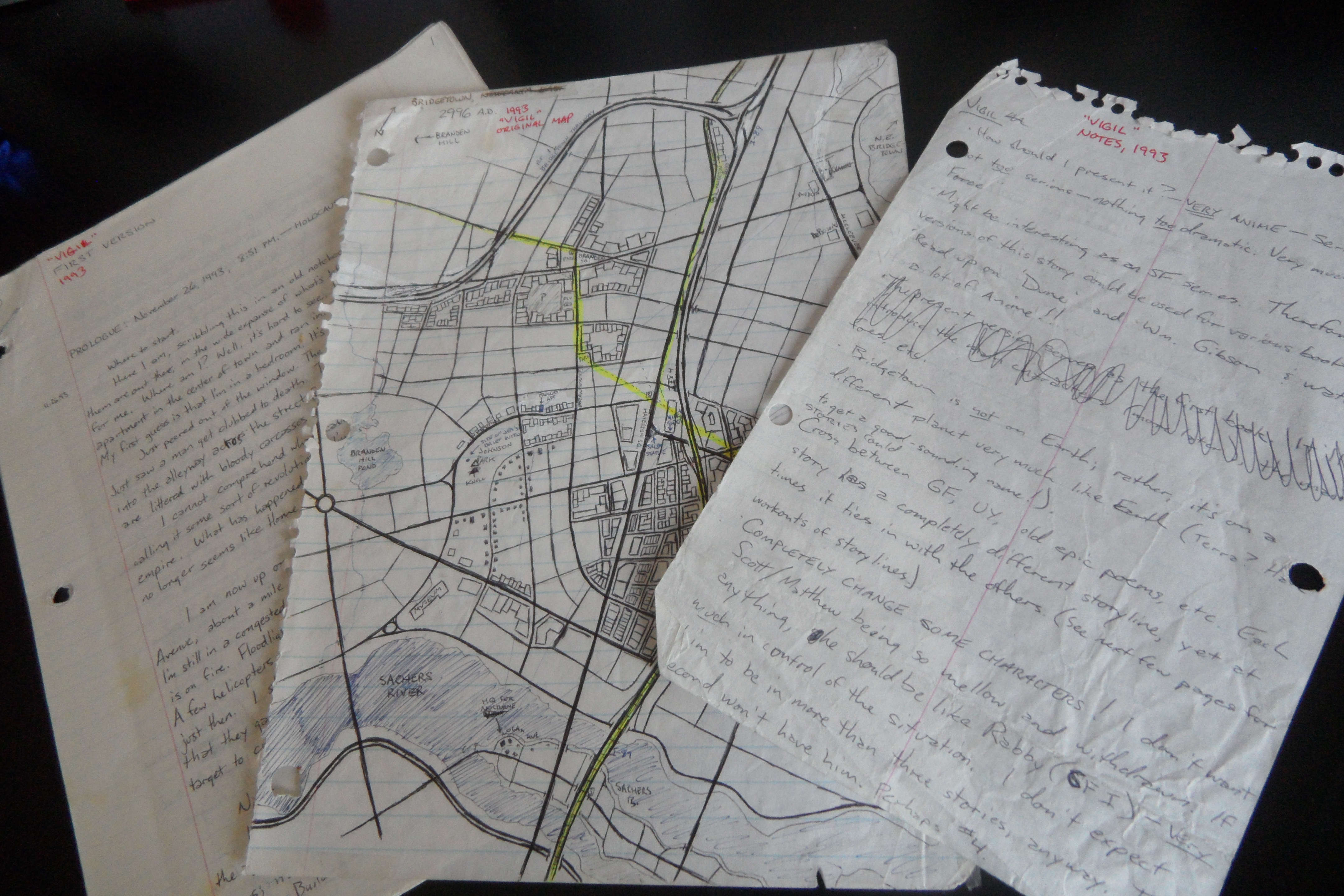
Some of the original notes from 1993.

That’s a hell of a long time to be working on a novel, don’t you think?

At 11:18pm PT last night, I completed what I call the Great Trilogy Revision Project, a major overhaul of all three novels in the Mendaihu Trilogy.  Entire scenes were rewritten, edited mercilessly, tightened up, names changed and characters strengthened.  It took the better part of fourteen months and I kicked my own ass numerous times to avoid laziness and weak prose; I read, reread, re-reread, and re-re-reread (sometimes while at the gym!) until I knew the story, its history and its cast inside and out.  And I read it again to make sure I knew where it worked and where it didn’t.

Today marks the first day in probably a decade or so where I have no plans to work on the existing novels or work on anything related.  [Mind you, I definitely have plans to work on future Mendaihu Universe stories, just not at the moment.]  In my mind, this epic project is DONE.

Notes made while doing laundry, October 1993.

In late 1993, I’d just watched the first two Gall Force animes (I’d find the third movie a short time later) and found inspiration to write what I often call my Infamous War Novel, or IWN–my first novel from my high school years–in a completely new style I hadn’t tried before: science fiction.  I wrote a few notes in a steno notebook while waiting for my clothes to dry at the Charles Street Laundry, and came up with a number of ideas that I could work with.  I’m amused by the first line saying “VERY ANIME”, as well as the consistent anime references on that one page.  As if I knew what the hell anime was at that point in time, other than my latest obsession!  All I wanted to do was write something that was totally unlike American SF at the time.

Did I know what the hell I was doing?  Probably not.  I was woefully ignorant of genre fiction other than through movies, comic books and Japanese animation.  But I was willing to learn along the way.  I understood right away that storytelling in Japan is significantly different than storytelling in America, and I wanted to try my hand at writing that way.

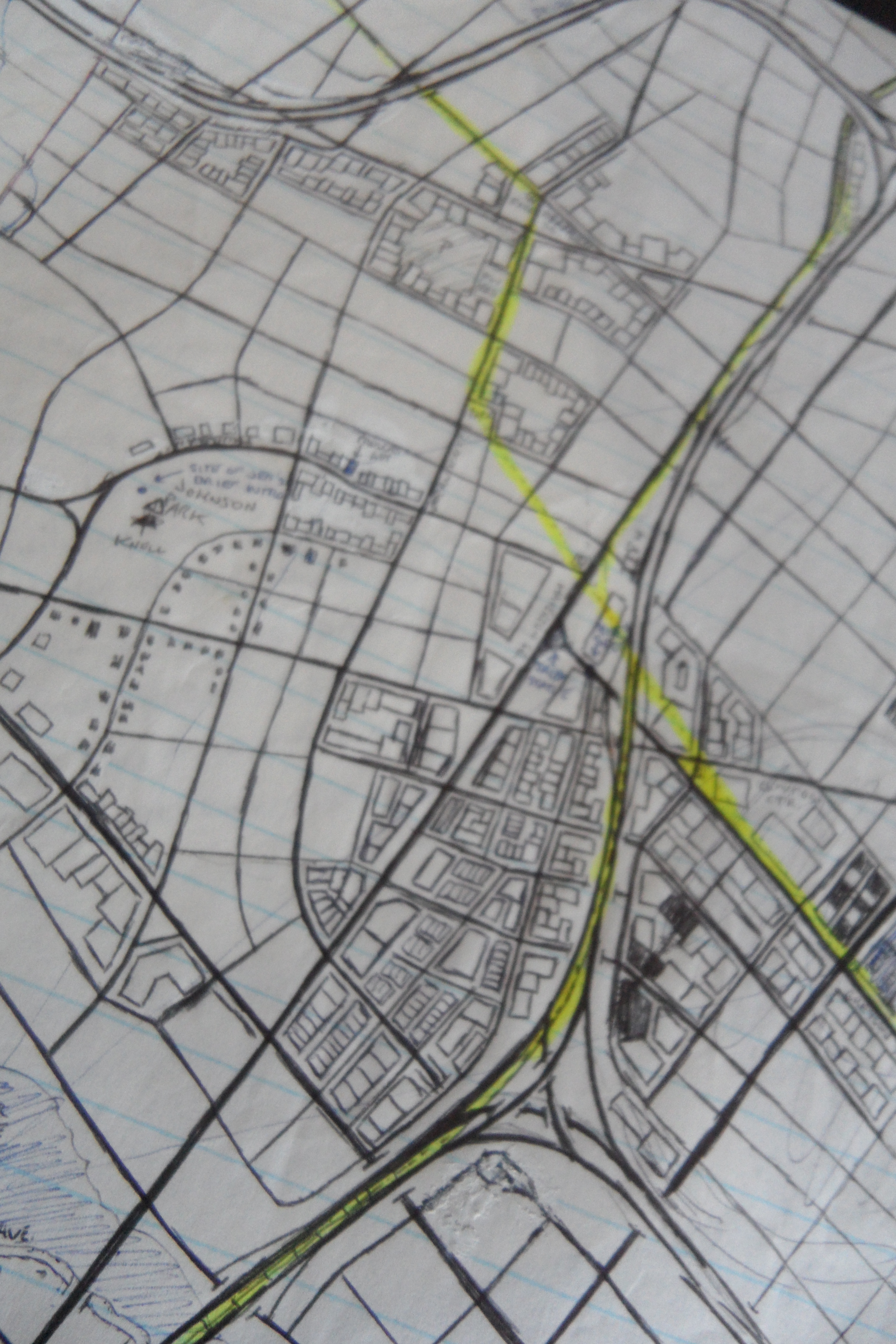
Soon after, I did what I normally do when I come up with story ideas: I draw maps.

The original Bridgetown Sprawl as of November 1993

I knew I wanted a few things: a sprawling metropolis, a giant tower (hints of the GENOM Tower from Bubblegum Crisis), and a megacity so packed with different places and cultures that I knew I’d be able to use the setting for multiple story arcs.  Bridgetown morphed and grew considerably and exponentially over the years, but there are points here that made it all the way to the finished product in one form or another.  Sachers Island, Branden Hill Park (named Johnson Park here, but pretty much in the same shape), the warehouse district,  and the dirty and dangerous strip of McCleever Street were there from the start.

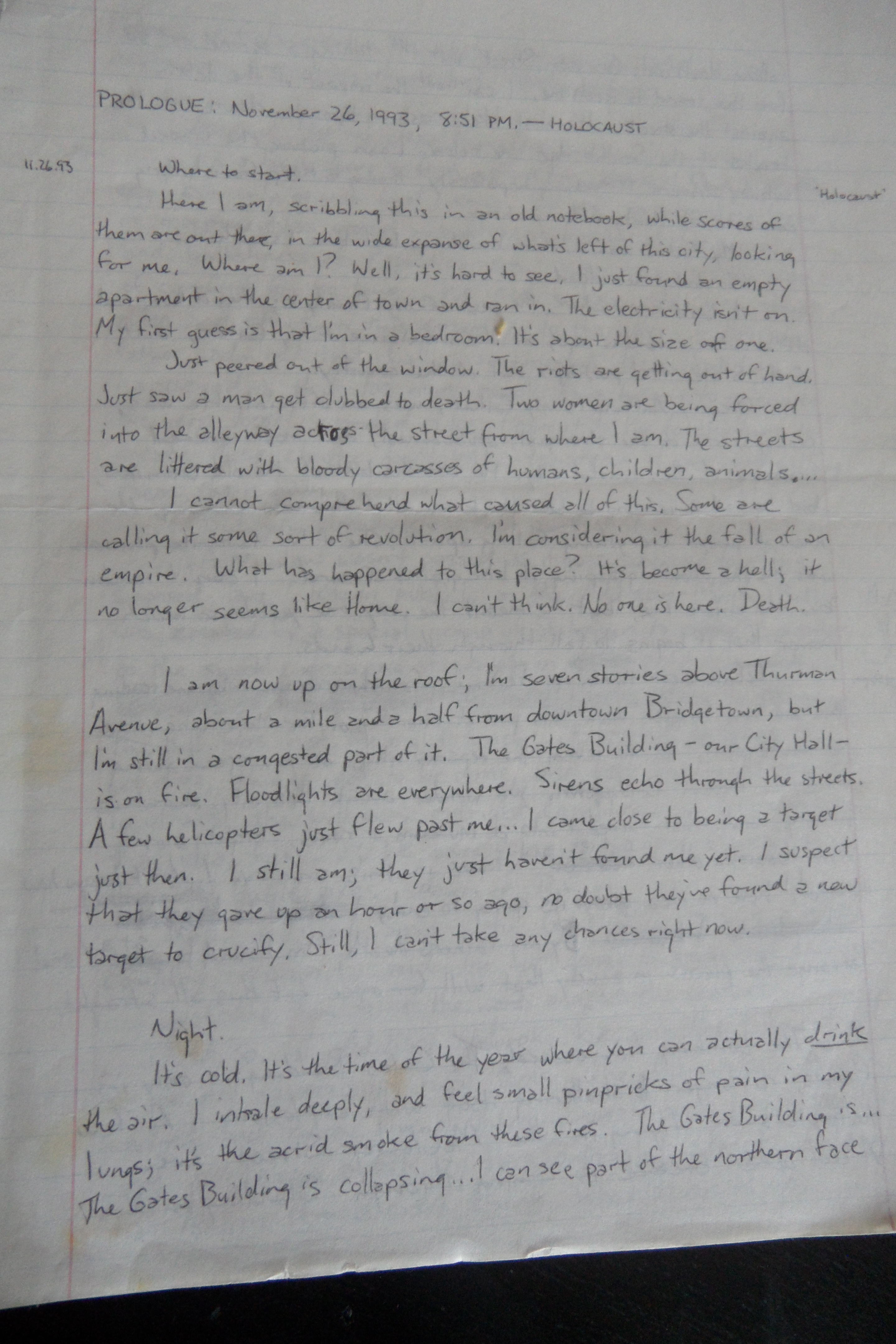
Vigil, Take One.  Started 26 November 1993, 8:51pm ET in my shoebox apartment.
Vigil, Take One. Started 26 November 1993, 8:51pm ET in my shoebox apartment.

Where to start, indeed.

My primary aim when I first started this novel was to write something totally unlike anything I’d written before.  I wanted everything about this project to be completely new for me–an untried style, a setting I’d never ventured through, a plot that challenged me to work it through to the best of my ability.

Granted, I was far from perfecting that, but I was going to try anyway.  Vigil–so named after this band of rebellious misfits bent on saving the world from corruption–was started on the Friday after Thanksgiving 1993, after getting off work.  I’d had a few ideas written out here and there, but this was where it all started.

True Faith–the aborted rewrite from summer 1994–would grow out of this, introducing the spiritual background.  The Phoenix Effect, the project from 1997-1998, grew out of TF and introduced the alien races. TPE in turn became the trilogy after a complete restart from scratch.

So for all intents and purposes, Vigil was the version that started it all.  And now it’s done.

Any author will tell you that they have a hard time letting go of their projects, even once they’re completely finished and on their way to publication, and I am no different.  I’m sure I’ll want to pick these three books up again and tinker with them some more.  I’ve already got Book 1 out to a publisher, and am ready to take the next steps to shop it around and even get an agent if need be.  I’ve also debated self-publication as an alternative.   It’s a wide world out there, and I’d like to introduce you all to the Mendaihu Universe someday.  On this evening, I’m finally that much closer to doing so.

But for now?  I think I’ll do what I haven’t done since I started writing the trilogy proper, way back in 2000:  I think I’ll let it sit awhile, and let it age gracefully.

Fly-By: Coming Soon

Hey there!  Sorry to keep you all waiting for new entries here at Welcome to Bridgetown…I’ve been busy with a number of things both personal and otherwise, so I haven’t had the time to sit down and do some serious writing about the Mendaihu Universe, or about writing in general.

That said, after the Easter holiday, I plan on getting back on the high horse and posting new entries here and at Walk in Silence as well.  Here’s a few offerings I have in store:

–On Spiritualism: the One of All Sacred and other deities in the Mendaihu Universe

–On Language in the Mendaihu Universe:  speaking and innerspeak

–On Faith in the Mendaihu Universe: the Personal and the Religious

–On Dialogue:  Realism versus conversation

–On Conlangs in Fiction: When should a writer use it?


Stay tuned! 🙂

On Writing: Letting Ideas Percolate

I’ll be truthful–the Mendaihu Universe has been percolating in my brain for at least twenty years this past winter.

Twenty years. Isn’t that a bit long for me to be sitting on these novels? Shouldn’t they have all been written, published and made into movies by now? Shouldn’t I already be working on the next trilogy in the universe? Well, in a perfect world–yes, of course! And with that, I’d have some nice cash in the bank as well. This, however, is not that perfect world. There are reasons it’s taken me so long to get those beginning scraps of ideas into the shape they’re in now. For one, back in winter 1993-94, I only had the gung-ho to write them but the barest of plots. For another, I had to do more homework in the genre, learn what makes a good SF/F novel that people would enjoy.

But a very large portion of it was the fact that I had to learn how to write in the first place.

I’d been toying with writing science fiction during most of fall 1993, just after I’d graduated college. There were a few pieces of inspiration: Akira, the Gall Force OVAs, other SF/F-themed anime, Orson Scott Card’s How to Write Science Fiction & Fantasy and Ray Bradbury’s Zen in the Art of Writing. And there was my music collection as well, to inspire me and keep me company.

The first few ideas popped up most likely that December–I’d finally given up on trying to resurrect one of my earlier novel ideas, and scrapped nearly everything except a single idea: an underground gang who broke the all the rules, but for the right reasons. From there I played around with a few tropes: a multi-planetary setting (created while doing laundry one afternoon on Charles Street), a giant sprawling city (part of my lifelong compulsive habit of map drawing), cyberterrorism (Hi, CompuServe and AOL! Glad to have you around!), politics (Clinton had just entered office) and so on. I hadn’t quite latched onto cyberpunk yet, though I had read a bit of Gibson by then, and within a few years we’d get a short but interesting wave of internet-themed movies (The Net, Hackers, Strange Days, and Johnny Mnemonic for example) that would add fuel to this idea. I was pretty much open to anything at that point.

A number of months later I was writing the first attempt, True Faith. [To spare you the story some of you already know, here’s the short version: TF was an extension of the “Vigil” underground gang idea with all the other inspirations I noted above, plus a twist: I added a bit of spiritual enlightenment, inspired by my then-recent foray into Wicca. It was co-written with my then-girlfriend Diana; it was mostly my idea and my writing, but she came up with a few of the character backgrounds, plot twists and wrote a few passages as well.] This version lasted from summer 1994 to probably late 1996 and was never completed, for various reasons. One of the most important being I just was not happy with the prose.

What was wrong with it, anyway? Well, for one, I think I was focused too much on inner dialogue.  The characters did a lot of thinking and contemplating and not much doing anything afterwards. For another, I’d written a lot of scenes starting something but never quite completing them. And worse, I had a habit of writing what I call “stage directions”: the character did this, he went over there, he got up and tapped a code, he did that, he went there. The end result was that I’d come up with a lot of interesting ideas and scenes, but the execution lacked any kind of oomph.

Come 1997, I chose to start again, almost completely from scratch. This was The Phoenix Effect; it retained the spiritual bent, the underground gang and the cyberpunk ideas, but the focus was now on two new characters, investigators hired to figure out why certain AI units were now becoming more human. That last idea was inspired by my 1996-8 foray into New Age spirituality, infusing the idea that the soul came from elsewhere other than Earth. This novel did get finished, and I even attempted to submit it to a few places, but I was still unhappy with it.

I toned down the stage directions, I followed through on the action, and I had the characters doing things instead of just thinking about them. What was wrong this time?

Two further problems: quantity and delivery. The description of scenes and characters was slim to nil, as I’d focused too much on getting the story out on paper. Who were these people in my novel, anyway? Why were they there? Where were they? In my head, to be honest. I had them up here in my cranium–I knew exactly what they looked like, where they were, what they sounded like…but I’d put none of that on paper. I realized part of this was due to having written this longhand–I was focusing on keeping the story moving that pausing for a few seconds to describe something felt like I’d tripped up. I’d expand on these things a little when I transferred it computer, but there was still a lot missing.

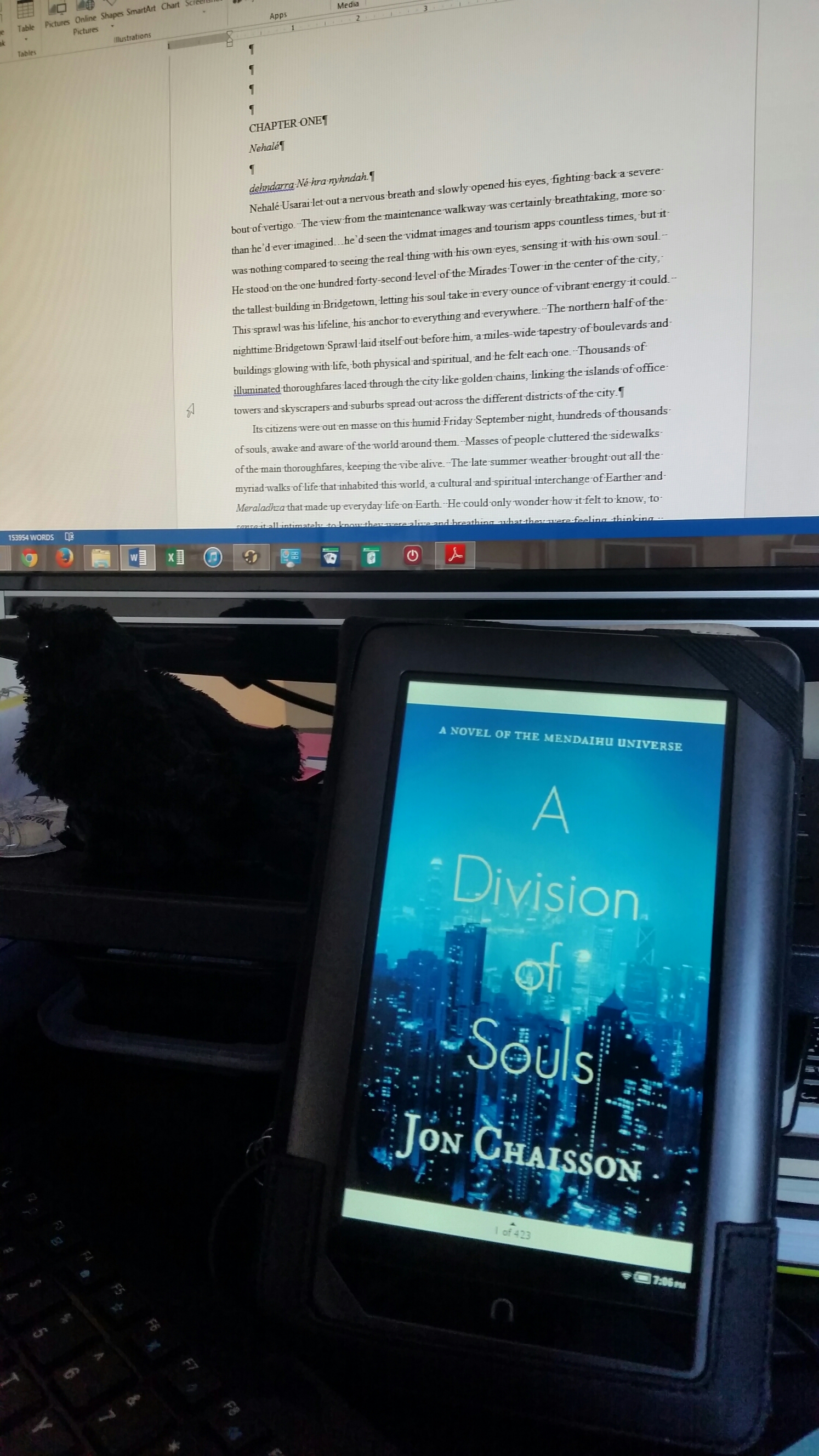
Cue the third attempt, right around 2000-1, with A Division of Souls. This would be the first novel I’d write completely on the PC. Fully-expanded, complete scenes? Check. Expanded description of characters and scenery? Check. Expansion of the characters’ backstories? BIG check. Expansion of plot? BIG check. Scenes and plot points were completely rewritten and others totally new. I even plotted ahead a few chapters before writing them, something I rarely did before then. The outcome worked so well that I ended up with not one but three novels, which I wrote well into 2004. I was quite proud of this trilogy. And yet…

What was the problem this time? Well, aside from burning out in late 2004 and never finishing Book 3, I still didn’t quite get what I was doing wrong. I had a great story idea, an extended universe to play in, well-crafted characters, and description galore. So why was I still not quite there yet?

Again: the writing. It took me a long time to figure this part out, and only recently, in the last year or so, did I finally get it. You could see the choppy edits, the “screw it, I’ll fix it later” passages, the subplots that went nowhere. In other words, I had an extremely rough draft, and I’d said “good enough”, and that was the killer. I had the finished product, but I just hadn’t bothered to polish it at all. You see, I wasn’t quite there yet. I still had that final hurdle.

This meant some major review and revision. And I mean major review. So how did I go about it this time? Well, this time out I took all three books (I’d finally finished Book 3 in January of 2010) and put them on my Nook, and proceeded to read them. And read them. And read them. AND READ THEM.

I immersed myself in these three books to the point that I had the entire trilogy arc in my head. Over the course of six months or so, I must have read all three books from start to finish through at least three or four cycles, and each time I made a mental note of what needed fixing, from big things like story arcs to miniscule things like dialogue tags. And starting in 2012, I started the biggest revision I’d ever gone through in my life. I painstakingly went through each chapter and worked the hell out of each one. Some chapters were relatively quick to work through, but those first six or seven chapters in Book 1 were almost completely rewritten from scratch–a lot of those passages hadn’t been properly revised since their 2001 inception.

As of today, I’m on Chapter 10 of Book 3. It’s been one hell of a long trip, but it’s been worth it. I learned a hell of a lot in these past few months, possibly more than I’ve ever done in the last ten years combined, about what makes a decent manuscript and what doesn’t. And most important, I finally learned how to write.

*

Now, should this have taken twenty years?  Who knows. I’ve got other interests aside from writing science fiction, and I’ve had day jobs that took precedence. I’ve had personal events intervene. And yes, just like any other writer, I get distracted easily. Am I fine that it’s taken two decades to get where I am, and I still haven’t gotten these things published? Yes, I am. I’d rather have a complete and professional product out there that I’m proud of, rather than release a half-assed, phoned-in book that I wouldn’t be able to resell, at least not to any publisher. I’ve learned other things on the way too, come up with new ideas for the Mendaihu Universe. I’m not about to write this world off just yet, not when I have more to say about it. As soon as I’m done with this major revision of the first trilogy, I’m going to start working on the next one.

So yes, sometimes it’s a good idea to let ideas percolate. Sometimes the end result is worth the wait.