New MU Story Update: Where I Am and Where I’m Going

It’s a silly milestone, but a milestone nonetheless:  I’ve been writing this new story in a wide-ruled three-subject spiral bound notebook, and a short time ago I just hit the first of two subject tabs, which means I’m a third of the way through the notebook already.  With 120 pages in the notebook, this means I’ve used 40 of them so far, which means I’ve written at least 80 pages.  Woo! Go me!

Still no title for it yet, either, which is totally not me.  Usually I give a new project a temporary title soon after starting it — either a borrowed song title or a boring phrase as a placeholder — but at this point it’s still known as “New MU Story.”  And you know what?  I’m okay with that.  It means I’m focusing on the right things.

At this time it’s still longhand as well…I haven’t started with the transcription to Word yet.  I suppose I’ll do that soon, when the time comes for me to expand the initial first draft.  From past experience, that usually ends up being somewhere around halfway through Act II, when things start to get complicated plot-wise.  I do that for two reasons:  one, by that time I have a firmer grasp of the story as a whole and what may need adjustment; and two, the revisiting of the Story So Far gives me a good idea of where I need to go from there.  At this time I’m going to assume that I’ll start on the transcription sometime next month.

Is this going to be a single book, or will it be another trilogy?  That’s a good question, and one I’m not going to answer right away, not even to myself.  It’s definitely one of many in this universe, that’s for sure.  I’m not even sure when I’ll be finished. I’m just happy that it’s still going strong, and that’s good enough for me right now.

On Writing: Point of Viewpoint, Or Different Mindsets for Different Styles

You’ve heard me (and other writers) talk about being ‘in the mood’ or ‘in the right mindset’ to write whatever projects they’re working on.  In the past it’s ended up being a crutch; I’d waste a good twenty minutes digging through my music collection trying to find the perfect album to listen to for a particular writing session.  I used to be really bad with that, but I’ve gotten better.  Most of the time now I listen to whatever newer release I happen to have close at hand, or if a specific album if I want to give that one another listen.

Actually, this post isn’t about that.  It’s about something I was subconsciously aware of for years, but just recently started monitoring, and it’s kind of interesting.  At least to me, anyway.

This one’s about where my mind is while working on whatever project I have in front of me.  At present I’m letting my imagination run rampant within the confines of my created world for the new Mendaihu Universe story…I picture novels as one long story of character evolution, where the the only rules are that nothing remains static and that consequences just as important as the actions.  I tend to let myself get well and truly lost in my created world; that is, ‘lost’ in the sense that if my brain suddenly and unexpectedly comes up with a doozy of a plot twist and I know it’ll work as part of the whole, I’ll let it take center stage and not hold back.  I think of it as writing for an audience of myself, though with full expectation that others will want to read and understand it as well.

Writing nonfiction is somewhat similar, only the boundaries are much tighter…at least that’s been my experience with Walk in Silence.  The focus is on the subject matter’s evolution within the confines of reality…thus imagination is reined in considerably, only given to the prose itself.  This is also true with my blog posts.  Not counting the more personal entries over at my LJ where my writing is more freestyle, I try to give my writing at least a little bit of professionalism.  When I’m writing nonfiction, I’m writing for an audience other than myself.

Poetry and song lyrics are a different beast, where I tend to be more emotional with my style.  I started writing poetry and songs back in my late teens as a release, but also as a playground for words, where I’d let myself come up with odd metaphors and weird imagery.  There’s really no rules here…I just riff it from start to finish.  This stuff is totally a personal indulgence, though I’ve been told by listeners that my Flying Bohemians and jeb! lyrics were pretty cool, so I’m fine with that.

The fascinating thing is that, now that I’m working on the new MU story, writing blog entries and (soon) working on Walk in Silence again, I find myself conscious of how my mind will shift from one style to another.  It can be tricky, especially if you have a lot of disparate writing ideas milling about in your head, but after all these years I’ve managed to make it work.  I think part of it is what I call the ‘going in’ phase of the session.  For instance, if I’m about to write the MU story, even before I put pen to paper I’ll start thinking about the characters, get in their heads and emotions for a few minutes to remember where I was.

[Noted, this is where the writing session soundtrack often comes in, and why I’m often a sucker for a certain mood in the songs.  The music helps me set the tone of the section I’m writing.  This is also true for nonfiction, or at least with Walk in Silence; for that I’m actually listening to the music I’m writing about so I can connect with the subject more clearly and emotionally.]

I think now that I’ve made sense of how my creative mind shifts from project to project, I’ve become better at giving each project a tighter focus.  I know how I’m doing it, so I’m less worried about whether or not I’m doing it right…as long as I’m doing it my own logical way, then that’s all that matters.

On Extremes and Evolution

I’ll note this now: this is not necessarily a post on violent extremism, like the kind we often see in today’s news, but about how far a character will go to hold onto their beliefs, and why.

One of the themes that I’ve been thinking about for this new Mendaihu Universe is extremes.  I used it to some degree in the Bridgetown Trilogy, wherein many characters have their beliefs and emotions tested.  Is what they’ve always felt really the truth?  Is the kind of peace they’re fighting for really what is needed?  And what if what you perceive to be the truth actually is the truth, at least in your own reality?  How far would you go to fight for what you believe to be the right thing to do for everyone?  These were the universal questions, set upon a group of people.  I wanted not only to show how they progressed as their own person, but also as a collective.  Actions do affect everyone involved in one way or another.  It’s not just about the action itself, however…it’s about the consequences.

For the new Mendaihu Universe book, I’m looking at the same themes again, but this time on a personal level.  After the spiritual revolution that took place in the Bridgetown Trilogy, we now see its outcome, some generations down the line.  Without going into too much detail (partly because I’m still pretty much at the beginning of the story anyway), I want to examine how the actions of the past affect the beliefs of the future.  I want to see how these beliefs and rituals have changed, now that they’ve been commonplace for a significant amount of time.

The idea of extremes for this new project came to mind after watching a large number of historical documentaries about Britain, and a lot of Time Team episodes with my wife over the last few months.  Specifically:  today we have believers of various faiths, many of them reinterpretations or reimaginings or revolutionary versions of older ones.  Some faiths raise imagery, idolatry and destination to holy statuses, for instance.  I started pondering about something I’d thought of much earlier in my life, back when I was taking catechism classes.  I started thinking about what life was like when these Biblical stories took place; not just what the stories tell us in description or what’s given to us over the years with tapestries and paintings and whatnot.  This is where the Time Team episodes were coming in:  while watching Phil and Mick and Raksha and all the other Time Teamers troweled their way into the past and tried to reconstruct what ancient buildings may have looked like, I started thinking about the Bridgetown Trilogy from the same point of view.  What we see now, as we’re excavating the past, may be something completely alien from the original idea, changed and mutated by time and evolution.  It’s only when we take the time to not just look but understand what that past moment was about, do we get closer to the truth of that point in history.

First thought of course being: how would Denni Johnson, awakened as the the deity, the One of All Sacred in its last iteration, be viewed by those who follow the One some fifty to a hundred years later?  One of the first mentions of Denni in this new book is when a character sees an eight foot statue of her, complete with angelic wings, hands reaching down to all those who look up at it, near the same corner of the warehouse where she’d ascended to deity status in the first place.  I followed up with a few other ideas: new characters taking the names of those in the trilogy, following in the footsteps of their ancestors.  The human-alien relationship on Earth becoming closer in some respects and more tenuous in others.  And so on.

This is what I think about now when I’m watching a documentary or reading a book about something historic.  I’m not just being told a story about something that happened in the past; I’m also being given an idea of what thoughts, ideas and emotions may have been like as well.  I’m being given context to go with the story.  And this is what’s been going on with this new Mendaihu Universe story; I’m writing about a far future that’s trying to remember what the past was like, in order to learn from it and move forward in the right direction.

Changes in Writing Habit

My writing habits seem to change about every two years.  I’ll find something that fits with what I’m working on perfectly, and I’ll stick with it until it doesn’t work anymore.  Sometimes I’ll retain it for far much longer than I probably should, but I’ll eventually change it up.

I came to the conclusion a few weeks ago that this new change is going to be rather significant.  The whiteboard that I’ve been using for the last few years has suddenly been cleared off, with only the blog post schedules showing.  I’m even putting off continuing the daily 750 Words for the time being (though I may be continuing the ‘secret project’ I’ve been using those words for, using a different format).  In fact, I’m pretty much backing away from the internet for a while, because it’s been a distraction.

It came to me when I first started writing the new Mendaihu Universe project longhand.  I’ve mentioned this over at my LiveJournal, but I’ll mention it here: I felt a need to return to my old writing habits.  And more importantly, I felt a very strong need to back away from the internet, maybe even backing away from writing directly to PC for a while.  I’ll keep the computer on by having some music playing in the background, and I’ll keep it handy for when I need it for research or to check on an older manuscript or something…but I felt the need to create more organically.

I came to this conclusion via many different ways, really.  I think part of it came to me last year when I started writing a personal journal entry almost every day, It also surfaced in October when I’d bought art pens and took part in the Inktober meme.  Interestingly, my ‘secret project’ also had a hand in it, even though I was typing it as part of my daily 750 Words.  The point being:  I was writing swiftly and fluidly, forcing myself not to self-edit, and this included the personal journal.  There’s a few entries here and there in that moleskine where I’ll stop midsentence and write “No, let me reiterate that” instead of crossing it out.

And that’s the key.  In the years working on the Bridgetown Trilogy rewrite/revision, the Walk in Silence project and the aborted Two Thousand, I realized that I’d been stuck in the mode of internal revision as I was writing, and working solely on PC has that effect on me.  That is because it’s always been like that.  I wrote about ninety percent of The Phoenix Effect longhand in two spiral notebooks — no revision, just pantsing it as I go — and transcribing and revising it on the PC in the Belfry in the evenings.  I consider the Bridgetown Trilogy a major revision/rewrite of that same book, even though it contains mostly new passages that were never in TPE.  Pretty much every other project I’ve worked on since then was straight to Word.

I wanted to change that with this new MU story.  I realized that most of those post-trilogy projects were tough slogs because I’d never turned my Internal Editor off.  Plus, now that we’re in the Space Age and can jump online any second of the day if we so choose, that gave me all the reasons to procrastinate.  At first I thought a strict whiteboard schedule would help…and indeed, it has, to some extent.  Because of that schedule I got rid of the ‘out of sight, out of mind’ mentality.  I’m back to the point where I want and need to write something every day, even weekends.  But I felt it wasn’t enough.

That’s why I chose to start this new project completely offline, like I did with TPE.  I wanted to see if I could recapture my old writing habits, without all the distractions and the internal editing.  Just pick up the notebook and the pen and start writing.  No worries if I mess up or make a continuity error; this is not the place to fix it right now.  This is the time to write the story purely as it comes to me.  No focusing on word count or anything else…just let it ramble for however long it would take during that session.  I’ve even taken this “new” old habit to an extreme; instead of writing at my desk, I put some music on my PC and sit across the room on the love seat instead.  It’s a little better for my back (I think?), and I’m able to stretch out a little more.  I can also take it elsewhere: I can write in the living room while A watches a movie.  Or as I did last weekend, I can write at our hotel (both in bed and in one of the chairs) in the middle of New York City, as well as during the flights to and from said city.

Suffice it to say, I was pleasantly surprised when I noticed just how amazingly well this recaptured habit was working out for me over the course of a month.  The story is still evolving and I’m sure I’ll be completely rewriting the beginning at some point (as I always do), but it’s moving at just the speed I like for first drafts.  My average over the last few days has been about two pages in a half hour, which is about right; I used to hit five pages in the hour I used to spend writing TPE back in the late 90s.  Once I become more involved in this new MU story, I’m sure the time spent writing and the page count itself will extend itself.  I haven’t even planned on when I’ll start the transcription, and I’m choosing to leave that wide open.  I’ll start it when I feel I’m ready for it.

Is this for everyone?  Who knows?  Each writer has their own best habits and rituals.  It took me a while to realize it, but I seem to have rediscovered mine.


Fly-by: Doing Site Research

image

Well, here I am in Midtown Manhattan on a mini vacation. You didn’t think I was going to pass up doing site research, did you?

We’re only here for a few days (visiting coworkers and A’s aunt), but I thought this would also be a perfect time to really get the feel of a bustling city so I can ensure that I’m describing Bridgetown correctly. Pictures are being taken, but more so, I’m paying attention to those surrounding me, how each person interacts with those around them. And it’s been a very interesting and eye-opening experience.

Oh–and I may have also gotten a good number of handwritten pages of the new MU story done whilst in flight. Yay, go me!

Fly-By: Still here, just busy

Hey there!

Sorry I haven’t been able to update at all this week…I’ve had an extremely busy few weeks with Day Jobbery stuff — training, office visits, and whatnot — which has put a bit of a strain on my writing schedule.  You probably know already that I hate it when that happens, but it is what it is.  I was really looking forward to drawing and posting my next character sketches, too!

On the plus side, I’ve been using what writing time I do have on a new Mendaihu Universe story, which I am writing completely via longhand in a trusty 3-subject notebook.  I’ve also been working on a ‘secret project’ on my daily words as well.

[What’s that, you say?  What happened to Walk in Silence and Blogging the Beatles?  Well, long story short, let’s just say I was a bit, er, generous about my assumptions as to where I was in terms of having them finished.  WiS needs a major retooling and BtB is off the table for now, for various reasons I won’t get into at the moment.  The Curse of Announcing Best Laid Plans and all that.  Still–the shopping around of the Bridgetown Trilogy and related projects is moving quite nicely, so it’s not a complete loss.]

ANYWAY.

Due to said Day Jobbery stuff and multiple personal events going on, I will most likely not be able to make any updates here until at least after 7 April.  So hang tight, there’s more coming!   Thanks for waiting!

Look!  New words! Yay!
Look! New words! Yay!

A Division of Souls: More Character Sketches

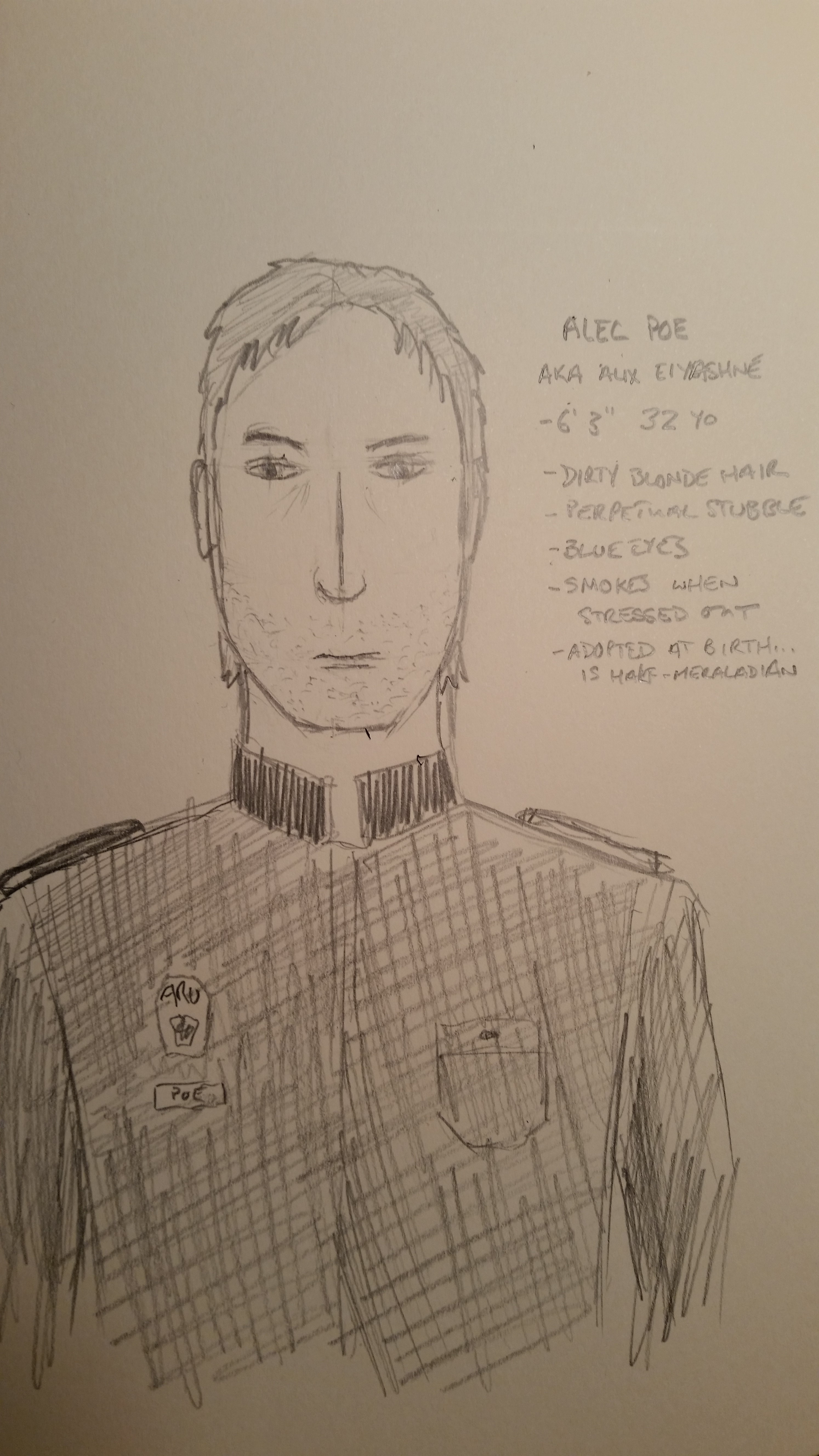
20150317_190725Please welcome Alec Poe, emha si edha!  Alec looks a little tired here for his mug shot, but that’s because HR took it first thing in the morning, and he’s not a morning person.  More to the point, he’s definitely a night owl.

A little bit about Alec, who’s often referred to as “Poe” at HQ and by his closest friends: he’s half-Meraladian and was given up for adoption when he was an infant, and grew up with the Poe family in the blue collar McCleever South district, where he still lives in the same apartment.  Like his ARU partner Caren his extrasensory abilities are above average (this will be a major plot point later on).  He’s very protective of his friends and extended family.  He’s a semi-habitual smoker who often lights up when he’s under severe stress.  In large crowds he’s more of an observer than a participant, but within his inner circle of friends he’s quite intelligent and chatty.

On Writing: More About Submission

[Note: I’ll state here and now that I’m still at that point where I have not yet been accepted by a publisher or an agent.  These are merely thoughts and ideas that have come to me over the years via the submission process and the numerous articles, con panels and books that I’ve encountered.  These entries are not about how to win at submitting; they’re more about giving you things to think about.]

After I posted last week’s entry about submitting to an agent, I had a few more thoughts about it that I’d like to share.  These aren’t exactly how-to-query thoughts, but more along the lines of FYIs; stuff to think about when you’re at this stage.

Multiple Submissions. This one’s confusing to a lot of people, especially new authors, and that’s totally understandable, because it can be a very vague phrase and misintepreted easily.  You’ll see submission guidelines that say “no multiple submissions.”  What does that mean, really?  Does it mean “you can only submit to us and no one else until you hear back from us (whenever that turnaround time is)”?  Or does it mean “don’t submit everything you’ve ever done to us all at once”?  Or does it mean “don’t submit the same novel query to my co-agent Bob that you’re also sending to me”?  For those like me, this could mean just about anything.  I need a bit more to go with.

Thankfully, most agencies and publishers have more detailed submission guidelines nowadays, which they have on their websites.  One agency I submitted to last week said “If submitting to me, please do not also send it to the other agents on my team.”  To put it another way, it’s a bit like getting one of those “Reply All” emails you sometimes get at work.  Should you work on this issue, or should James?  Or do you both ignore it and thus nothing gets done?  Pick one agent you’d like to work with at that agency and stay with them until they say yes or no.

I’ve also seen agents where they want exclusivity; if you’re sending to them, do them a favor and don’t send to another agency, because that’s just bad business.  [Granted, there are some writers and agents who take umbrage to exclusivity, and I have my own opinions about it which I won’t go into here.  How you want to handle your manuscript is completely up to you, not me.]

On the other hand…

Do you really want to send to one agent at a time?  Do you want to send your Awesomesauce Novel to an agent, hope for the best, and have no idea what your answer may be in the next six to eight weeks or however long it takes?  Maybe so, but what if you don’t get any bites until, say, the twentieth agent that says yes?  Do a bit of quick math, and that’s a good year or so between the first submission and the final successful one.  Do you really want to wait that long to maybe achieve your goal of being published?

This is why some agents and publishers state off the record that they accept that you’re more likely submitting to multiple places at once, to cut down on the time.  Remember, you’re not entirely at their mercy…they want to do business with you, if your novel is what they want to work with.  If you get a yes in the meantime and you’ve made your informed decision that you want to work with that particular agent or publisher, at least be courteous and tell them you’ve withdrawn your submission.

As always, if in doubt, check out their submission guidelines. They usually have their own linked page on the company’s website, and many of them are totally fine with you asking for clarification if need be.

What Agency and/or Publisher to Choose.  This one can be as easy or as difficult as you want it to be.  When I was growing up I had dreams of getting published at a Big Name Publishing House.  I took these dreams a bit less seriously in the 90s, though at the same time I started paying attention to who was publishing most of the books I enjoyed.  It’s a little like noticing how a lot of my favorite late 80s albums were released on 4AD, or how many great bands I liked were distributed by Warner.  Take a look at what you’re reading and why you enjoy it so much, and think about whether or not your novel would fit in their roster.  I have a small list of genre publishers in my head that I think would like the Bridgetown Trilogy, and am aiming to submit to them.  I also have a list of agents I’ve been researching over the years and have been submitting to them as well.

At the same time, I’m keeping an open mind.  I could just as easily check out a few small presses who could suit my needs as well.  And I could even try my hand at indie publishing (read: going the self-pub route — I like the “indie-pub” moniker better, as it makes more sense logically).  Don’t be afraid to have backup plans.  I’m reasonably sure that agents and publishers are also well aware of these alternate routes. Keep in mind, they’re also looking for new work, so they’re not about to say “oh–well, he might be skiving off and using BookBaby instead, screw him.”  That ain’t good business sense.  If you can get picked up by them, both you and they will be happy for it.

I buy Writer’s Digest’s Writer’s Market every other year or so, just as a reference guide to see which agents and publishers are out there and doing business, and I also subscribe to various magazines: The WriterPoets & WritersWriter’s Digest, and Publishers Weekly.  [That last one can be pretty expensive for those on a budget, but it’s extremely worth it for the news coverage, book reviews, and other business-side issues.  Ask your library if you can’t afford it.]  Keep an open mind about it, and use these reference tools to come up with a good solid idea of how you want to sell your novel.

Social Media.  There are so many things being said about this right now, many of it contradictory.  On the one side, you’ve got pros suggesting you have some kind of social media platform: a blog, a Twitter account, and so on, and reminding you to be visible as much as you can.  On the other, you’ve got people howling in frustration that so-and-so spends way to much time tweeting that their new book is out.  There are others out there suggesting you must have an extremely professional website if you want to make it…and George RR Martin only shows up in person on LiveJournal.

There are no hard and fast rules, no matter what anyone says, save one: all in moderation.  You don’t need to spend thousands of dollars on a pro website when you can get a free one via WordPress (or drop an annual Benjamin for an upgraded version, which I do).  Your social media visibility should be at your own pace, design, and comfort level.  I post a lot of unique blog entries over different platforms, depending on the subject, maybe once or twice a week.  I’m on Twitter a lot, though I don’t always actively tweet.  I balance all this with a lot of offline activity as well, which I don’t always make public.

You may need to sell yourself to some extent, especially if you’ve got a book coming out or you’ve got an appearance at a con or a local book store, and that’s totally fine.  You may even want to occasionally remind people that your book can be nominated for a Hugo or whatever award.  [I know there’s a lot of guff about this subject, but again–all in moderation.  A sticky note on your website or an occasional reminder on Twitter is fine; hourly announcements probably less so.]  If you feel you can get away with livetweeting your life, by all means go for it.  If you’re more an analog person like me and enjoy not being plugged in 24/7, that’s fine too.

Do you have any other thoughts about submission you’d like to share?
A Division of Souls: More Character Sketches

image

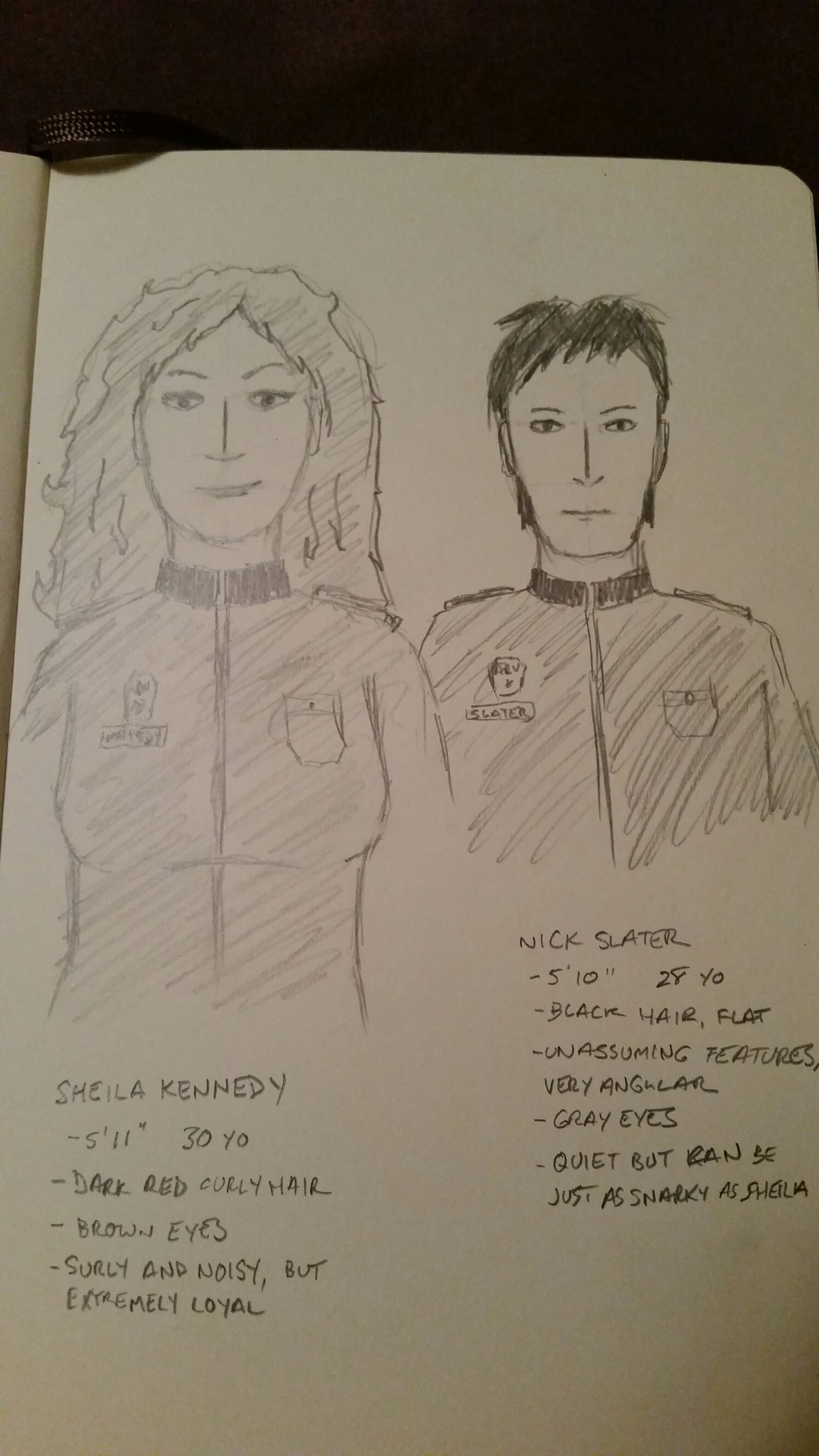
A two-fer this time, featuring Sheila and Nick. They’re Caren and Alec’s team two on the ARU.  Admittedly rough (eyes and eye symmetry seem to be the hardest for me), but I like how they came out.  These two are my favorite secondary characters in the Bridgetown trilogy, as they seem to have that “we’re from a different book but somehow we got dropped here” aura about them.  They do have very important roles, however.

Sheila Kennedy is Caren’s former ARU partner; they split up while Caren was on LOA due to her parents’ deaths.  They have an extremely close friendship that transcends some boundaries — they were lovers for a very brief time as well — and though they are on separate teams now, they remain very close friends.  She’s that girl you knew in college who was loud and silly and friends with everyone, and you’d better be far away if you piss her off.  Her extrasensory abilities aren’t as strong as, say, Caren’s or Alec’s, but she has a knack for using them in unconventional ways to get the job done when need be.

Nick Slater on the other hand comes from the darker edge of Bridgetown; he was both part of the B-town Metro Police and a bodyguard for various government visitors.  He left the BMPD because he felt he could do more working for the Alien Relations Unit.  This is an interesting decision, considering unlike most of ARU agents, he shows no outward signs of having any extrasensory abilities.  He is, however, extremely observant and stronger than he looks.

Edit: I’ve gone back and done a bit of similar description for the Caren and Denni drawings, if you’re so interested.  It’s two entries below!

On Writing: The Submission Process

From past experience, I would say that manuscript submission is both the most exhilarating and most frustrating process a writer has to contend with.  On the one hand, we’re absolutely thrilled that we’re sending our finest work off into the great big world like we’re sending our five year-old child off to kindergarten.  It’s an immensely proud and exciting moment, and we can’t wait for the point where our handiwork will be seen by many on the shelves of bookstores.  Yet at the same time…

At the same time, we have absolutely no idea if the agent and/or the publisher will think our book is the best thing they’ve ever read, or if it’s absolute drivel and all our beta readers were just being nice to us out of pity.

Okay, maybe it’s not that bad…it’s not always a bad manuscript that gets the rejection, and a writer needs to remember that more than anything else during the submission process.  I know I certainly do.  There are a lot of reasons for rejection, and “because it’s drivel” is actually pretty low on the list, from what I’ve seen and heard from the professionals.

Here’s a short overview of issues one might face when submitting your novel:

You’re not paying attention to the guidelines.  A lot of newbies run into this.  It’s understandable, but it’s really something you should be vigilant about.  I just recently sent out two agent submissions for A Division of Souls, and I made sure I followed directions. Both agencies request e-queries only; they even went out of their way say snail mail queries will be recycled unopened.  Frustrating for some, yes, especially if you’re not wired…but this can be easily rectified by a trip to the local library or anywhere that has a connection.  Most agencies actually request the first few pages within the body of the email, which makes it even better for those unable to attach files.

Many agencies and publishers request a specific page amount; one agency I submitted to requested the first chapter, whereas the other asked for the first twenty pages.  When I submitted to Angry Robot’s Open Door last year, they asked for the first fifty pages.  They all requested a short synopsis (one agent had no length limit, the other requested one paragraph), maybe a short personal bio, and contact information.  Point being: what you put in your query really does depend on who you’re sending it to.

They’re just not interested.  Well…this doesn’t necessarily mean your novel bored them, nor is it proof that your novel is in fact drivel.  This merely could actually mean that you’re trying to sell Noel Gallagher’s latest High Flying Birds album to someone who can’t stand Oasis.  You could be trying to sell your zombie novel to someone who thinks zombies are the stupidest trope ever, and would be doing both you and their agency a disservice trying to sell something they don’t like.  Or on the other hand, it might not be their personal taste but the agency’s or publisher’s tastes; sometimes they state they’re looking specifically for hard science fiction but no swords and sorcery books.  Again…it’s all about the guidelines.  Instead of trying to shoehorn your book into a spot where it doesn’t quite fit, look for a place where they would fawn over it like adorable fluffy kittens.  [Or puppies.  Your choice there.]

You can write it, but you just can’t sell it.  This is the problem I run into the most; I consider myself a pretty decent writer, but I can’t sell you sliced bread to save my life.  I’m no salesman.  I hate the process of trying to sell something to someone.  [The only exception to that was my job at HMV.  I can upsell you music like no tomorrow.]  But how the hell do I distill a novel that’s around 150,000 words down to one paragraph?  I don’t mean the one sentence elevator pitch, which I can kind of get away with.  I’m talking about explaining the entire book’s plot in about ten sentences.  What do I keep in?  What to I leave out?  How do I best describe what goes on without rambling incoherently, as well as explaining the entire arc?  It’s pretty damned hard, I tell you.

I spent the other night forfeiting a writing session just so I could focus on explaining A Division of Souls with just enough detail to spark the agent’s interest.  Here’s what I came up with:

In A Division of Souls, the delicate supernatural balance between two spiritual factions is threatened when a renegade leader sets off a powerful ritual that escalates a mass psychic and spiritual ascension well before the alien Meraladhza and the human race are ready for it.  In the process, he’s also awakened their deity, the One of All Sacred, much earlier than anyone expected.  Alien Relations Unit agents Caren Johnson and Alec Poe are assigned to find and stop this man, but as they learn more about his ritual and its aftereffects it becomes a bigger race to keep this enlightenment from spiraling dangerously out of control.  They must not only come to terms with a changed city, but the change within themselves, and what it means to be a part of a new conscience.  And Caren must face her worst fear: her lone surviving family member, her young sister Denni, is in fact the resurrected One…and a spiritual war has just been declared in her name.

I’d like to think this covers most of the bases: the main plot of the spiritual war between the Shenaihu and the Mendaihu (names taken out here to avoid too much confusion…just mentioning the imbalance is enough); the introduction of two of the major characters who have to fix the conflict (Alec and Caren); the other main arc of the awakening of the One of All Sacred (and the fact that she’s a lead character’s little sister, thus showing further conflict); the fact that the awakening ritual had affected more than just Denni.  [Note: as a follow-up paragraph, I gave very brief one-sentence descriptions of Books 2 and 3 to show that the trilogy was in fact already complete, and what they would entail.]

So did I sell it?  Again, I have no idea…I’m a horrible salesman when it comes to selling my own work, and I thought I did, but I could be totally wrong.  I do know that I can talk convincingly about my trilogy because I’m so familiar with it from the many versions and revisions.  If any questions come up, given a few moments I can probably give a detailed and reasonably concise answer.  But the hardest part of this query was not the writing of it…it was trying to see my book from the perspective of someone who hasn’t yet read it.  I had to back away from all that Mendaihu Universe knowledge just enough so I could give the novel the leanest yet most informative description I could.

All told, it’s one of the toughest pieces of writing I’ve ever had to do, but I’m proud and relieved that I forced myself to do it despite the odds.


Of course, at this point I’ve been hitting the refresh button at my GMail account in hopes that a response will have arrived.  And I’m sure I’m not the first or last writer who’s done that after they send their book off into the wild.