An Introduction to the Bridgetown Trilogy

Hi there, and thanks for sticking around!  And hello if you’re a new visitor!  Welcome to Bridgetown!

So…what is The Bridgetown Trilogy, you say? Where is this mythical B-Town?  And why does the banner picture of the city look suspiciously like downtown Los Angeles as seen from the Getty Museum?  What is this trilogy all about anyway?

Well–it’s high time I give you the rundown.  The one-sentence pitch that I’d come up with, which I’m currently using:

Caren Johnson’s younger sister has been forcefully awakened as a powerful and supernatural deity, revered by multiple worlds…and a war has just been declared in her name.

Nice kicker, eh?  I’d like to think so.  [Mind you, that was probably the hardest damn thing to create.  I’m not one for brevity.]

So let me give you the situation:  Caren Johnson is an elite member of a special branch of the Bridgetown Metro Police called the Alien Relations Unit.  With the humanoid Meraladzha living among us, the ARU has been tasked with keeping the peace between aliens and humans.   She’s proud of her work; she’s followed the career paths of her parents, Aram and Celine, both highly revered and decorated ARU agents.  They were both killed in the line of duty five years before the events that take place in the trilogy.  She’s become the legal guardian of her younger sister Denni, a precocious and very intelligent fifteen year-old, and she loves her dearly.  Caren does her best to balance life and work, but because of her parents’ history, they sometimes blur…

Aram and Celine were also a part of an elite force called the Mendaihu–a collection of supernaturally strong and highly spiritual people whose primary goal is to protect the planet…not just the humans and the aliens, but their souls within as well.  The reasons for their deaths had never been officially released publicly, but Caren knows why; they were protecting their daughters from a potential evil that had come to kill them.

Caren fears she will become Mendaihu as well, for it’s in her soul and in her blood.  But what she fears most is when Denni ‘awakens’ to her own Mendaihu powers.   Her one wish is to let Denni live a normal life without such heavy responsibility.

Nehalé Usarai, a rebel Meraladian and an one of the strongest Mendaihu in the province, has other plans.  He knows Denni’s fate…but he also knows that she’s the current incarnation of the One of All Sacred, one of the highest revered deities in Meraladh history.  He performs a dangerous and potentially lethal Awakening ritual, and in the process not only awakens Denni, but a large swath of Bridgetown as well.  He knows this is dangerous, but he fully believes that she will bring peace and balance to the world.

The only thing that could stop her is an equally strong and formidable force called the Shenaihu; they are the yang to the Mendaihu yin, their spiritual opposite.  When one acts, the other must act in kind to retain the balance, or the both the physical and the spiritual world could spiral out of control.

Both sides have other plans, despite the balance.  It will be up to Denni, Caren, and a host of others, both awakened and not, to ensure that the balance returns.

The story takes place over three books:  A Division of Souls, The Persistence of Memories, and The Process of Belief.   It’s about many things: belief, patience, clarity, and love.  It’s about physical and spiritual evolution.  It’s about family.  If I had to whittle it down to a single sentence, I would say this: it’s about devotion to oneself despite outside influence.


*   *   *

At this time, the first book has been submitted to a potential publisher, and I’m currently awaiting a response.  I’m keeping my options open, but my aim is to have the trilogy published by a professional house.

Here’s to hoping!

20 years 5 months 18 days (give or take)

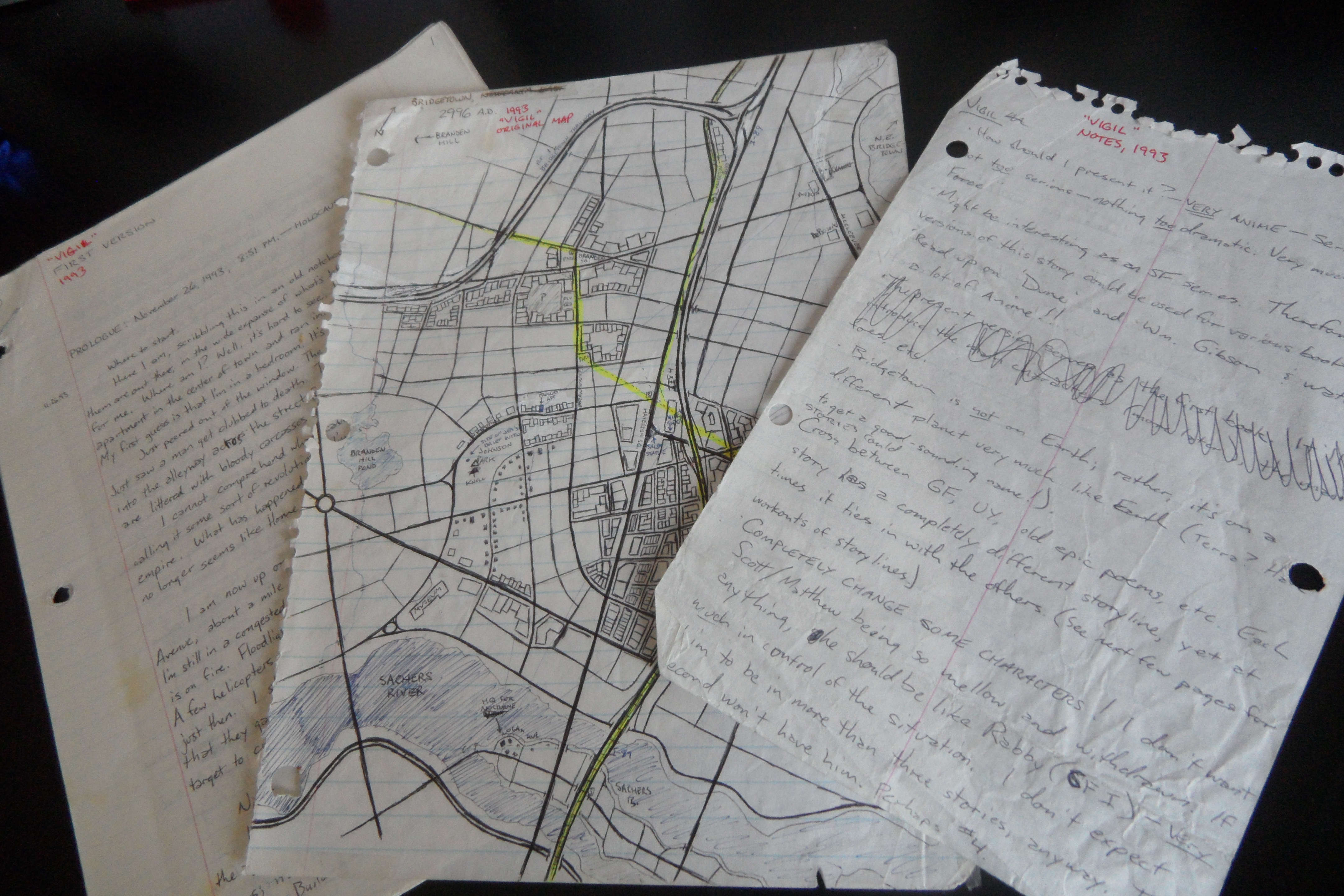
Some of the original notes from 1993.

That’s a hell of a long time to be working on a novel, don’t you think?

At 11:18pm PT last night, I completed what I call the Great Trilogy Revision Project, a major overhaul of all three novels in the Mendaihu Trilogy.  Entire scenes were rewritten, edited mercilessly, tightened up, names changed and characters strengthened.  It took the better part of fourteen months and I kicked my own ass numerous times to avoid laziness and weak prose; I read, reread, re-reread, and re-re-reread (sometimes while at the gym!) until I knew the story, its history and its cast inside and out.  And I read it again to make sure I knew where it worked and where it didn’t.

Today marks the first day in probably a decade or so where I have no plans to work on the existing novels or work on anything related.  [Mind you, I definitely have plans to work on future Mendaihu Universe stories, just not at the moment.]  In my mind, this epic project is DONE.

Notes made while doing laundry, October 1993.

In late 1993, I’d just watched the first two Gall Force animes (I’d find the third movie a short time later) and found inspiration to write what I often call my Infamous War Novel, or IWN–my first novel from my high school years–in a completely new style I hadn’t tried before: science fiction.  I wrote a few notes in a steno notebook while waiting for my clothes to dry at the Charles Street Laundry, and came up with a number of ideas that I could work with.  I’m amused by the first line saying “VERY ANIME”, as well as the consistent anime references on that one page.  As if I knew what the hell anime was at that point in time, other than my latest obsession!  All I wanted to do was write something that was totally unlike American SF at the time.

Did I know what the hell I was doing?  Probably not.  I was woefully ignorant of genre fiction other than through movies, comic books and Japanese animation.  But I was willing to learn along the way.  I understood right away that storytelling in Japan is significantly different than storytelling in America, and I wanted to try my hand at writing that way.

Soon after, I did what I normally do when I come up with story ideas: I draw maps.

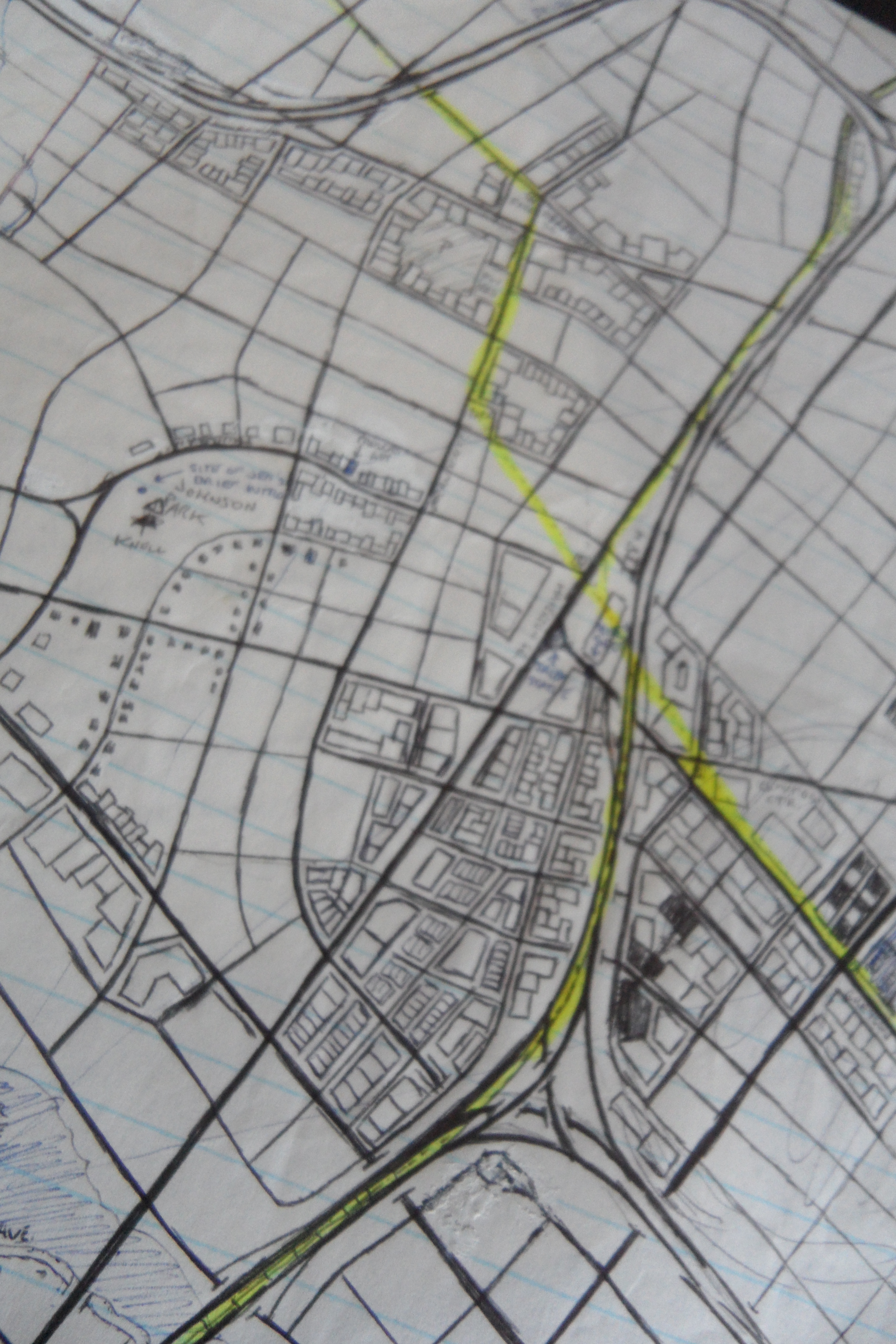
The original Bridgetown Sprawl as of November 1993

I knew I wanted a few things: a sprawling metropolis, a giant tower (hints of the GENOM Tower from Bubblegum Crisis), and a megacity so packed with different places and cultures that I knew I’d be able to use the setting for multiple story arcs.  Bridgetown morphed and grew considerably and exponentially over the years, but there are points here that made it all the way to the finished product in one form or another.  Sachers Island, Branden Hill Park (named Johnson Park here, but pretty much in the same shape), the warehouse district,  and the dirty and dangerous strip of McCleever Street were there from the start.

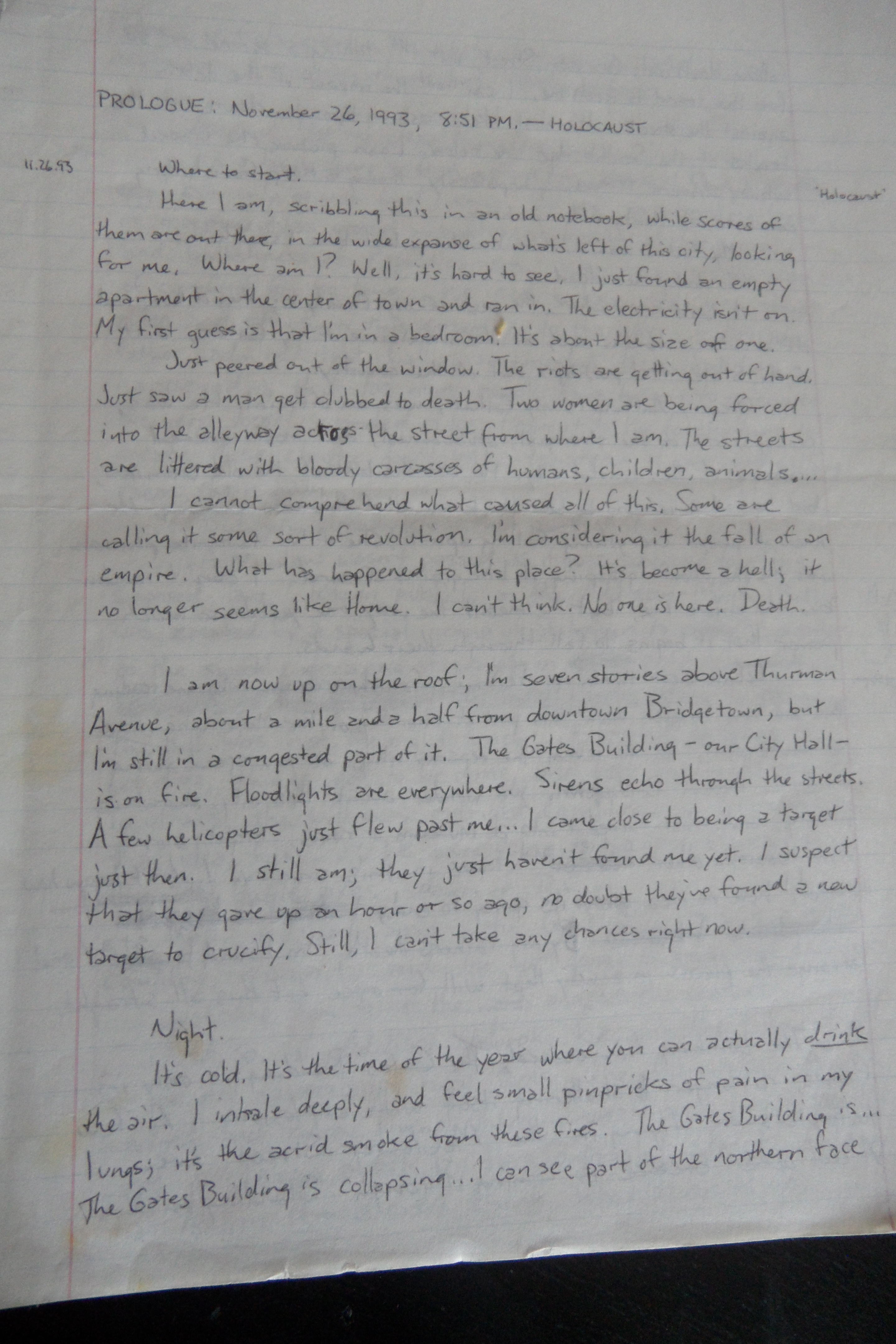
Vigil, Take One.  Started 26 November 1993, 8:51pm ET in my shoebox apartment.
Vigil, Take One. Started 26 November 1993, 8:51pm ET in my shoebox apartment.

Where to start, indeed.

My primary aim when I first started this novel was to write something totally unlike anything I’d written before.  I wanted everything about this project to be completely new for me–an untried style, a setting I’d never ventured through, a plot that challenged me to work it through to the best of my ability.

Granted, I was far from perfecting that, but I was going to try anyway.  Vigil–so named after this band of rebellious misfits bent on saving the world from corruption–was started on the Friday after Thanksgiving 1993, after getting off work.  I’d had a few ideas written out here and there, but this was where it all started.

True Faith–the aborted rewrite from summer 1994–would grow out of this, introducing the spiritual background.  The Phoenix Effect, the project from 1997-1998, grew out of TF and introduced the alien races. TPE in turn became the trilogy after a complete restart from scratch.

So for all intents and purposes, Vigil was the version that started it all.  And now it’s done.

Any author will tell you that they have a hard time letting go of their projects, even once they’re completely finished and on their way to publication, and I am no different.  I’m sure I’ll want to pick these three books up again and tinker with them some more.  I’ve already got Book 1 out to a publisher, and am ready to take the next steps to shop it around and even get an agent if need be.  I’ve also debated self-publication as an alternative.   It’s a wide world out there, and I’d like to introduce you all to the Mendaihu Universe someday.  On this evening, I’m finally that much closer to doing so.

But for now?  I think I’ll do what I haven’t done since I started writing the trilogy proper, way back in 2000:  I think I’ll let it sit awhile, and let it age gracefully.

On Writing: Letting Ideas Percolate

I’ll be truthful–the Mendaihu Universe has been percolating in my brain for at least twenty years this past winter.

Twenty years. Isn’t that a bit long for me to be sitting on these novels? Shouldn’t they have all been written, published and made into movies by now? Shouldn’t I already be working on the next trilogy in the universe? Well, in a perfect world–yes, of course! And with that, I’d have some nice cash in the bank as well. This, however, is not that perfect world. There are reasons it’s taken me so long to get those beginning scraps of ideas into the shape they’re in now. For one, back in winter 1993-94, I only had the gung-ho to write them but the barest of plots. For another, I had to do more homework in the genre, learn what makes a good SF/F novel that people would enjoy.

But a very large portion of it was the fact that I had to learn how to write in the first place.

I’d been toying with writing science fiction during most of fall 1993, just after I’d graduated college. There were a few pieces of inspiration: Akira, the Gall Force OVAs, other SF/F-themed anime, Orson Scott Card’s How to Write Science Fiction & Fantasy and Ray Bradbury’s Zen in the Art of Writing. And there was my music collection as well, to inspire me and keep me company.

The first few ideas popped up most likely that December–I’d finally given up on trying to resurrect one of my earlier novel ideas, and scrapped nearly everything except a single idea: an underground gang who broke the all the rules, but for the right reasons. From there I played around with a few tropes: a multi-planetary setting (created while doing laundry one afternoon on Charles Street), a giant sprawling city (part of my lifelong compulsive habit of map drawing), cyberterrorism (Hi, CompuServe and AOL! Glad to have you around!), politics (Clinton had just entered office) and so on. I hadn’t quite latched onto cyberpunk yet, though I had read a bit of Gibson by then, and within a few years we’d get a short but interesting wave of internet-themed movies (The Net, Hackers, Strange Days, and Johnny Mnemonic for example) that would add fuel to this idea. I was pretty much open to anything at that point.

A number of months later I was writing the first attempt, True Faith. [To spare you the story some of you already know, here’s the short version: TF was an extension of the “Vigil” underground gang idea with all the other inspirations I noted above, plus a twist: I added a bit of spiritual enlightenment, inspired by my then-recent foray into Wicca. It was co-written with my then-girlfriend Diana; it was mostly my idea and my writing, but she came up with a few of the character backgrounds, plot twists and wrote a few passages as well.] This version lasted from summer 1994 to probably late 1996 and was never completed, for various reasons. One of the most important being I just was not happy with the prose.

What was wrong with it, anyway? Well, for one, I think I was focused too much on inner dialogue.  The characters did a lot of thinking and contemplating and not much doing anything afterwards. For another, I’d written a lot of scenes starting something but never quite completing them. And worse, I had a habit of writing what I call “stage directions”: the character did this, he went over there, he got up and tapped a code, he did that, he went there. The end result was that I’d come up with a lot of interesting ideas and scenes, but the execution lacked any kind of oomph.

Come 1997, I chose to start again, almost completely from scratch. This was The Phoenix Effect; it retained the spiritual bent, the underground gang and the cyberpunk ideas, but the focus was now on two new characters, investigators hired to figure out why certain AI units were now becoming more human. That last idea was inspired by my 1996-8 foray into New Age spirituality, infusing the idea that the soul came from elsewhere other than Earth. This novel did get finished, and I even attempted to submit it to a few places, but I was still unhappy with it.

I toned down the stage directions, I followed through on the action, and I had the characters doing things instead of just thinking about them. What was wrong this time?

Two further problems: quantity and delivery. The description of scenes and characters was slim to nil, as I’d focused too much on getting the story out on paper. Who were these people in my novel, anyway? Why were they there? Where were they? In my head, to be honest. I had them up here in my cranium–I knew exactly what they looked like, where they were, what they sounded like…but I’d put none of that on paper. I realized part of this was due to having written this longhand–I was focusing on keeping the story moving that pausing for a few seconds to describe something felt like I’d tripped up. I’d expand on these things a little when I transferred it computer, but there was still a lot missing.

Cue the third attempt, right around 2000-1, with A Division of Souls. This would be the first novel I’d write completely on the PC. Fully-expanded, complete scenes? Check. Expanded description of characters and scenery? Check. Expansion of the characters’ backstories? BIG check. Expansion of plot? BIG check. Scenes and plot points were completely rewritten and others totally new. I even plotted ahead a few chapters before writing them, something I rarely did before then. The outcome worked so well that I ended up with not one but three novels, which I wrote well into 2004. I was quite proud of this trilogy. And yet…

What was the problem this time? Well, aside from burning out in late 2004 and never finishing Book 3, I still didn’t quite get what I was doing wrong. I had a great story idea, an extended universe to play in, well-crafted characters, and description galore. So why was I still not quite there yet?

Again: the writing. It took me a long time to figure this part out, and only recently, in the last year or so, did I finally get it. You could see the choppy edits, the “screw it, I’ll fix it later” passages, the subplots that went nowhere. In other words, I had an extremely rough draft, and I’d said “good enough”, and that was the killer. I had the finished product, but I just hadn’t bothered to polish it at all. You see, I wasn’t quite there yet. I still had that final hurdle.

This meant some major review and revision. And I mean major review. So how did I go about it this time? Well, this time out I took all three books (I’d finally finished Book 3 in January of 2010) and put them on my Nook, and proceeded to read them. And read them. And read them. AND READ THEM.

I immersed myself in these three books to the point that I had the entire trilogy arc in my head. Over the course of six months or so, I must have read all three books from start to finish through at least three or four cycles, and each time I made a mental note of what needed fixing, from big things like story arcs to miniscule things like dialogue tags. And starting in 2012, I started the biggest revision I’d ever gone through in my life. I painstakingly went through each chapter and worked the hell out of each one. Some chapters were relatively quick to work through, but those first six or seven chapters in Book 1 were almost completely rewritten from scratch–a lot of those passages hadn’t been properly revised since their 2001 inception.

As of today, I’m on Chapter 10 of Book 3. It’s been one hell of a long trip, but it’s been worth it. I learned a hell of a lot in these past few months, possibly more than I’ve ever done in the last ten years combined, about what makes a decent manuscript and what doesn’t. And most important, I finally learned how to write.

*

Now, should this have taken twenty years?  Who knows. I’ve got other interests aside from writing science fiction, and I’ve had day jobs that took precedence. I’ve had personal events intervene. And yes, just like any other writer, I get distracted easily. Am I fine that it’s taken two decades to get where I am, and I still haven’t gotten these things published? Yes, I am. I’d rather have a complete and professional product out there that I’m proud of, rather than release a half-assed, phoned-in book that I wouldn’t be able to resell, at least not to any publisher. I’ve learned other things on the way too, come up with new ideas for the Mendaihu Universe. I’m not about to write this world off just yet, not when I have more to say about it. As soon as I’m done with this major revision of the first trilogy, I’m going to start working on the next one.

So yes, sometimes it’s a good idea to let ideas percolate. Sometimes the end result is worth the wait.
[Request] On Writing: The Long Haul

From Amy, a friend and fellow writer in Houston:

[Talk to me about] developing a writing practice that lets you complete a large work.

The short answers? Give up watching TV and hole yourself up at your writing nook for a few hours every night. Immerse yourself into the created world as often as you can–this includes thinking about it while you’re at work, and writing down notes on scraps of paper during down times. Stay up way too late on the weekends so you can write for hours at a time. And above all, write EVERY NIGHT for at least two hours. In other words, dedicate way too much of your time to it. It’ll drive you nuts, you’ll want to give up and erase the damn thing from your memory, but if you persevere, the payoff will trump all that. Oh–and don’t think too seriously about publication until it’s done and revised. [I made an error in that last part and sent it out well before it was ready a few times.]

But more seriously…

The Bridgetown Trilogy was started around 2000 or so, after a number of months trying to rewrite and revise its predecessor, The Phoenix Effect. That novel was to be the first in a trilogy as well, and about thirty or so pages were started on its sequel, before I realized I was going in the wrong direction and would need to seriously revise and rewrite the whole thing. There were just too many problems with it: too many holes in the plot, too many tropes that wouldn’t age well, and background that was shoehorned in where it didn’t belong. And worst of all, the prose was weak. Really weak. I’m talking barebones description, hokey dialogue, and subplots that led nowhere. Frustrated and annoyed but full of New Englander stubbornness, I chose to start from the beginning again. Yes–start the whole damn thing over from scratch.

I say this, because this is when I created the writing practice that I still employ today.

I was incredibly lucky in that I could create time for this…one of the most irritating parts of dedicating time for writing is finding that time, which can be incredibly tough when one is working eight hours a day, even more so when a commute is involved. I was lucky in that my warehouse job was purely physical with very little need for heavy duty problem solving, so I could actually think about my writing while I stacked boxes on pallets. I was also lucky in that I had super early hours, 6am to 2pm, which gave me the entire afternoon and evening to do what I wanted. Once I restarted the trilogy, I chose to set up a strict writing time of 7pm to 9pm every night, no exceptions (this included weekends as well) and would do nothing except working on the trilogy project. As my family had dinner around 5pm, more often than not I’d start at 6 instead, giving me a good three-hour block. [Okay, I would often spend twenty minutes at the start goofing off, deciding what music I’d listen to (often the new releases I’d bought that week), and playing a few rounds of FreeCell, but I’d get there soon enough.] Things have obviously changed since then, but I still try to utilize my time the best I can. I can’t stress enough how important it is to dedicate time solely to your writing projects.

The other goal I had was that I would write at least a thousand new words every night. Sometimes I did more, sometimes less, but that was the goal I aimed for. This did a few things for me…first, it forced me to be more detailed in my prose. My previous works tended to be rather thin, lacking in detail and oomph; this goal forced me to look at how I described things, and how to make the scene glow. Second, it forced me to be prepared–I started sketching out quick outlines and notes a few scenes and chapters ahead that would come to me while I was at work, which I would use later on as a guide. Third, the more I hit this goal, the easier it felt. It may not have been perfect prose, but it was good, beefy prose that I could work with and revise later on. By the third or fourth month, I was consistently going over the word count, hitting 1200 to 1500 a day. I still kept the goal at a thousand words, however–as long as I hit that thousand, everything else was gravy.

All this writing time was focused solely on the trilogy, and this is one of the most important parts of the process: I’d fully immersed myself into the world on purpose. I continually expanded the created world, studying the lives of the characters and their actions and thoughts, and putting a sharp focus on how each plot arc unfolded. I thought of events that might not show up in the finished product. I did short writing exercises of writing from a character’s POV so I could understand them better. I drew maps of Bridgetown and various neighborhoods, and made notes about the surrounding megacities, and even touched a little on future sociology. I created backgrounds for the characters that had little to do with the trilogy (though in a few cases, I used the information as off-the-cuff description just to give them more life). In short: this was going to be an epic story, so I’d better be a supernerd about its background so I wouldn’t leave anything out or go in the wrong direction!

I did this for four years straight, almost without fail. I did have the occasional sick day or prior plans, of course. I felt a brief pang of guilt when I missed a day, but it wasn’t the end of the world. My writing nook was down in my parents’ basement at the time, and sometimes I’d have to work upstairs instead when it was too cold downstairs in the winter (that didn’t always stop me, however). And there were some days when I just wanted to be lazy or needed to give my brain a rest. It was exhausting at times, but it was also a hell of a lot of fun, and it made me enjoy the writing craft all that much more. I stopped around 2004 for a few reasons, both personal and writing-related. I won’t go into detail here, but suffice it to say, it was a great run, and I wrote two and three-quarters novels–the first two in the trilogy, and most of the third–during that time.

*

So…that was my previous writing practice. How is it now?

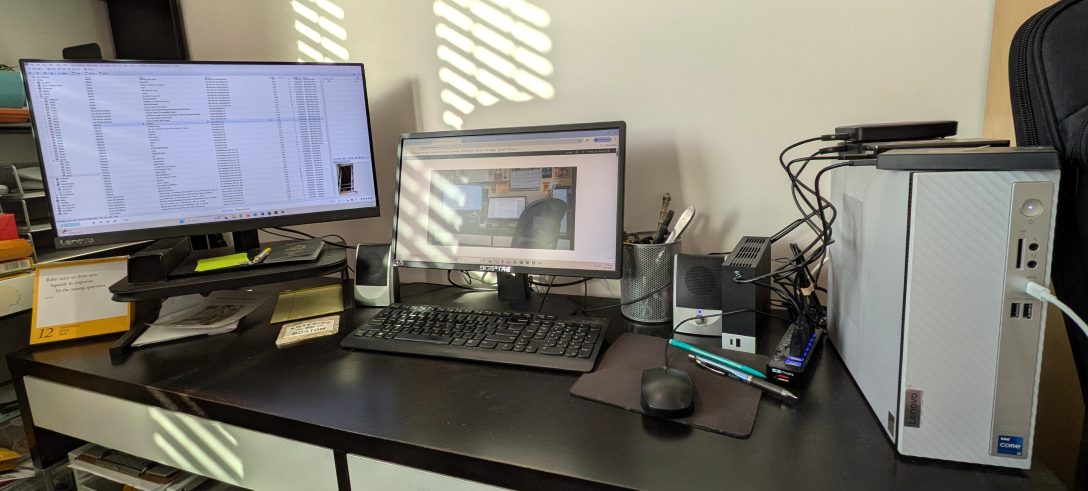
After a few dry years, I finally returned to the nightly work, and I’ve been doing it ever since. It’s changed a bit, obviously: instead of writing new words, I’ve been focusing on the completion and revision of the trilogy. I’ve had some professional critiquing done on it, which has helped immensely. For now, I merely focus at least an hour or so in the evening to work on my projects, and if I can squeeze in extra work here and there during the day, I will of course do so. I’ve also expanded on my writing environs: I work in the back room of our apartment, but I also work on the laptop in the living room, and have been known to work on a tablet on vacation, especially when flying cross country. I’ve always been able to write anywhere, given time and space and minimal interruption, and it’s a good habit to get away from your home base now and again to get used to different environments. The focus here is not where you write, but that you write.

Am I ever going to go back to the previous schedule? I sure hope so…it was hard and exhausting work, but it was fun and fulfilling as well. Once I’m caught up with this revision, I hope to start on new projects again. It won’t be exactly the same, considering I have a different work schedule and other personal non-writing things going on, but I do plan on ramping up the volume this year once the major revision project is done. I find I work best and enjoy writing the most when I’m running at top speed, losing myself in the craft (so to speak), even if it’s only for a few hours a day. And if I can expand that even more in the future, maybe to the point of paying full-time writing, so much the better. That’s a far goal, though…but one I’d like to eventually reach.

*

All that said…in answer to your question? There’s no ultimate answer, but the above is what worked for me. Find out what systems and habits work best, and continually improve and upgrade them as necessary. If you’re working on a large work, be prepared to go the distance with it, because it’ll certainly show either way. Immerse yourself in the world as much as possible (but don’t get hopelessly lost in it!). Pay attention to your world’s restrictions, but figure out how to break them when you need to. And keep tabs on everything, even the small stuff, because it may come in handy later on. Be a compulsive note-taker.

Treat writing as a guilty pleasure, like you’re getting away with it. Have fun with it, because if it ceases being fun, it’ll show. And if it gets that far, it’s not the end of the world–take some time off, distance yourself from it (even if that means working on something completely unrelated), and come back to it when you’re good and ready. You will, of course, need to look at it professionally for revision and submission purposes, and it’s fine to think about that, but don’t let that get in the way of creating the story in the first place.

And repeat and adjust as necessary. 🙂