#atozchallenge: B is for Branden Hill

Branden Hill Sector artwork, circa summer 2001
Branden Hill Sector map, circa summer 2001

Branden Hill Sector is considered the “collegiate” sector of Bridgetown, as it is home to multiple colleges and universities, including Spender College, the arts and architecture campus of Bridgetown University, Kuhlmann University, and Longwood College of Pharmacology.  It is also home to a number of museums and cultural centers.  Most of its dwellings are relatively small apartment buildings, a handful of SROs, and a small number of apartment complexes.  The community of Branden Hill (colloquially called “Brandhillers”) have fully embraced its ‘cozy’ image, and have strived to keep the sector from becoming too gentrified.  Most of the towers and high rises are in eastside, which borders Main Street Sector.  Due to limited availability of homes and apartments, the cost of living in this sector can be expensive.  It is cheaper to live in the more suburban westside (bordering West Brandenville and Swope Heights).  Some live in nearby sectors while commuting here for work.

Getting in and around BH is quick and easy; it contains three major subway branches and numerous shuttle paths.  A number of major thoroughfares run through the sector, including Baird Avenue, Krieger Avenue, Ormand Street, Shattuck Street, Guyton Street, Jamison Avenue, and Bridgetown Parkway.  Interstate 91 runs down its eastern border, with multiple access points.  Baird River Park is a greenbelt stretching all the way through the sector and is a local favorite on the weekends.  There are many shopping sections within the sector that provide wares and entertainment for its community.

The sector was named for the hill in the center of the sector, where BH Park now sits.  It was named after its original landowner, Joseph Branden.

The Branden Hill headquarters of the Alien Relations Unit is situated on the corner of Baird Avenue and Ormand Street, about a mile south of Branden Hill Park.  The headquarters building is one of the larger buildings in its neighborhood at eight stories, though its unassuming reniform shape and light color keeps it from being an eyesore.  The Unit is well-respected in this community.  Reporting here are agents Caren Johnson, Alec Poe, Sheila Kennedy, and Nick Slater; they are all reporting under Chief Inspector Dylan Farraway.  Christine Gorecki was a former agent here, though she has taken a leave of absence and is currently a registered soulhealer and private investigator.

#atozchallenge: A is for Akaina and Ashyntoya Shalei

[Apologies for the delay…I had quite the full schedule yesterday and was not able to post until today.  Thus we’ll have multiple entries today.  Woo!]

Welcome to Jonc’s A to Z Challenge!   I’ve chosen to have some fun and post about the stuff that goes on behind the scenes in the Mendaihu Universe; character backgrounds, FAQs, behind-the-scenes production, and more.  Hope you enjoy!

Q: First off:  how do you pronounce their names?

A: Last name first:  Shalei is shah-LEY, even if it’s a distant relative that has the extra ‘i’ at the end.  It’s an extremely common Meraladian surname, as it’s one of the largest clans to come from Trisanda.  They do sometimes get queries about if they’re all related; some do find it irritating, others merely brush it off with a quick answer.
Ashyntoya is ahsh’n-TOY-ah.  He’s named after his great-grandfather who was quite the epic Mendaihu, and a major player in the Fifth Season of Embodiment of the One of All Sacred.  Someone he feels he’s expected to live up to, but he doubts he’d even be fit to stand in that great man’s shadow.  He prefers to be called Ashan (ASH-ahn); he usually explains that it’s just a nickname, but in truth he borrowed it from another less known and much older ancestor who was connected to an uprising at Bann Currin on Trisanda.
Akaina is ah-KAH’ee-nah (although I admit my brain still sometimes reads it as ah-KAY-nah).  She understands cultural differences in speech origins, so she’s totally fine with people pronouncing it either way.  She prefers people call her Kai (kah’ee, rhymes with ‘sigh’).  She’s named after her aunt on her mother’s side; the two sisters were best friends growing up and are still extremely close.  Her aunt is one of her favorite relatives; she was the one who first taught her about the Mendaihu and the Shenaihu.

Q: How did you come up with the twin Mendaihu agents for the Bridgetown Trilogy?

A: That’s a good question…they just sort of evolved, really.  If I’m not mistaken, Kai originally showed up as a humanoid AI in The Phoenix Effect, and Ashan was one of the background AIs.  I dropped nearly all the AI ideas during the 2000 reboot and kept those two, giving them a completely new background and purpose.
They weren’t twins at first; originally I was going to have Ashan as the older brother.  However, I realized both characters had an almost exact equal purpose in the story; it made more sense for them to be not just physical twins but spiritual twins as well.  There’s no special psionic connection between the two; they merely know each other’s soul so well they work perfectly together as a team.  And of course, as siblings, they do get under each other’s skin now and again.

Q: Are they based on anyone in particular?

A: When I create characters, I often picture various actors playing them, just to get an idea of what they might look like or how they’d act.  In this case, however, I never really thought about it.  I purposely didn’t base them on anyone famous.  I wanted their characters to feel like that person you meet where you can’t quite put a finger on who they remind you of, and instead you find yourself attracted to their uniqueness.

Q: What do they look like?

A: In A Division of Souls I described them in general terms as Meraladians; they are human in form, though larger in height and size.  Their skin color is a very light brown, which is common for Meraladians.  As they are fraternal twins, they look similar to each other in certain ways, though Kai’s face is more oval and Ashan’s is narrower.  Ashan is slightly larger in frame.  They both have very dark brown eyes; from a distance it looks like their pupils are fully dilated.  They have small rounded and smallish noses and wide mouths.  They both have long black hair that they tie back in a triple tail, often threaded with small beads near the ends — this is an old cultural practice of the Shalei clan.

Q: Where do they come from?

A: They’ve been NewCanta Province citizens for almost all their lives.  [NewCanta Province is northwest of Bridgetown, and is the center of government for the Upper Midlantic Range.  Bridgetown is the second largest province in this Range.]  Nearly all of their extended family have been lifelong Mendaihu.  They have no other siblings, though they have quite a large extended family of relatives and close friends.

Q: What are their personality types?

A: Ashan is often misconstrued as being standoffish, maybe a little arrogant, but in truth he’s just not entirely sure how to act in front of others.  That’s not to say he doesn’t understand people, far from it; he’s just a little too self-conscious about whether or not he’s doing the right thing.  His anger does get the best of him sometimes, though after the fact he will apologize immediately, even sending out a small sensing thread to invite them closer to his spirit to show his true emotions.  He’s truly loyal to his friends, acquaintances and fellow Mendaihu agents.
Akaina is more open with her emotions and thoughts.  She has a bright demeanor, but when angered her words can be extremely barbed.  She loves meeting new people; she loves getting to know them on multiple levels so she can understand their many quirks and inconsistencies.  She’s also quite loyal to her friends, acquaintances and fellow Mendaihu agents.  She fully trusts what her soul sings to her, sometimes to a fault, but she understands the problems that might cause, and is willing to work through them.
They both absolutely love a good feast with friends, especially if a warm beverage of tea or coffee is served afterwards.

Q: Anything else?

A: Bits and bobs:  Both are often seen in their Mendaihu agency uniforms — long black dusters with a gray patch on their right shoulders, on which is stitched the Mendaihu sigil of two intersecting circles.  They choose to do this because they like to show they are always performing their Mendaihu duties at any time of day.  Both graduated from their Mendaihu training with very high marks.  Ashan has a long thin scar on his right forearm, the result of a training exercise accident.  Kai’s night vision is weaker than Ashan’s.   During the Bridgetown Trilogy, they share an apartment in the Pullock Street Heights Sector, not that far from Pullock Street Park.  Kai won’t tell him, but Ashan snores like a freight train.  Neither have ever traveled to Trisanda, though they are well informed of its history and what goes on there.

*

Want to know more about the Mendaihu Universe?  Leave a question below in the comments, and I’ll be happy to answer it or expand on it in a future post!

On Worldbuilding: Fluid History

John: “Hey there, Jeremy, what do you know about holes?”

Jeremy HIllary Boob, PhD: “There are simply no holes in my education.”

–Yellow Submarine

If you’ve ever watched any kind of documentary or series, there’s always some element of “we’re not entirely sure what happened at this point in time, but we can make an educated guess by looking at the following clues” or some such.  The further back we go in time, the harder it is to pinpoint the date of an event; eventually the most we can say is “sometime during the [x] Era.”   Those are extreme examples, though.  Sometimes our view of history changes within a few decades, when we look at the events of a specific time with the eyes of a different generation, maybe even a different culture.

I started thinking about this sometime ago when I started writing the new Mendaihu Universe story.  One of the subplots deals with the events that took place in the original Bridgetown Trilogy, though this new story takes place about seventy years later. Without going into too much detail, our histories of our heroes in that trilogy have become somewhat embellished, even after so short a time.  Denni Johnson, the teenager who had ascended as the earthbound deity the One of All Sacred, is now viewed as a saint, complete with a marble statue that thousands flock to and pray at.  Her sister Caren and Caren’s ARU partner Alec Poe, who never ascended as far as Denni did, are seen as more than human; Caren is believed to be an angelic protector, and Poe is seen as a Mighty Warrior.

And yet, all three were merely human.  Gifted with psionic abilities, just like anyone else in the Mendaihu Universe who have gone through an awakening ritual, but still — they were just as human as the rest of us.

Part of the focus on this new story is how certain people and events in history get changed over the years.  We may have documents, we may have databases and videos, but it still boils down to how the person or event is seen by the viewer.  We put amazing people on pedestals, even if their personalities were less than stellar, because regardless of their infallibility, they changed the world in some way.  The same could be said of horrible people as well; their vileness goes down in history as a grim reminder (even if, on a personal level, they weren’t one hundred percent vile).  We rarely look at these things objectively; we always have some emotional attachment to them, however big or small.

The evolution of historical accuracy fluctuates a lot more than we’d like it to, quite often because of this emotional attachment.  In this new story, the views of the new devout (those who follow the steps of the One of All Sacred — that is, Denni — and hope to find clarity in their lives) have become reasonably established.  However, schisms have already broken out; there are those who see Denni as a savior, and others who see her as an ascended but flawed human.  There are the Elders, the spiritual leaders who have been around for centuries, who are also splitting: those who have embraced the evolution of belief, and those who want to retain the status quo.

It’s a bit of a mess, but that’s the fascinating part of history as it happens.  No one really knows what the hell is going to happen next until it does.


On Extremes and Evolution

I’ll note this now: this is not necessarily a post on violent extremism, like the kind we often see in today’s news, but about how far a character will go to hold onto their beliefs, and why.

One of the themes that I’ve been thinking about for this new Mendaihu Universe is extremes.  I used it to some degree in the Bridgetown Trilogy, wherein many characters have their beliefs and emotions tested.  Is what they’ve always felt really the truth?  Is the kind of peace they’re fighting for really what is needed?  And what if what you perceive to be the truth actually is the truth, at least in your own reality?  How far would you go to fight for what you believe to be the right thing to do for everyone?  These were the universal questions, set upon a group of people.  I wanted not only to show how they progressed as their own person, but also as a collective.  Actions do affect everyone involved in one way or another.  It’s not just about the action itself, however…it’s about the consequences.

For the new Mendaihu Universe book, I’m looking at the same themes again, but this time on a personal level.  After the spiritual revolution that took place in the Bridgetown Trilogy, we now see its outcome, some generations down the line.  Without going into too much detail (partly because I’m still pretty much at the beginning of the story anyway), I want to examine how the actions of the past affect the beliefs of the future.  I want to see how these beliefs and rituals have changed, now that they’ve been commonplace for a significant amount of time.

The idea of extremes for this new project came to mind after watching a large number of historical documentaries about Britain, and a lot of Time Team episodes with my wife over the last few months.  Specifically:  today we have believers of various faiths, many of them reinterpretations or reimaginings or revolutionary versions of older ones.  Some faiths raise imagery, idolatry and destination to holy statuses, for instance.  I started pondering about something I’d thought of much earlier in my life, back when I was taking catechism classes.  I started thinking about what life was like when these Biblical stories took place; not just what the stories tell us in description or what’s given to us over the years with tapestries and paintings and whatnot.  This is where the Time Team episodes were coming in:  while watching Phil and Mick and Raksha and all the other Time Teamers troweled their way into the past and tried to reconstruct what ancient buildings may have looked like, I started thinking about the Bridgetown Trilogy from the same point of view.  What we see now, as we’re excavating the past, may be something completely alien from the original idea, changed and mutated by time and evolution.  It’s only when we take the time to not just look but understand what that past moment was about, do we get closer to the truth of that point in history.

First thought of course being: how would Denni Johnson, awakened as the the deity, the One of All Sacred in its last iteration, be viewed by those who follow the One some fifty to a hundred years later?  One of the first mentions of Denni in this new book is when a character sees an eight foot statue of her, complete with angelic wings, hands reaching down to all those who look up at it, near the same corner of the warehouse where she’d ascended to deity status in the first place.  I followed up with a few other ideas: new characters taking the names of those in the trilogy, following in the footsteps of their ancestors.  The human-alien relationship on Earth becoming closer in some respects and more tenuous in others.  And so on.

This is what I think about now when I’m watching a documentary or reading a book about something historic.  I’m not just being told a story about something that happened in the past; I’m also being given an idea of what thoughts, ideas and emotions may have been like as well.  I’m being given context to go with the story.  And this is what’s been going on with this new Mendaihu Universe story; I’m writing about a far future that’s trying to remember what the past was like, in order to learn from it and move forward in the right direction.

Fly-by: Doing Site Research

image

Well, here I am in Midtown Manhattan on a mini vacation. You didn’t think I was going to pass up doing site research, did you?

We’re only here for a few days (visiting coworkers and A’s aunt), but I thought this would also be a perfect time to really get the feel of a bustling city so I can ensure that I’m describing Bridgetown correctly. Pictures are being taken, but more so, I’m paying attention to those surrounding me, how each person interacts with those around them. And it’s been a very interesting and eye-opening experience.

Oh–and I may have also gotten a good number of handwritten pages of the new MU story done whilst in flight. Yay, go me!

A Division of Souls: More Character Sketches

image

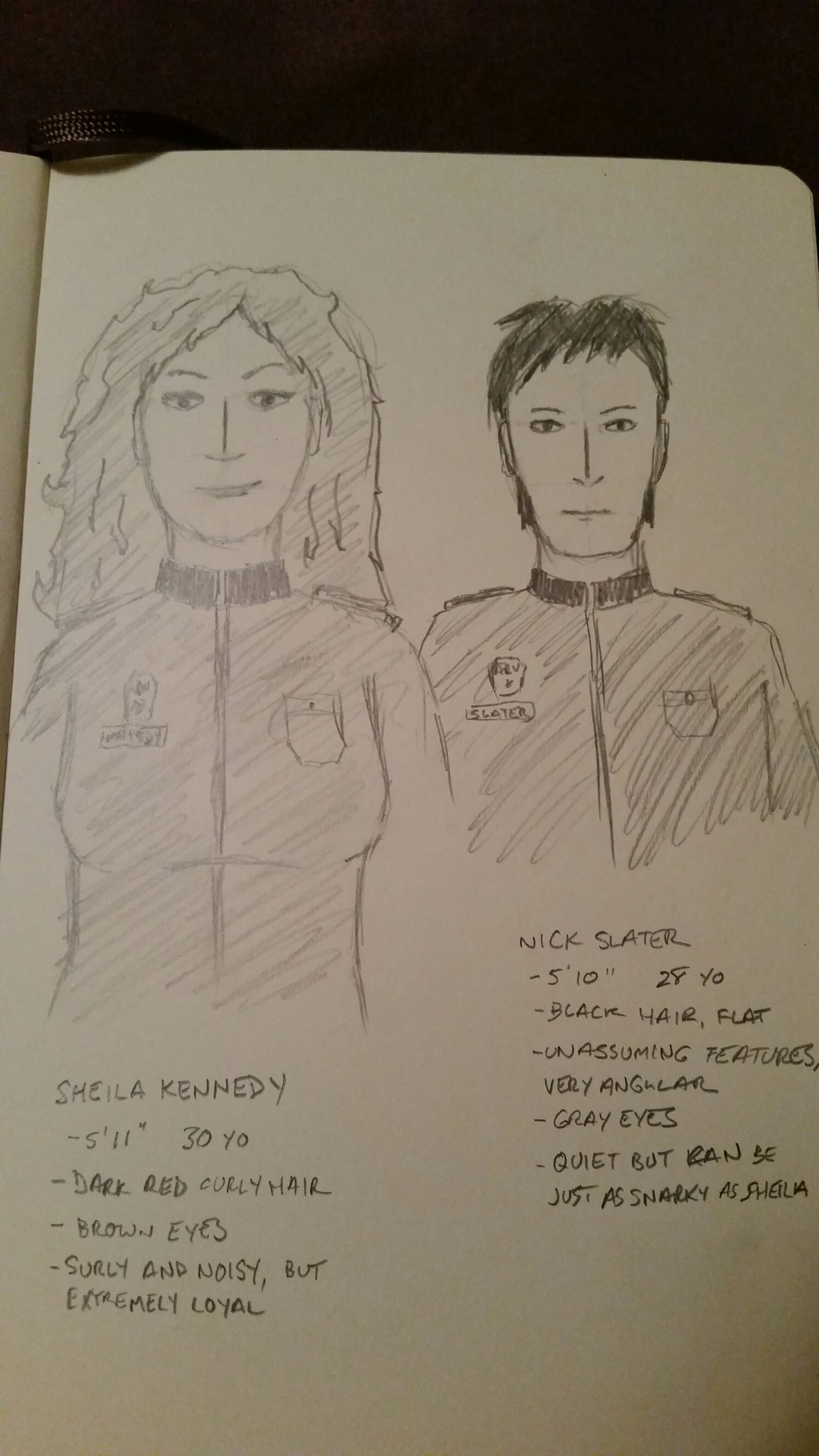
A two-fer this time, featuring Sheila and Nick. They’re Caren and Alec’s team two on the ARU.  Admittedly rough (eyes and eye symmetry seem to be the hardest for me), but I like how they came out.  These two are my favorite secondary characters in the Bridgetown trilogy, as they seem to have that “we’re from a different book but somehow we got dropped here” aura about them.  They do have very important roles, however.

Sheila Kennedy is Caren’s former ARU partner; they split up while Caren was on LOA due to her parents’ deaths.  They have an extremely close friendship that transcends some boundaries — they were lovers for a very brief time as well — and though they are on separate teams now, they remain very close friends.  She’s that girl you knew in college who was loud and silly and friends with everyone, and you’d better be far away if you piss her off.  Her extrasensory abilities aren’t as strong as, say, Caren’s or Alec’s, but she has a knack for using them in unconventional ways to get the job done when need be.

Nick Slater on the other hand comes from the darker edge of Bridgetown; he was both part of the B-town Metro Police and a bodyguard for various government visitors.  He left the BMPD because he felt he could do more working for the Alien Relations Unit.  This is an interesting decision, considering unlike most of ARU agents, he shows no outward signs of having any extrasensory abilities.  He is, however, extremely observant and stronger than he looks.

Edit: I’ve gone back and done a bit of similar description for the Caren and Denni drawings, if you’re so interested.  It’s two entries below!

On Conlangs in Science Fiction: When Should a Writer Use It?

As you have seen here and here, the Mendaihu Universe has its own constructed language, or conlang. which I’ve chosen to use for the alien Meraladhza race.  Creating this ersatz language was not just a hella nerdy thing to do, but it was a lot of nerdy fun as well.  As noted in that previous blog post, there were two reasons for doing so:

1. To give the aliens their own language, pure and simple.  Once you read Douglas Adams’ The Hitchhiker’s Guide to the Galaxy, as a writer you can’t help but feel super-conscious about aliens being able to speak your native tongue so easily, and sometimes fluently to the point of using localisms, without thinking it’s a cop-out.  It’s a silly worry, as it’s widely accepted in the genre, expected even, for aliens from other worlds to be able to speak your language, or at least to have some sort of translating device.  Thus Adams’ brilliant sendup using the babel fish–it’s a brilliant satire of the old-school science fiction stories where the aliens somehow knew the Queen’s English upon first contact.

2. What if I wanted them to use their language?  In a way, I wanted to play around with the idea that our languages have permeated Anjshé, just as it has permeated ours–which is how a lot of real languages have evolved on Earth, anyway.  This is another reason I chose the aliens to have been among us for at least a few hundred years before the trilogy’s timeline; this would have given time for a bit of cultural bleedover to take place, including language.  The Meraladh would have picked up on various languages, and the Earth humans would have picked up on Anjshé, and both sides would have appropriated a few phrases into their own language at that point.

So if you’ve created a conlang for your novel or your created world, you may need to ask yourself: when is it needed?   In my opinion: when it’s needed within the context of the story.  Think about why you want to use the alien language–I mean, aside from “because it’s cool”, of course.  Give the language a reason for being there.

Say your main character is meeting up with your aliens for the first time, and he or she doesn’t know the language, or doesn’t have a translating device on them.  You could play up the tense moments by having them attempt to converse, never quite sure if they’re being friendly or aggressive.  Some writers have used this as an ongoing plot device, such as CJ Cherryh whenever she has the alien kif speak in her Chanur books.  Even Adams used this idea to amusing effect, having Arthur Dent hear a few moments of the Vogon language before Ford Prefect slams a babel fish into his ear; in the process, we find that the Vogons are not just horrible amoral aliens in general, but their language is so hard on the ears that it has literally caused other aliens to kill themselves rather than listen any further.

Within the trilogy, I use the Anjshé language only where it’s truly needed, specifically when a character is having an extremely emotional or spiritual moment.  It could be passive, such as when Alec Poe spits out the word pashyo (a general exclamation of surprise or frustration) whenever he’s annoyed with the situation.  Or it could be when Caren Johnson humbly apologizes to a Meraladian character with nyhnd’aladh…I am sorry, when she speaks out of turn and inadvertently says something hurtful.  I also use it whenever a character is performing some kind of spiritual action; just before a major ritual begins, I have Denni Johnson speak an entire introduction completely in Anjshé before she repeats it in English.  All these moments not just utilize the conlang to give the moment realism, but I’ve also given it a reason for being there:  as the Meraladians are a very spiritual people, so is their language, which they deem just as important as their actions.

*

As always, one major thing to remember about creating a conlang is to make it pronounceable to the reader.  Unless you’re creating a language that’s deliberately hard on the tongue and/or ears, such as Adams for his Vogons or Cherryh for her kif, you’ll want to voice them out as you create them.  If you can’t pronounce it without tripping over your tongue or your throat seizing on you, chances are good that your reader will have the same problem.

A few other hints to think about:

–Make some ground rules to keep it consistent.  As stated in a previous entry, the most common sounds in Anjshé are “mmh” and “aah”, as they are the sounds of the spirit at rest.  Creating these kinds of rules will show that you put effort into this conlang, that you’re not just making it up as you go along.

–Study up on real foreign languages–or even your own native tongue–as a way to see how and why that culture created its vocabulary.  Anjshé is partly inspired by real languages that create new words through existing shorter words, like some Japanese and German; it’s also partly inspired by the aural flow of Gaelic.  In this process, keep in mind how these new words will affect your characters:  how would they deliver them, and is there a specific reason why they are saying them?

–Create a primer or a glossary that you can always refer to while writing to help you remain consistent in usage as well as in spelling.  You may even want to add these words to your word processor’s dictionary to avoid the auto-correct kicking in.  Additionally, you can use this glossary as part of your novel’s endnotes so the reader can refer to it when necessary.

–Have fun with it and see where it leads you!  Don’t think of it as your boring homework from high school–you’re creating not just new words here, but a new created culture, which you can then integrate into the novel itself.  This  will give your story more depth in the process, even if it’s just a short passage.  Readers will pick up on this and enjoy the reaction it causes.


Creating a conlang can be as detailed or as vague as you want and need it to be.  On the whole I believe I only have about seventy or so Anjshé words I created and added to the Bridgetown Trilogy, and used them only when necessary.  I left the door wide open for expansion, of course, and if that is part of your long-term goal, then by all means, go for it!

An Introduction to the Bridgetown Trilogy

Hi there, and thanks for sticking around!  And hello if you’re a new visitor!  Welcome to Bridgetown!

So…what is The Bridgetown Trilogy, you say? Where is this mythical B-Town?  And why does the banner picture of the city look suspiciously like downtown Los Angeles as seen from the Getty Museum?  What is this trilogy all about anyway?

Well–it’s high time I give you the rundown.  The one-sentence pitch that I’d come up with, which I’m currently using:

Caren Johnson’s younger sister has been forcefully awakened as a powerful and supernatural deity, revered by multiple worlds…and a war has just been declared in her name.

Nice kicker, eh?  I’d like to think so.  [Mind you, that was probably the hardest damn thing to create.  I’m not one for brevity.]

So let me give you the situation:  Caren Johnson is an elite member of a special branch of the Bridgetown Metro Police called the Alien Relations Unit.  With the humanoid Meraladzha living among us, the ARU has been tasked with keeping the peace between aliens and humans.   She’s proud of her work; she’s followed the career paths of her parents, Aram and Celine, both highly revered and decorated ARU agents.  They were both killed in the line of duty five years before the events that take place in the trilogy.  She’s become the legal guardian of her younger sister Denni, a precocious and very intelligent fifteen year-old, and she loves her dearly.  Caren does her best to balance life and work, but because of her parents’ history, they sometimes blur…

Aram and Celine were also a part of an elite force called the Mendaihu–a collection of supernaturally strong and highly spiritual people whose primary goal is to protect the planet…not just the humans and the aliens, but their souls within as well.  The reasons for their deaths had never been officially released publicly, but Caren knows why; they were protecting their daughters from a potential evil that had come to kill them.

Caren fears she will become Mendaihu as well, for it’s in her soul and in her blood.  But what she fears most is when Denni ‘awakens’ to her own Mendaihu powers.   Her one wish is to let Denni live a normal life without such heavy responsibility.

Nehalé Usarai, a rebel Meraladian and an one of the strongest Mendaihu in the province, has other plans.  He knows Denni’s fate…but he also knows that she’s the current incarnation of the One of All Sacred, one of the highest revered deities in Meraladh history.  He performs a dangerous and potentially lethal Awakening ritual, and in the process not only awakens Denni, but a large swath of Bridgetown as well.  He knows this is dangerous, but he fully believes that she will bring peace and balance to the world.

The only thing that could stop her is an equally strong and formidable force called the Shenaihu; they are the yang to the Mendaihu yin, their spiritual opposite.  When one acts, the other must act in kind to retain the balance, or the both the physical and the spiritual world could spiral out of control.

Both sides have other plans, despite the balance.  It will be up to Denni, Caren, and a host of others, both awakened and not, to ensure that the balance returns.

The story takes place over three books:  A Division of Souls, The Persistence of Memories, and The Process of Belief.   It’s about many things: belief, patience, clarity, and love.  It’s about physical and spiritual evolution.  It’s about family.  If I had to whittle it down to a single sentence, I would say this: it’s about devotion to oneself despite outside influence.


*   *   *

At this time, the first book has been submitted to a potential publisher, and I’m currently awaiting a response.  I’m keeping my options open, but my aim is to have the trilogy published by a professional house.

Here’s to hoping!

[Request] On Writing: The Long Haul

From Amy, a friend and fellow writer in Houston:

[Talk to me about] developing a writing practice that lets you complete a large work.

The short answers? Give up watching TV and hole yourself up at your writing nook for a few hours every night. Immerse yourself into the created world as often as you can–this includes thinking about it while you’re at work, and writing down notes on scraps of paper during down times. Stay up way too late on the weekends so you can write for hours at a time. And above all, write EVERY NIGHT for at least two hours. In other words, dedicate way too much of your time to it. It’ll drive you nuts, you’ll want to give up and erase the damn thing from your memory, but if you persevere, the payoff will trump all that. Oh–and don’t think too seriously about publication until it’s done and revised. [I made an error in that last part and sent it out well before it was ready a few times.]

But more seriously…

The Bridgetown Trilogy was started around 2000 or so, after a number of months trying to rewrite and revise its predecessor, The Phoenix Effect. That novel was to be the first in a trilogy as well, and about thirty or so pages were started on its sequel, before I realized I was going in the wrong direction and would need to seriously revise and rewrite the whole thing. There were just too many problems with it: too many holes in the plot, too many tropes that wouldn’t age well, and background that was shoehorned in where it didn’t belong. And worst of all, the prose was weak. Really weak. I’m talking barebones description, hokey dialogue, and subplots that led nowhere. Frustrated and annoyed but full of New Englander stubbornness, I chose to start from the beginning again. Yes–start the whole damn thing over from scratch.

I say this, because this is when I created the writing practice that I still employ today.

I was incredibly lucky in that I could create time for this…one of the most irritating parts of dedicating time for writing is finding that time, which can be incredibly tough when one is working eight hours a day, even more so when a commute is involved. I was lucky in that my warehouse job was purely physical with very little need for heavy duty problem solving, so I could actually think about my writing while I stacked boxes on pallets. I was also lucky in that I had super early hours, 6am to 2pm, which gave me the entire afternoon and evening to do what I wanted. Once I restarted the trilogy, I chose to set up a strict writing time of 7pm to 9pm every night, no exceptions (this included weekends as well) and would do nothing except working on the trilogy project. As my family had dinner around 5pm, more often than not I’d start at 6 instead, giving me a good three-hour block. [Okay, I would often spend twenty minutes at the start goofing off, deciding what music I’d listen to (often the new releases I’d bought that week), and playing a few rounds of FreeCell, but I’d get there soon enough.] Things have obviously changed since then, but I still try to utilize my time the best I can. I can’t stress enough how important it is to dedicate time solely to your writing projects.

The other goal I had was that I would write at least a thousand new words every night. Sometimes I did more, sometimes less, but that was the goal I aimed for. This did a few things for me…first, it forced me to be more detailed in my prose. My previous works tended to be rather thin, lacking in detail and oomph; this goal forced me to look at how I described things, and how to make the scene glow. Second, it forced me to be prepared–I started sketching out quick outlines and notes a few scenes and chapters ahead that would come to me while I was at work, which I would use later on as a guide. Third, the more I hit this goal, the easier it felt. It may not have been perfect prose, but it was good, beefy prose that I could work with and revise later on. By the third or fourth month, I was consistently going over the word count, hitting 1200 to 1500 a day. I still kept the goal at a thousand words, however–as long as I hit that thousand, everything else was gravy.

All this writing time was focused solely on the trilogy, and this is one of the most important parts of the process: I’d fully immersed myself into the world on purpose. I continually expanded the created world, studying the lives of the characters and their actions and thoughts, and putting a sharp focus on how each plot arc unfolded. I thought of events that might not show up in the finished product. I did short writing exercises of writing from a character’s POV so I could understand them better. I drew maps of Bridgetown and various neighborhoods, and made notes about the surrounding megacities, and even touched a little on future sociology. I created backgrounds for the characters that had little to do with the trilogy (though in a few cases, I used the information as off-the-cuff description just to give them more life). In short: this was going to be an epic story, so I’d better be a supernerd about its background so I wouldn’t leave anything out or go in the wrong direction!

I did this for four years straight, almost without fail. I did have the occasional sick day or prior plans, of course. I felt a brief pang of guilt when I missed a day, but it wasn’t the end of the world. My writing nook was down in my parents’ basement at the time, and sometimes I’d have to work upstairs instead when it was too cold downstairs in the winter (that didn’t always stop me, however). And there were some days when I just wanted to be lazy or needed to give my brain a rest. It was exhausting at times, but it was also a hell of a lot of fun, and it made me enjoy the writing craft all that much more. I stopped around 2004 for a few reasons, both personal and writing-related. I won’t go into detail here, but suffice it to say, it was a great run, and I wrote two and three-quarters novels–the first two in the trilogy, and most of the third–during that time.

*

So…that was my previous writing practice. How is it now?

After a few dry years, I finally returned to the nightly work, and I’ve been doing it ever since. It’s changed a bit, obviously: instead of writing new words, I’ve been focusing on the completion and revision of the trilogy. I’ve had some professional critiquing done on it, which has helped immensely. For now, I merely focus at least an hour or so in the evening to work on my projects, and if I can squeeze in extra work here and there during the day, I will of course do so. I’ve also expanded on my writing environs: I work in the back room of our apartment, but I also work on the laptop in the living room, and have been known to work on a tablet on vacation, especially when flying cross country. I’ve always been able to write anywhere, given time and space and minimal interruption, and it’s a good habit to get away from your home base now and again to get used to different environments. The focus here is not where you write, but that you write.

Am I ever going to go back to the previous schedule? I sure hope so…it was hard and exhausting work, but it was fun and fulfilling as well. Once I’m caught up with this revision, I hope to start on new projects again. It won’t be exactly the same, considering I have a different work schedule and other personal non-writing things going on, but I do plan on ramping up the volume this year once the major revision project is done. I find I work best and enjoy writing the most when I’m running at top speed, losing myself in the craft (so to speak), even if it’s only for a few hours a day. And if I can expand that even more in the future, maybe to the point of paying full-time writing, so much the better. That’s a far goal, though…but one I’d like to eventually reach.

*

All that said…in answer to your question? There’s no ultimate answer, but the above is what worked for me. Find out what systems and habits work best, and continually improve and upgrade them as necessary. If you’re working on a large work, be prepared to go the distance with it, because it’ll certainly show either way. Immerse yourself in the world as much as possible (but don’t get hopelessly lost in it!). Pay attention to your world’s restrictions, but figure out how to break them when you need to. And keep tabs on everything, even the small stuff, because it may come in handy later on. Be a compulsive note-taker.

Treat writing as a guilty pleasure, like you’re getting away with it. Have fun with it, because if it ceases being fun, it’ll show. And if it gets that far, it’s not the end of the world–take some time off, distance yourself from it (even if that means working on something completely unrelated), and come back to it when you’re good and ready. You will, of course, need to look at it professionally for revision and submission purposes, and it’s fine to think about that, but don’t let that get in the way of creating the story in the first place.

And repeat and adjust as necessary. 🙂
On Holidays in the Mendaihu Universe

This occurred to me the other day, and it’s something that wasn’t touched upon directly in the Bridgetown Trilogy: in this universe, what with multiple deities and a Universal Goddess floating around, will there be any set-date holidays? The simple answer? Yes, Virginia, there will still be a Santa Claus.

The spirituality of the Meraladhza and Earth human does not affect any currently held religious beliefs, actually. As the alien spirituality is a tangible thing, something focusing on the actual soul and not the religious aspect, most if not all major religions of the day have accepted any Meraladian deities that have popped up, such as the Universal Goddess, the One of All Sacred, Saisshalé, and many others. Conversely, Earthbound Meraladians have embraced the holiday spirit, so to speak, having fully grasped and enjoyed the positive energies that so often come from it. Celebrations are often ramped up to go consecutive days, which encourages people to “unplug” from the day-to-day rush and also to visit friends and relatives they would not normally be able to visit due to time constraints.

In Bridgetown, another holiday tradition is to visit the month-long Winter Festival, which takes place at Kendall Fields, in the southeast section of Mirades Tower Park. This festival, created over a hundred years previous, has a longstanding tradition of bringing together all walks of life both human and alien, and all belief systems, to celebrate life and spirit. It features numerous concerts, plays and productions, entertainment galleries, and more.

More to Come:
–On Religion in the Mendaihu Universe
–On Faith: the Personal and the Religious