A Division of Souls: More Character Sketches

image

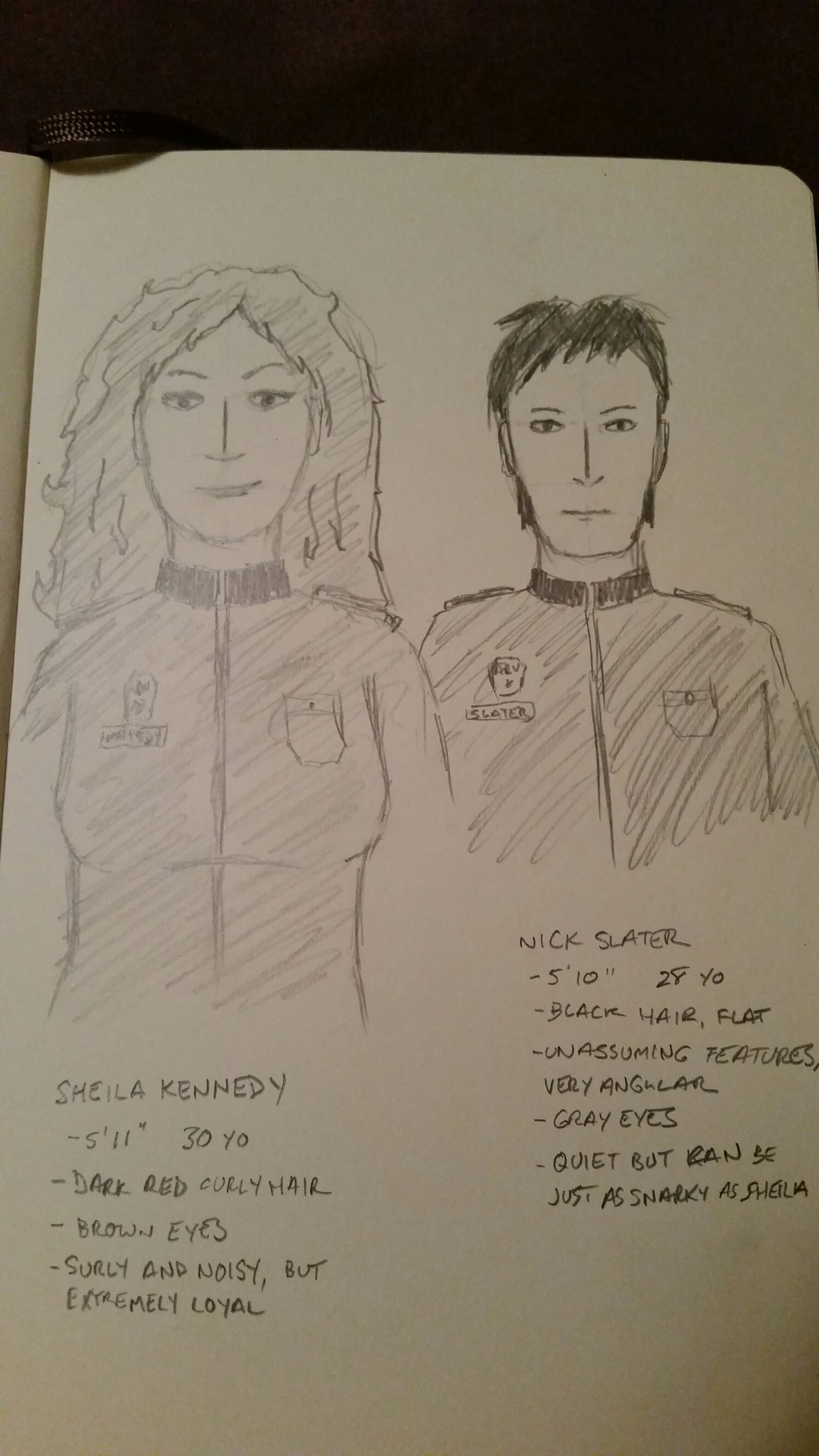
A two-fer this time, featuring Sheila and Nick. They’re Caren and Alec’s team two on the ARU.  Admittedly rough (eyes and eye symmetry seem to be the hardest for me), but I like how they came out.  These two are my favorite secondary characters in the Bridgetown trilogy, as they seem to have that “we’re from a different book but somehow we got dropped here” aura about them.  They do have very important roles, however.

Sheila Kennedy is Caren’s former ARU partner; they split up while Caren was on LOA due to her parents’ deaths.  They have an extremely close friendship that transcends some boundaries — they were lovers for a very brief time as well — and though they are on separate teams now, they remain very close friends.  She’s that girl you knew in college who was loud and silly and friends with everyone, and you’d better be far away if you piss her off.  Her extrasensory abilities aren’t as strong as, say, Caren’s or Alec’s, but she has a knack for using them in unconventional ways to get the job done when need be.

Nick Slater on the other hand comes from the darker edge of Bridgetown; he was both part of the B-town Metro Police and a bodyguard for various government visitors.  He left the BMPD because he felt he could do more working for the Alien Relations Unit.  This is an interesting decision, considering unlike most of ARU agents, he shows no outward signs of having any extrasensory abilities.  He is, however, extremely observant and stronger than he looks.

Edit: I’ve gone back and done a bit of similar description for the Caren and Denni drawings, if you’re so interested.  It’s two entries below!

A Division of Souls: Character Sketches

Something I’ve been doing lately as part of my whiteboard schedule is doing some kind of drawing at least once a week.  I’m trying to break out of my doodly comic style (I call it my “Murph” style after the character I used to draw in college) and attempt something a little more realistic.  The last few weeks I’ve been trying out characters from the Bridgetown Trilogy.

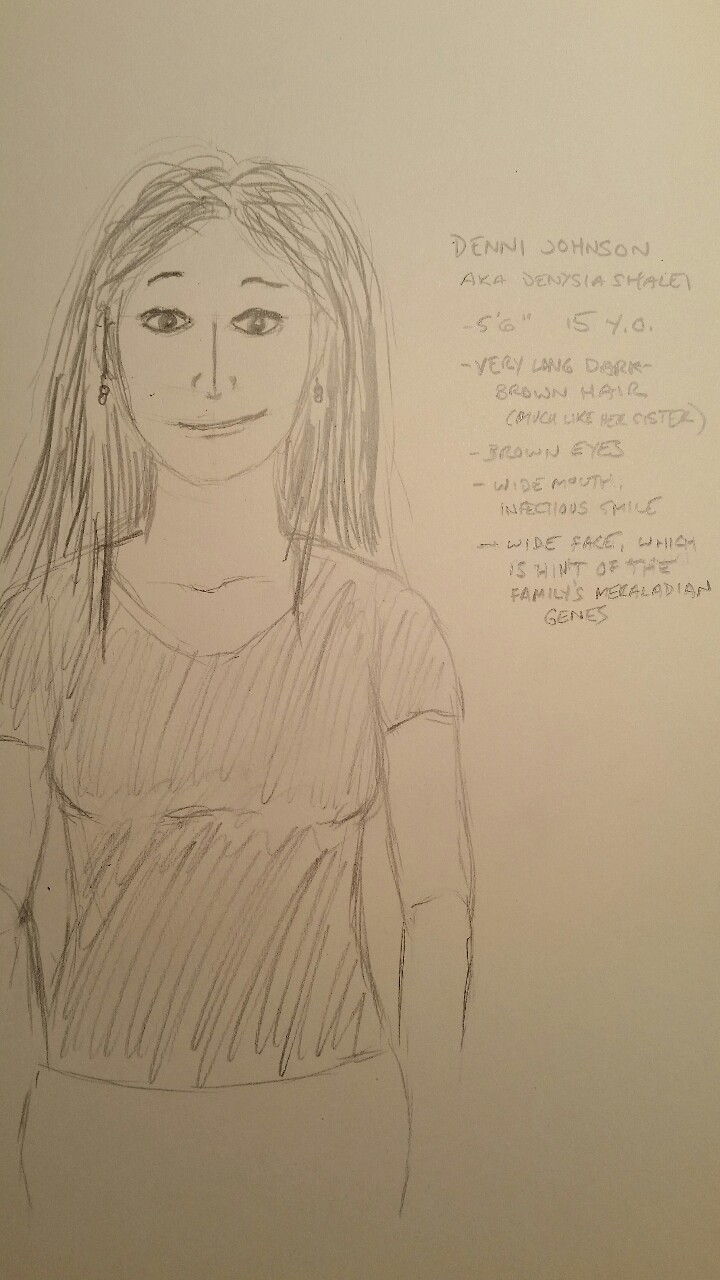
Here’s a perky looking Denni:

022415 Denni

Denni is an extremely intelligent girl for her age and nearly all of her classes are Advanced status.  She’s amiable with everyone, but she saves her real emotions for her closest friends, of which there are few.  Her closest friend is a boisterous and diminutive girl named Amna Ehramanis, a half-blood human (she has both Earther and Meraladian blood from both sides of the family and damn proud of it).  She seems to have taken the deaths of her parents (also ARU agents) a bit better than Caren; she still mourns for them but instinctively feels that their spirits have remained close by to watch over them, and that has helped her heal.

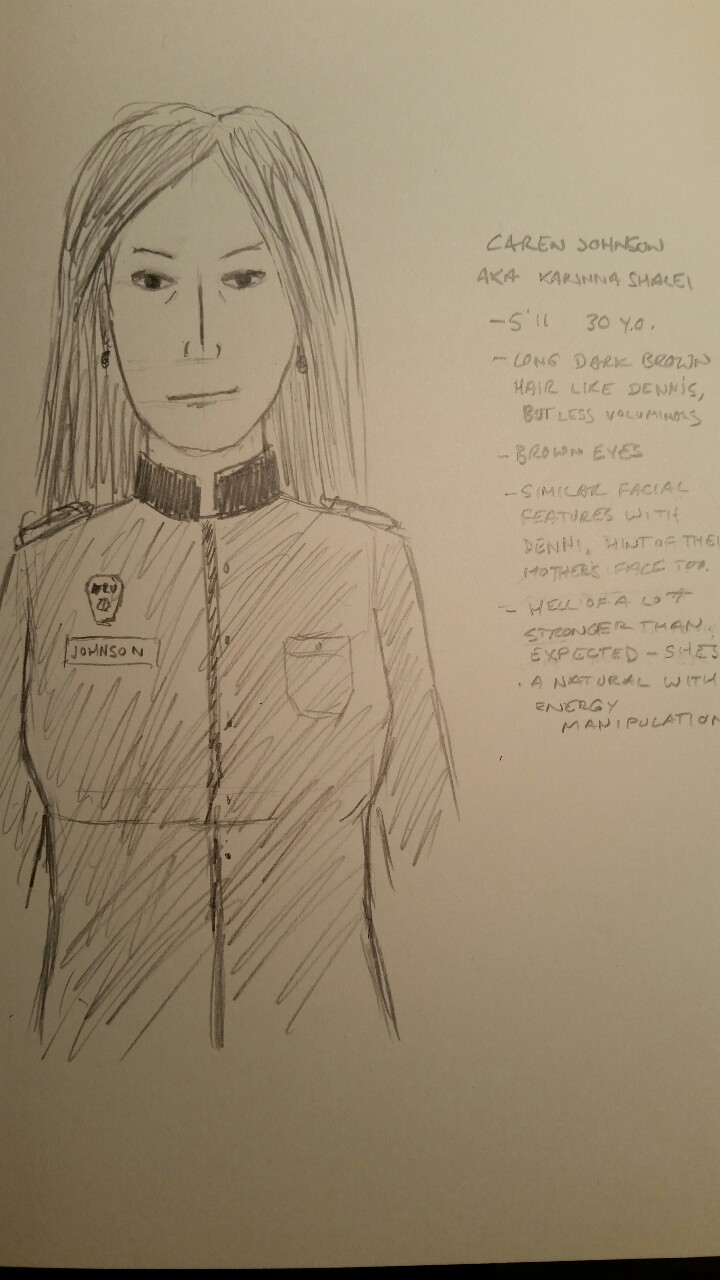
And here’s her older sister Caren, wearing her Alien Relations Unit uniform:

030315 Caren

Caren Johnson doesn’t look too happy here, and it’s because she hasn’t been truly happy for a long time, not since their parents died under questionable circumstances.  She herself did not know how they’d died while on a case until nearly six months later.  She’s healed somewhat, but she now feels frustrated and directionless, and feels she needs to do more to make everything right, especially now that she’s taking care of Denni.  Despite all that, she still cares deeply about her fellow ARU partners and everyone else close to her, and will go out of her way to do what is right for them.

This is actually kind of a fun exercise!  I know these characters so well, and yet all this time I never really got around to visualizing them in this manner.  [There’s also the fact that this is a half-serious attempt at drawing the characters for a possible webcomic version down the line, but that’ll be some time in the future.  For now I’m just trying to get them onto paper!]

I will of course add more sketches as they pop up!

On Reading: Be Not Afraid

I just finished reading AM Dellamonica’s Child of a Hidden Sea last night, and absolutely loved it.  It’s one of those books where you end up staying up past your bedtime so you can finish it up.  Fast-paced and fun, it straddles between YA and adult fantasy, following a girl named Sophie Hansa as she travels — first accidentally then purposely — to an alternate world full of magic, seafaring piracy, and family intrigue.

I mention this because I think it ties in nicely with a recent blog post by writer Shannon Hale called “No Boys Allowed: School visits as a woman writer”.  She talks of her tours of schools to talk about her Princess Academy books, specifically the problems she has at some schools where her audience is all (or nearly all) girls, with nary a boy in sight.  More to the point: the fact that the boys weren’t invited, or needing permission to join in.  It wasn’t just expected that boys would have no interest in a writer who writes about princesses…even if it was unintentional, they’ve also reinforced the idea that boys shouldn’t have an interest in stories about princesses.  It’s just not a manly thing to read, even if you’re 10.

This reminded me of an event in seventh grade, between myself and the school librarian.  [I mention it briefly in the comments section of Hale’s entry.]  They had this special event every month or so where kids could buy cheap paperbacks from a bookseller; they were your typical MG and YA novels, maybe some comic collections and kids magazines, that sort of thing.

I took an interest in that partly because my dad and I had started taking road trips on weekends to Northampton or elsewhere to stop at bookstores, and I’d pick up something to read every now and then.  This book club was an easy way for me to find more things to check out.

At the time, I was interested in a lot of YA novels from Apple Paperbacks and other publishers; the covers may have been kind of dorky and the stories somewhat simple (strangers following you, problems with your friends, having weird yet really cool magical abilities), but they were fun reads.  I knew pretty early on that I wasn’t that interested in stories about sports, or men of action, or any of those other typical boy-centric stories.  The reason was simple: I like a good story, regardless of the gender of the main character…but the subject has to interest me.  I wasn’t going to waste time reading about a kid trying to make the baseball team when I had no interest in baseball and sucked at it anyway.

Mind you, this was also the time where I’d started becoming interested in writing fiction.  The Infamous War Novel I started in 1984 was the first one I completed, but I’d had at least a dozen or so incomplete ideas dating back at least a few years earlier than that.  This had little to do with passive reading.  I was gravitating to what I knew I enjoyed and wanted to write.

So when I’d ordered a few of these Apple Paperbacks (including Willo Davis Roberts’ The Girl with the Silver Eyes — one of my first forays into the SF genre, come to think of it!), I was excited to start reading these things.  However…

However, the school librarian had side-eyed my choice in reading.  In fact, if I remember correctly she actually pulled me aside.  “Are you sure you want to read books like this?” she’d asked.  “Don’t you want to read about sports or spy novels?”  I stood my ground and kept reading these things, but there was something in the back of my mind that nagged at me: was I reading the wrong things?  Was it wrong for me to like books with female leads?  I shrugged that off just as quickly as it came, but that was probably the moment where I realized I would not be able to confide in this particular librarian.  After all, she was also the one who had seen me pick up a copy of James Fenimore Cooper’s The Deerslayer in the school’s library and asked if I would really ever get around to finishing it, considering it’s over five hundred pages long.  And now I had it in my head:  Would other boys think I was a fag (and I mean that in that wonderful 80s teen way) because I liked books about girls?  Did I have to keep these books to myself now, for fear that others would side-eye me as well?

She apparently had my number well before I had it myself.

The sad thing is, this was also right about the time where my attention span had started to wane.  Not out of any emotional or mental deficiency, but because I was starting to get bored.  I didn’t figure it out until many years later that my grades really started slipping right around that time because I’d lost interest.  I’d rather be listening to music or writing (yes, even then at 13…especially then) than reading some assigned book that I just didn’t want to deal with.  The end result was that I would end up with my first failing grade in my entire school career.  I got an F.  In English, of all things!  I wanted to be a writer and I loved reading!  What had happened?

Thankfully, I turned it around and managed to squeak by with a C- by the end of the semester and didn’t have to stay behind or take summer school. I knew I wasn’t dumb, I just needed to make a concerted effort to get the work done.  It was a slog and I did a half-assed job most of the time, but I did well enough to graduate with the rest of my class.

But the damage really had been done in junior high.  I don’t blame that librarian…she was of an older generation and was safe in her Boys Are Boys and Girls Are Girls world.  My bad grades were my own damn fault.  But if it wasn’t for my 7th grade English teacher assigning us Ray Bradbury’s Dandelion Wine (one of my all-time favorite novels), my mission to write and finish a novel, and a stubborn will to read what I wanted, I’d probably have done worse.  I remained a B- student pretty much all the way until I graduated college.  And I barely picked up a book for pure entertainment purposes, even though I was still attempting to be a writer…that wouldn’t happen until around 1995.

I know it sounds petty, but this is what happens when you throw preconceived expectations on kids of that age.  Let me explain — I know you mean well, and I can see where you’re coming from (even when the gender segregation is a dumbass thing to do).  You’re giving them anchors and guidelines, something for them to base their life experiences on.  You’re trying to train them to see potential roads they should follow for future education, and that’s a good thing.  But at the same time, you’re not paying attention to how the kids are processing it.  A. and I have similar tastes in some things, but wildly different tastes in others.  I don’t even have the same path of logic as she does half the time.  We should learn how to think critically, but we also have to remember that each person thinks, lives and reacts differently.

I like what I like, and I choose not to be afraid of admitting that.

This is also partly why I chose to put Denni and Caren Johnson as the most important characters of the Bridgetown Trilogy — I remembered those Apple Paperbacks (and I was reading Kate Elliott’s Jaran series at the time) and enjoyed reading female lead characters.  I had no other reason, political or feminist or what have you, for centering the story around them.  They. Are. Important. Characters.  And they were not extensions of me.  That’s all.

I know this is kind of a long diatribe, but I felt it was important to share.  I’d like to believe that the boundaries we should teach kids are not external such as gender roles or conformity, but internal, such as respect and awareness.  Read what you want to read.  Write what you want to write.  Learn what needs learning.  And don’t edit your reading preferences because of someone else’s opinions.

Be not afraid.

On Worldbuilding: Down the Rabbit Hole Willingly

It’s often said that the downside to worldbuilding is that sometimes we writers get caught up in it, to the detriment of the actual writing.  I’ll freely admit that creating a fictitious world is a never-ending source of fun.  The Mendaihu Universe has grown and evolved over the course of two decades, and even as the Bridgetown trilogy enters Submission Phase this year, I’m still coming up with new avenues, new details for it.  Just yesterday I started playing around with another MU story set on Mannaka, an outpost world mentioned on the periphery in the BTown trilogy.  For the love of my own sanity, why am I doing this?

Short and most obvious reason?  More stories!  Ever since the aborted True Faith novel, I’ve always planned on setting a number of books in the same universe.  Not always in the same fixed spot in the timeline, of course…the timeline for yesterday’s brainstorming is up to question, but it would be a few millennia either before or after the BTown events.  This was partially inspired by Anne McCaffrey’s Pern universe–I liked the idea of writing multiple stories in my own created universe.  Each story would stand on its own, but there would always be a reminder somewhere (either up front or in the periphery) of the spiritual evolution story that’s central to the Mendaihu Universe.

And I spent a lot of time between 1994 and 1997, the years before I started The Phoenix Effect, just playing around with the universe, coming up with various story ideas and plot points in the timeline.  I remember a lot of slow afternoons in the ticket booth at the theater (and later at the radio station) where I’d lay the ground rules for my universe, such as major world events, evolutionary steps, and so on.  Just enough to give me anchors for future projects.

I can understand when worldbuilding can be a writer’s downfall, of course; spending too much time on the minutiae and not enough on the prose, focusing too much on the history and not enough on the present.  Or worse, giving into the joy of worldbuilding so completely that doing the actual writing becomes less than exciting.  It becomes like Charles Foster Kane, focusing on building the empire and home, changing it and morphing it as time and whim permits, but never quite finishing it.

The trick is to balance it out…I can have a lush background history, but I have to do something with it.  I can create a sprawling city-province like Bridgetown, but I have to have something happen there in particular.  I can create various characters to act out my story, but I have to have them do something inherently them in the process.   And after all of that, while I’m writing the story, I have a background I can work with–I can put these characters through a historical event that will affect them in one way or another, which will in turn cause them to evolve somehow.

I learned this when I realized I could no longer get away with ‘making it up as I go along’.  I learned it with The Phoenix Effect, when I realized that there were way too many divergent plot points and “I’ll revise it later” moments caused by immediate worldbuilding, all of which caused the story to be full of holes and inconsistencies.  When I restarted with A Division of Souls I forced myself to focus on the created history I had, and if new points of reference came up I would make a concerted effort to ensure they made sense in the overall story.  [A great example of this is in Chapter 2, when Assistant Director Dylan Farraway states “…this certainly isn’t a Second Coming…” to which Alec Poe responds with an offhanded “Ninth, sir.”  It was a complete throwaway line at the time I wrote it, but as I continued writing, the Ninth Coming of the One of All Sacred became the most important plot point of the entire trilogy.]

Working with your worldbuilding is definitely a tricky business.  You have to make copious notes.  You have to have a very sharp memory of what you’ve written.  You have to make sure you don’t get lost in it.  But once you’ve found a way to successfully manage it and make your way through it, it’s quite possibly the most enjoyable part of the writing process.

On Writing in 2015: Schedules, Projects, and All Sorts of Things

20150101_160447a
The new whiteboard and my 2015 moleskine calendar notebook, hanging out with my Squier P-Bass.

I’ve been hinting at a new and improved writing process for a while now.  Taking a hard left and going in a completely different direction.  Looking at my creativity from a vastly different perspective.  Working with a new whiteboard schedule.  Being more consistent with updating my WordPress blogs.  Starting totally new projects, and seeing old ones off.

Well, it’s a little bit of everything, really.  Let’s just say I have a very busy 2015 ahead of me, in a positive way.

*  *  *

Let’s start with the new whiteboard.  [For those not too interested, scroll down to the next break for some fun news!]  Each day has something to do, as you can see from the picture…but noticeably missing is any mention of a main project.  This is a continuation from what I’d been doing with the previous whiteboard the last few months.  I know what main project I’m supposed to be working on, so I don’t feel I need to put add it to the board.  Also, I’ve decided that this is not going to be a “this is what I’m doing today” to-do schedule but a “this is due by today” deadline schedule.  This gives me more freedom to create something when I feel like it, and also gives me the impetus to create a surplus if need be (more on that in a few moments).  Here’s what I have set up:

Sunday: Welcome to Bridgetown blog.  Even though this blog is dedicated to the stories within the Mendaihu Universe that I’m writing, I will also be featuring more entries about the writing craft.  My weekend blog entries (such as on the good old LJ) tend to be longer and more contemplative, and channeling that into writing thoughts and MU extras seems like a good idea.

Monday: Storyboarding.  What is this, you say?  Am I thinking of going into film or animation?  Well, no, not as such, but this is something new I’d like to try out.  It’s an exercise in brainstorming.  It can be anything from brief outlining of a current work in progress to playing around with new ideas.  But yes, it could even include art!

Tuesday: Art.  Doing the Inktober meme last year definitely inspired me to start drawing again, so this is a reminder to keep that alive.  This will also serve as reminder to post any ongoing or finished artwork up on the Tumblr site.

Wednesday: Poetry.  I’m starting to be more consistent about this one lately, as I’ve often been using my daily word run on 750 Words as a playground for poetry ideas.  It might be just a few stanzas, or it might be epic in length, depending on the subject and what I want to write about.  These will most likely remain offline for now, although if I’m particularly proud of the end result, I may post it somewhere.

Thursday: Walk in Silence blog.  This one remains my all-purpose blog to write about music, and I felt that moving this to Thursday would be perfect, for two reasons:  One, new releases come out on Tuesdays and it sometimes takes me a day or so to connect with the ones I buy or download.  Two, because in my aim to become more consistent in my blogging, I’m going to be posting micro-reviews of new releases, alongside other music-related subjects I may want to talk about.  As with this blog, I’m planning on writing more entries than releasing them so I can create a backlog, and therefore have a more consistent release schedule.

Friday: Photos.  I’m continuing to get better at my photography, learning more how to tweak pictures using Photoshop, and so on, and I’d like to feature more pictures on my Tumblr.  Taking inspiration from a photographer I follow here on WP, I’d like to challenge myself by taking things other than panoramas or architecture; I’d like to try still life and nature, turn it more artistic, even if it’s just for practice.

Saturday: Music.  One major project for 2015: start recording!  I’ve got feasible software on my computer (Audacity), a small microphone, and a handful of song and melody ideas, so I think it’s high time I reignited the Drunken Owl project by making demos here in Spare Oom Studio.  I’m not planning on anything big, so it could be anything from short snippets to revisiting old Flying Bohemians tracks, and playing around with them.  I’d also like to do more research into more extensive software that could possibly let me record and mix multiple tracks.

*   *   *

I should also add that a good portion of this  year will also be spent submitting A Division of Souls to agents and publishers.  I’m hoping to get the Mendaihu Universe out into the wild within the next year or so.

All this, in conjunction to whatever main writing project I have going on.  And my day job.  And a personal journal.  And my daily words.  Did I manage to leave some time for eating and sleeping, and hanging out with Amanda?  Let’s hope so.

But wait, there’s more!

I’m proud to announce that I have not one but two self-published projects I’m planning on releasing into the world sometime this year as well!  I’m thinking epub at this point, although print could be involved, depending on which self-publishing company I end up working with to produce and release it.  These are two projects I’ve been working on over the last few years; one is complete and the other is about three-quarters of the way done.

The first will be a book version of Blogging the Beatles, the series I started over at the WiS blog a few years back, in which I listened and talked about the Beatles’ discography in chronological release order.  I had so much fun writing it, and learned so much musically as I studied the songs, that I felt it would be perfect for an ebook.  I’ll be revising it and adding new items as I do so, and hope to have this one out at least by midyear.

The second will be Walk in Silence itself.  This one’s the biggie.  I’m about three quarters of the way done on the more personal side of the story, with revision number two to add in more about the music.  This one may roll into 2016 if other issues pop up, but the aim is to get it out into the wild by autumn 2015.

Of course, releasing books about popular music could be tricky considering the rights involved, but since I’m not directly quoting the music but only commenting on it, I think I should be okay.  These are both books focusing on my love of music, in particular about a band and a genre that inspired me and shaped who I am.


So yeah…you should be seeing more of me here at Welcome to Bridgetown and elsewhere, so stick around–it’s gonna be a fun ride!

On Writing: Rejection Isn’t Always a Bad Thing

For those of you that have been following along for the last few years (or decade or so) with my grand scheme of getting the Bridgetown Trilogy published, today was an interesting day.

Angry Robot Books has had some kind of “Open Door” special event over the past few years in which they would accept unsolicited submissions* until a set date. As it so happened, I had just finished up a major revision of A Division of Souls, and thought this would be a perfect opportunity. I speedily worked through the rest of the revision and sent it in with about two weeks left to go before the December 31 deadline. You may have heard they had a bit of a business shake-up a few months ago**, which caused a significant delay in the reading and accepting process. I’m fine with that, especially as they took the time to follow up with an email informing us they would still read all the submissions.

This morning, I received an email stating that they have decided to pass on the novel.

Now, I’m well aware that this would most likely be the case, for a few reasons: a) they had over a thousand entries this time out (MUCH higher than previous Open Doors), b) digging through a high number of entries to find that one shining piece of gold is normal in the publishing biz, and c) I’ll readily admit that it could still use work. More on that in a few. The long and short of it is, this is not my first rejection, and will most likely not be my last. This is just part of the game.

Am I bummed? Of course, but not overly so. You might say I’m actually a bit relieved, as this gives me the freedom to tidy it up a bit more and shop it elsewhere now.*** Given that I’ve been working on this project off and on for way too long (twenty, seventeen, fourteen, or seven years, depending on the version you ask about and whether or not you count interim years of stasis), I’ve also been doing a lot of thinking about how I would want to see this book out in the wild. Between those years in the early 00’s where I sent it out to various agents and publishers, and now, where self-publishing has become a viable, more professional and accessible option, my options have actually expanded.

I’m actually kind of happy that Angry Robot took the time not only to read the first four chapters of A Division of Souls, but upon rejection went so far to state that they felt “the dialogue could use work, as it reads as too artificial, not natural enough” as part of the reason.

Honestly? That’s the best thing a publisher has ever said to me in all my years of being a writer.

In all the rejection letters I’ve ever received from both publishers and agents, I’ve only received the variation of the “not for us” form letter. Which is all well and good–I’m okay with those too, because I’m pretty sure they at least took a cursory look at it. But this is the first time I’ve actually received something that says “hey, it’s not for us…but here’s what you might want to fix/focus on in the future.”

To me, that means two things: they took my submission seriously, and that they took the time to let me know what didn’t work, even if it was one out of many possible issues that could be wrong with it. And that makes all the difference.

So what are my future plans for the Bridgetown Trilogy? Am I going to make good with the fake cover I made on the previous post and go self-pub? Am I going to be the stubborn bastard that I am, revise AGAIN and find a new home for it? It’s up in the air, really. I’m keeping my options open. Yet another recent reread has shown that some of the dialogue and prose is indeed a bit stiff, and oddly about halfway through, the default reaction for many characters seem to be that of sighing in frustration. Eesh!

One thing’s for sure, I’m not going to ragequit this writing life. I love it too damn much to give up now.

Learn from mistakes. Listen and process the critiques. And make the best damn piece of art you can.


* – For those unaware, ‘unsolicited submissions’ means that the publisher would accept manuscripts cold, rather than through agents or an agreed-upon offer. I highly suggest studying up on the submission guidelines of various publishers and agents to understand what’s needed–some want specific things and/or in specific formats, others will take printed copies, etc. Following their guidelines makes them happy and makes you look like a pro.

** – Short version: They closed down their YA and Mystery imprints earlier this year, and changed ownership last month. Not holding this against them, and I hope for the best, as they have quite a number of great titles out there that are definitely worth checking out.

*** – I would love to go into detail here about multiple submissions, but I’ll save it for a future entry. Suffice it to say, I purposely waited on this one to force myself to start working on other projects on the interim, which has worked out well so far.

Writing Soundtracks

Most of you out there know that, aside from being a writer, I’m an incurable music fan.  Not a day goes by where I’m not listening to some radio station or some new album I downloaded that week.  I laugh at polls that ask if I listen to music more than a few hours a day–it’s more like all day long.

This includes my writing time.  I’m one of those writers who prefers to have some sort of music going while I’m writing.  What I listen to actually boils down to whatever project I happen to be working on.  I’m currently working on Walk in Silence, so the music of choice has been strictly 80s alternative.  For the most part I’ve been listening to the 1st Wave channel on our Sirius XM setup, where Swedish Egil and Dave Kendall have been providing me with tasty retro goodness for the last few months.  This is perfect for this first draft, as I’m not focusing too much on specific albums and songs at this time.  The second draft will focus more on that, so my soundtrack will focus more on my own mp3 collection.

The evening writing sessions down in the Belfry that produced The Phoenix Effect from 1997 to 1999 and the Bridgetown Trilogy from 2000 to 2004 had their own expanding soundtrack; the former contained a high amount of the free cds I got when I worked at HMV, and the later contained many of the titles I bought during my weekly journeys to Newbury Comics back when it was in Amherst.

Was the writing influenced by the music I bought?  Well, yes and no.  I didn’t go out of my way to look for the perfect song that would fit a specific scene, nor was I writing and editing a scene to a specific song in a Miami Vice-like manner.  I’d grown out of that habit a long time ago.  I merely found myself gravitating towards the moods the music created when I listened to them, and used that as a mental anchor when I needed it.

When I was writing a number of scenes that needed personal and emotional tension, I would often throw on Dishwalla’s And You Think You Know What Life’s About.  If it was an epic action scene, it would be Failure’s Fantastic Planet.  Global Communication’s two albums 76:14 and Pentamerous Metamorphosis fit the bill perfectly when I was writing about the world of Trisanda.  Trip-hop like Massive Attack and Sneaker Pimps worked good when I was writing about the seedier areas of Bridgetown.  I also had certain go-to bands whose entire discography worked, like Porcupine Tree.

I always made a conscious effort never to let the music interfere with the story; I tried not to write scenes that lost their energy when the music wasn’t playing.  If anything, the music served as an anchor, giving  me something to focus on, something to aim for.  Failure’s epic album closer “Daylight” served as the audio anchor for the final scene in A Division of Souls–I needed something desperate and angry and with a hint of fear that would mirror what was going on during those final pages, and I think that it paid off.

Now that I’m working on a project that’s specifically about music, I have every reason to listen to whatever I like.  Whatever my next writing project is, will I have the same listening habits during my writing sessions?  Who knows, but I’m pretty sure something will be playing.

[Request] On Writing: The Long Haul

From Amy, a friend and fellow writer in Houston:

[Talk to me about] developing a writing practice that lets you complete a large work.

The short answers? Give up watching TV and hole yourself up at your writing nook for a few hours every night. Immerse yourself into the created world as often as you can–this includes thinking about it while you’re at work, and writing down notes on scraps of paper during down times. Stay up way too late on the weekends so you can write for hours at a time. And above all, write EVERY NIGHT for at least two hours. In other words, dedicate way too much of your time to it. It’ll drive you nuts, you’ll want to give up and erase the damn thing from your memory, but if you persevere, the payoff will trump all that. Oh–and don’t think too seriously about publication until it’s done and revised. [I made an error in that last part and sent it out well before it was ready a few times.]

But more seriously…

The Bridgetown Trilogy was started around 2000 or so, after a number of months trying to rewrite and revise its predecessor, The Phoenix Effect. That novel was to be the first in a trilogy as well, and about thirty or so pages were started on its sequel, before I realized I was going in the wrong direction and would need to seriously revise and rewrite the whole thing. There were just too many problems with it: too many holes in the plot, too many tropes that wouldn’t age well, and background that was shoehorned in where it didn’t belong. And worst of all, the prose was weak. Really weak. I’m talking barebones description, hokey dialogue, and subplots that led nowhere. Frustrated and annoyed but full of New Englander stubbornness, I chose to start from the beginning again. Yes–start the whole damn thing over from scratch.

I say this, because this is when I created the writing practice that I still employ today.

I was incredibly lucky in that I could create time for this…one of the most irritating parts of dedicating time for writing is finding that time, which can be incredibly tough when one is working eight hours a day, even more so when a commute is involved. I was lucky in that my warehouse job was purely physical with very little need for heavy duty problem solving, so I could actually think about my writing while I stacked boxes on pallets. I was also lucky in that I had super early hours, 6am to 2pm, which gave me the entire afternoon and evening to do what I wanted. Once I restarted the trilogy, I chose to set up a strict writing time of 7pm to 9pm every night, no exceptions (this included weekends as well) and would do nothing except working on the trilogy project. As my family had dinner around 5pm, more often than not I’d start at 6 instead, giving me a good three-hour block. [Okay, I would often spend twenty minutes at the start goofing off, deciding what music I’d listen to (often the new releases I’d bought that week), and playing a few rounds of FreeCell, but I’d get there soon enough.] Things have obviously changed since then, but I still try to utilize my time the best I can. I can’t stress enough how important it is to dedicate time solely to your writing projects.

The other goal I had was that I would write at least a thousand new words every night. Sometimes I did more, sometimes less, but that was the goal I aimed for. This did a few things for me…first, it forced me to be more detailed in my prose. My previous works tended to be rather thin, lacking in detail and oomph; this goal forced me to look at how I described things, and how to make the scene glow. Second, it forced me to be prepared–I started sketching out quick outlines and notes a few scenes and chapters ahead that would come to me while I was at work, which I would use later on as a guide. Third, the more I hit this goal, the easier it felt. It may not have been perfect prose, but it was good, beefy prose that I could work with and revise later on. By the third or fourth month, I was consistently going over the word count, hitting 1200 to 1500 a day. I still kept the goal at a thousand words, however–as long as I hit that thousand, everything else was gravy.

All this writing time was focused solely on the trilogy, and this is one of the most important parts of the process: I’d fully immersed myself into the world on purpose. I continually expanded the created world, studying the lives of the characters and their actions and thoughts, and putting a sharp focus on how each plot arc unfolded. I thought of events that might not show up in the finished product. I did short writing exercises of writing from a character’s POV so I could understand them better. I drew maps of Bridgetown and various neighborhoods, and made notes about the surrounding megacities, and even touched a little on future sociology. I created backgrounds for the characters that had little to do with the trilogy (though in a few cases, I used the information as off-the-cuff description just to give them more life). In short: this was going to be an epic story, so I’d better be a supernerd about its background so I wouldn’t leave anything out or go in the wrong direction!

I did this for four years straight, almost without fail. I did have the occasional sick day or prior plans, of course. I felt a brief pang of guilt when I missed a day, but it wasn’t the end of the world. My writing nook was down in my parents’ basement at the time, and sometimes I’d have to work upstairs instead when it was too cold downstairs in the winter (that didn’t always stop me, however). And there were some days when I just wanted to be lazy or needed to give my brain a rest. It was exhausting at times, but it was also a hell of a lot of fun, and it made me enjoy the writing craft all that much more. I stopped around 2004 for a few reasons, both personal and writing-related. I won’t go into detail here, but suffice it to say, it was a great run, and I wrote two and three-quarters novels–the first two in the trilogy, and most of the third–during that time.

*

So…that was my previous writing practice. How is it now?

After a few dry years, I finally returned to the nightly work, and I’ve been doing it ever since. It’s changed a bit, obviously: instead of writing new words, I’ve been focusing on the completion and revision of the trilogy. I’ve had some professional critiquing done on it, which has helped immensely. For now, I merely focus at least an hour or so in the evening to work on my projects, and if I can squeeze in extra work here and there during the day, I will of course do so. I’ve also expanded on my writing environs: I work in the back room of our apartment, but I also work on the laptop in the living room, and have been known to work on a tablet on vacation, especially when flying cross country. I’ve always been able to write anywhere, given time and space and minimal interruption, and it’s a good habit to get away from your home base now and again to get used to different environments. The focus here is not where you write, but that you write.

Am I ever going to go back to the previous schedule? I sure hope so…it was hard and exhausting work, but it was fun and fulfilling as well. Once I’m caught up with this revision, I hope to start on new projects again. It won’t be exactly the same, considering I have a different work schedule and other personal non-writing things going on, but I do plan on ramping up the volume this year once the major revision project is done. I find I work best and enjoy writing the most when I’m running at top speed, losing myself in the craft (so to speak), even if it’s only for a few hours a day. And if I can expand that even more in the future, maybe to the point of paying full-time writing, so much the better. That’s a far goal, though…but one I’d like to eventually reach.

*

All that said…in answer to your question? There’s no ultimate answer, but the above is what worked for me. Find out what systems and habits work best, and continually improve and upgrade them as necessary. If you’re working on a large work, be prepared to go the distance with it, because it’ll certainly show either way. Immerse yourself in the world as much as possible (but don’t get hopelessly lost in it!). Pay attention to your world’s restrictions, but figure out how to break them when you need to. And keep tabs on everything, even the small stuff, because it may come in handy later on. Be a compulsive note-taker.

Treat writing as a guilty pleasure, like you’re getting away with it. Have fun with it, because if it ceases being fun, it’ll show. And if it gets that far, it’s not the end of the world–take some time off, distance yourself from it (even if that means working on something completely unrelated), and come back to it when you’re good and ready. You will, of course, need to look at it professionally for revision and submission purposes, and it’s fine to think about that, but don’t let that get in the way of creating the story in the first place.

And repeat and adjust as necessary. 🙂
On Conlangs: Creating a “Constructed Language” for the Mendaihu Universe

The Anjshé language I created for the Bridgetown Trilogy didn’t come about well until about 2002 or so, when I was rewriting Book I, A Division of Souls and also working on Book II, The Persistence of Memories. As the revised plot moved further into alien relations and advanced spirituality, I’d decided to make the move of giving the Meraladhza a native tongue.

Creating an invented language is always a detailed undertaking, and one that has to be taken somewhat seriously. You can’t merely select sounds at random without giving them some semblance of order. And most of all, they need to be pronounceable, or at least pronounceable to the characters who will use them as a first language.

Then there’s the basic ground rules. I’ve heard it suggested that the best way to try out your new words is to pronounce them yourself; if you can’t get your mouth around it, chances are neither can the reader.

Some, like I did, will go a few steps further and decide what will be the most common sounds and letters. In English, “e” is the most common letter and the mid-central vowel “ə” is the most common sound.

In Anjshé, I’d decided that the most common letters/sounds are A/”ah” and M/”mmm” (note: not “emm” but a humming sound); I chose these as the most relaxed sounds in Meraladhza history, given their spiritual background. Thus there are a lot of Meraladian names and Anjshé words with these two letters and sounds.

The other ground rule was the way words were built. Anjshé was inspired partly by the process in which many real languages have words primarily created out of smaller mono- or duosyllabic words.

My starting point, I’d decided, would be the Anjshé equivalent of “I think, therefore I am.” I wanted the first alien words spoken to us humans to be along the lines of “we exist as well.”  In a notebook I wrote the following words:

dehndarra Né hra nyhndah

[Mind you, I didn’t have specific words in mind, I just wanted something where the sounds hinted at perceived meaning, and sounded mystical without being too derivative. More on this momentarily.]

Next, I broke it down to mono- or duosyllabic words:

dehn – darra – Né – hra – nyhn – dah

Let’s start with the second word. Né [/nay/] was the one I’d chosen as the pronoun. And since only this word is capitalized, it was an important pronoun…but it wasn’t going to be “I” or “me”. It was going to refer to the One of All Sacred, the deity these aliens revered. This is the reason why only that word is capitalized–only names and spiritual nouns should be such, to denote their importance.

Now to the next few words. hra [/hrah/] (the initial ‘h’ is more exhalation than a laryngeal sound) I felt was a “small but mighty” type of word, so I chose that to be the all-important verb “to be”.

dehndarra [/denn-DARR-ah/] I chose to use as the verb “to believe”. I then split it into two syllables and created two more words. “dehn-“ was a shortening of dayen [/DAY-en/] meaning the verb “to know”, and “-darra” being a shortening/mutation of the next word up there, “nyhndah”. nyhndah [/n’YIN-dah/] is an extremely important word in this universe–it means heart, or spirit. [Thus, dehndarra = dayen + nyhndah = “to know in one’s heart” = to believe.]

So literally, it translates “to believe One to be in spirit”.

From the other end, I deliberately chose dehndarra Né hra nyhndah to mean “To know oneself is to be One in Spirit” in its intent. It’s an extremely loose literal half-translation, so that left an opening for the other half–the unspoken intent.

This is where I came up with the idea that it wasn’t just the words that were spoken, but the emotional/spiritual intent behind the words that gave Anjshé the rest of its meaning. This fit in quite nicely with my aliens having heightened extrasensory awareness–they were able to not just voice their thoughts, but to transmit them voicelessly as well. This is why Anjshé sentences don’t start with a capital letter, as capitalization there is considered superfluous.

And that’s how I created Anjshé.

(Note: The word “Anjshé” is also part of this created language–it comes from “anjh” [/ahng/] meaning ‘word’ and “Shé” [/shay/], the feminine form of Né. So thus: “Anjshé” [/ahng-SHAY/] literally means “word of the One of All Sacred”.  The spiritual capitalization was merely moved to the start of the word.)

*   *   *

More to Come:
–On Conlangs: An Anjshé Primer
–On Language in the Mendaihu Universe: Speaking and Innerspeak

On Spirituality in the Mendaihu Universe: alien and human relations

Many of you have already heard versions of the story as to how I came up with the spiritual setting in the Mendaihu Universe–short version, I was inspired by my own attempts at spiritual enlightenment in the mid- to late-90s, specifically when I started focusing on New Age philosophies. Some of these ideas raised the question as to where souls came from, such as other realities or other planets. I not only found this an interesting twist on spiritualism, but I felt this would be an interesting idea for the basis of a belief system in a novel or a series. That was sometime around 1996-1997, and it evolved over the years between writing the original story The Phoenix Effect (more on that book in a future post) and the finished product. Most of the connections to the original inspiration have gone away, though the general idea remains:

What if the souls of Earth humans really did come from elsewhere?

Which led to many related questions: What is the connection to Earth? Why did these souls choose this planet out of any of the habitable ones in the universe? What is the physical relationship between Earth and this “homeworld” planet? How would it relate to physical, tactile, logical reality?

And lastly, what would happen when we re-established contact with that homeworld?

It took me a good number of years and novel drafts to figure that out.

In the timeline for A Division of Souls, we’ve already been in contact with the Meraladhza for at least three centuries.  First Contact took place in somewhat mundane situations, via long distance communication only. It took nearly a full century before these very humanlike aliens worked with us to facilitate a First Landing. By that time, a few things took place: firstly, the human race on Earth had time to come to terms with The Other Being Out There in the Cosmos to some extent. The cold and true fact that there really are others out there, not to mention that we’d been given proof that we really are all but an infinitely small percentage of all life in the universe, had humbled us deeply. Secondly, these human aliens were just like us in almost every way except for when it came to the inner Self–their inherent spiritualism taught us new ways to overcome (or at least assuage) our Fears of the Other. This was another surprising point in history, considering our own haunted pasts; to put it bluntly, we’d finally had a grown-up put us in our place. [This isn’t to say we finally got rid of wars and extremism and what have you; it’s more that we gradually learned to better chose our fights, and fight them for smarter reasons, with less destruction and fallout.]

The third and the most important point is that, sometime about twenty to thirty years after the First Contact, the Meraladhza explained just who they were: our distant ancestors. [Part of the delayed revelation was rightly and understandably to soften the blow.] There was, of course, a lot of argument and theorizing here: how could the Meraladzha, even when they were so biologically, physically and mentally just the same as us, be our ancestors when we’ve had centuries of Darwinian evolutionary theory to (sort of) prove our own existence? The answer was twofold: physical and spiritual evolution. Physical: the Meraladhza “seeded” our planet quite far back in our history–itself full of holes due to the ravages of time and erosion of known histories–far enough that we had no knowledge nor proof or idea of it. [Yes, that’s a bit vague, but it’s worth focusing on in a later post.] Spiritual: the Meraladhza also instilled a spiritual presence, the human soul, here on the planet. To the Meraladhza, they felt it more important that we be cognizant of our spirit, even if it was the simple “who am I?” question. The remaining seventy or so years before First Landing were spent with alien and human in constant communication, learning about each other like long-separated siblings finally reunited. By the time they arrived, we were all more or less back on the same page.

In the Mendaihu Universe, this spiritualism is one of the strongest traits for both the Meraladhza and the Earth human. By ‘spiritualism’ I mean a deep understanding and reverence for the soul within; it is a Zen of sorts, a highly dedicated and conscious understanding of who we are and our effect on others. Over the years since First Contact and especially after First Landing, many were willingly ‘awakened’ to our ancient Meraladian memories, and with such awakenings came heightening of the senses. To our vision came Veilsight, the ability to view spiritual activity on a heightened level; to our hearing came innerspeak, the ability to hear and subvocalize communication; to our sense of touch came soulsensing, the ability to reach out and “touch” other spirits with our own. Some come into this heightened awareness on their own; others need training and/or awakening ritual; it is a highly regulated and monitored process. Regardless, over the past three centuries it has become an accepted and well-regarded state of being.

More to come:
–On Spiritualism: Mendaihu, Shenaihu, and cho-nyhndah
–On Spiritualism: Levels of belief and practice
–On Spiritualism: the Goddess, the One of All Sacred, and other deities