On Writing: A Room of One’s Own

20150111_161009a

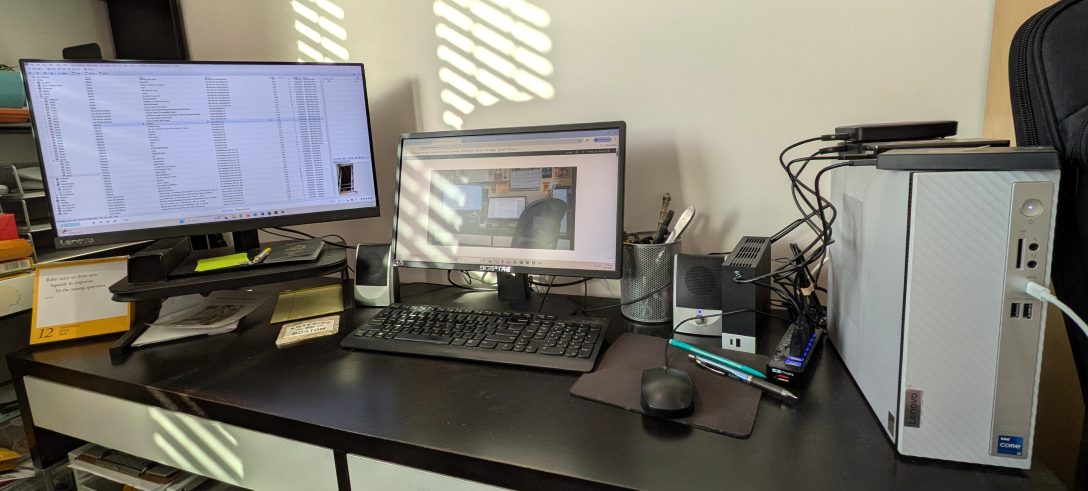
When we moved out here to the Richmond District of San Francisco, we ended up with a second bedroom, which has since been turned into an all purpose room: it’s my day job/writing office, our hardcover and trade fiction library, my music studio, and A’s knitting and canning stashery.  It’s a mite bit crowded in here, but I’m not complaining.  I’ve got my computer for my writing and my mp3 collection to entertain me.

Today was a day for cleaning and rearranging.  I’d just recently bought a new printer–specifically, a three-in-one printer-scanner-copier–and was in need of putting it somewhere central where A. could get at it if necessary.  Which meant getting rid of the old trusty printer I’d had since our last apartment (and still working fine, though the power button’s a bit wonky) and the scanner that for some reason no longer worked.  Which also meant finding a new spot for this new one, because it’s much bigger.  Which means I have to find something stable to put it on.  Which means a filing cabinet.  Which means getting rid of the filing boxes currently on the floor (or repurposing them for other things elsewhere). And the filing cabinet needs to mobile or at least on legs so the heater it’ll partially be blocking will have some place to push the heat directly without blockage.

And so on and so forth.  I had to think about five to ten steps ahead while planning out how to move everything around without cluttering up the room.  This is what happens when you have a finite amount of space to work with.  As you can see above, there’s a lot going in a small area.  A. pointed out last night that a goodly amount of the stuff in this room is indeed mine, and that, sadly, is the truth.  But from past experience I’m quite adept at getting maximum use out of minimum space.

The desk is a long and narrow one acquired from Ikea.  The left side is my home PC and other bits and bots, and the phone and laptop to the right is my Day Job stuff.  This works out perfectly as I get to focus on my job during the day but still get to listen to my music and take an internet break every once in a while.  And in the evening, my focus is on the left side of the desk, where I do all my writing.  And off to the far right of the picture, you can see the new cabinet and printer.  I still need to refile a number of things and move those file boxes in front of the bookshelf, but other than that I’m happy how it looks.  It took a good number of days and a lot of cleaning, but it worked out well, and no extra floor space was taken up.

It’s a small room, but it gets the job done.

On Worldbuilding: Down the Rabbit Hole Willingly

It’s often said that the downside to worldbuilding is that sometimes we writers get caught up in it, to the detriment of the actual writing.  I’ll freely admit that creating a fictitious world is a never-ending source of fun.  The Mendaihu Universe has grown and evolved over the course of two decades, and even as the Bridgetown trilogy enters Submission Phase this year, I’m still coming up with new avenues, new details for it.  Just yesterday I started playing around with another MU story set on Mannaka, an outpost world mentioned on the periphery in the BTown trilogy.  For the love of my own sanity, why am I doing this?

Short and most obvious reason?  More stories!  Ever since the aborted True Faith novel, I’ve always planned on setting a number of books in the same universe.  Not always in the same fixed spot in the timeline, of course…the timeline for yesterday’s brainstorming is up to question, but it would be a few millennia either before or after the BTown events.  This was partially inspired by Anne McCaffrey’s Pern universe–I liked the idea of writing multiple stories in my own created universe.  Each story would stand on its own, but there would always be a reminder somewhere (either up front or in the periphery) of the spiritual evolution story that’s central to the Mendaihu Universe.

And I spent a lot of time between 1994 and 1997, the years before I started The Phoenix Effect, just playing around with the universe, coming up with various story ideas and plot points in the timeline.  I remember a lot of slow afternoons in the ticket booth at the theater (and later at the radio station) where I’d lay the ground rules for my universe, such as major world events, evolutionary steps, and so on.  Just enough to give me anchors for future projects.

I can understand when worldbuilding can be a writer’s downfall, of course; spending too much time on the minutiae and not enough on the prose, focusing too much on the history and not enough on the present.  Or worse, giving into the joy of worldbuilding so completely that doing the actual writing becomes less than exciting.  It becomes like Charles Foster Kane, focusing on building the empire and home, changing it and morphing it as time and whim permits, but never quite finishing it.

The trick is to balance it out…I can have a lush background history, but I have to do something with it.  I can create a sprawling city-province like Bridgetown, but I have to have something happen there in particular.  I can create various characters to act out my story, but I have to have them do something inherently them in the process.   And after all of that, while I’m writing the story, I have a background I can work with–I can put these characters through a historical event that will affect them in one way or another, which will in turn cause them to evolve somehow.

I learned this when I realized I could no longer get away with ‘making it up as I go along’.  I learned it with The Phoenix Effect, when I realized that there were way too many divergent plot points and “I’ll revise it later” moments caused by immediate worldbuilding, all of which caused the story to be full of holes and inconsistencies.  When I restarted with A Division of Souls I forced myself to focus on the created history I had, and if new points of reference came up I would make a concerted effort to ensure they made sense in the overall story.  [A great example of this is in Chapter 2, when Assistant Director Dylan Farraway states “…this certainly isn’t a Second Coming…” to which Alec Poe responds with an offhanded “Ninth, sir.”  It was a complete throwaway line at the time I wrote it, but as I continued writing, the Ninth Coming of the One of All Sacred became the most important plot point of the entire trilogy.]

Working with your worldbuilding is definitely a tricky business.  You have to make copious notes.  You have to have a very sharp memory of what you’ve written.  You have to make sure you don’t get lost in it.  But once you’ve found a way to successfully manage it and make your way through it, it’s quite possibly the most enjoyable part of the writing process.

On Writing: Rejection Isn’t Always a Bad Thing

For those of you that have been following along for the last few years (or decade or so) with my grand scheme of getting the Bridgetown Trilogy published, today was an interesting day.

Angry Robot Books has had some kind of “Open Door” special event over the past few years in which they would accept unsolicited submissions* until a set date. As it so happened, I had just finished up a major revision of A Division of Souls, and thought this would be a perfect opportunity. I speedily worked through the rest of the revision and sent it in with about two weeks left to go before the December 31 deadline. You may have heard they had a bit of a business shake-up a few months ago**, which caused a significant delay in the reading and accepting process. I’m fine with that, especially as they took the time to follow up with an email informing us they would still read all the submissions.

This morning, I received an email stating that they have decided to pass on the novel.

Now, I’m well aware that this would most likely be the case, for a few reasons: a) they had over a thousand entries this time out (MUCH higher than previous Open Doors), b) digging through a high number of entries to find that one shining piece of gold is normal in the publishing biz, and c) I’ll readily admit that it could still use work. More on that in a few. The long and short of it is, this is not my first rejection, and will most likely not be my last. This is just part of the game.

Am I bummed? Of course, but not overly so. You might say I’m actually a bit relieved, as this gives me the freedom to tidy it up a bit more and shop it elsewhere now.*** Given that I’ve been working on this project off and on for way too long (twenty, seventeen, fourteen, or seven years, depending on the version you ask about and whether or not you count interim years of stasis), I’ve also been doing a lot of thinking about how I would want to see this book out in the wild. Between those years in the early 00’s where I sent it out to various agents and publishers, and now, where self-publishing has become a viable, more professional and accessible option, my options have actually expanded.

I’m actually kind of happy that Angry Robot took the time not only to read the first four chapters of A Division of Souls, but upon rejection went so far to state that they felt “the dialogue could use work, as it reads as too artificial, not natural enough” as part of the reason.

Honestly? That’s the best thing a publisher has ever said to me in all my years of being a writer.

In all the rejection letters I’ve ever received from both publishers and agents, I’ve only received the variation of the “not for us” form letter. Which is all well and good–I’m okay with those too, because I’m pretty sure they at least took a cursory look at it. But this is the first time I’ve actually received something that says “hey, it’s not for us…but here’s what you might want to fix/focus on in the future.”

To me, that means two things: they took my submission seriously, and that they took the time to let me know what didn’t work, even if it was one out of many possible issues that could be wrong with it. And that makes all the difference.

So what are my future plans for the Bridgetown Trilogy? Am I going to make good with the fake cover I made on the previous post and go self-pub? Am I going to be the stubborn bastard that I am, revise AGAIN and find a new home for it? It’s up in the air, really. I’m keeping my options open. Yet another recent reread has shown that some of the dialogue and prose is indeed a bit stiff, and oddly about halfway through, the default reaction for many characters seem to be that of sighing in frustration. Eesh!

One thing’s for sure, I’m not going to ragequit this writing life. I love it too damn much to give up now.

Learn from mistakes. Listen and process the critiques. And make the best damn piece of art you can.


* – For those unaware, ‘unsolicited submissions’ means that the publisher would accept manuscripts cold, rather than through agents or an agreed-upon offer. I highly suggest studying up on the submission guidelines of various publishers and agents to understand what’s needed–some want specific things and/or in specific formats, others will take printed copies, etc. Following their guidelines makes them happy and makes you look like a pro.

** – Short version: They closed down their YA and Mystery imprints earlier this year, and changed ownership last month. Not holding this against them, and I hope for the best, as they have quite a number of great titles out there that are definitely worth checking out.

*** – I would love to go into detail here about multiple submissions, but I’ll save it for a future entry. Suffice it to say, I purposely waited on this one to force myself to start working on other projects on the interim, which has worked out well so far.

On Writing: Determination and Distraction

Some of you may have seen my Twitter pic or my LiveJournal post last night regarding “the Return of the Whiteboard Writing Schedule.”  A few years back I bought one of those erasable whiteboards that has a calendar grid on it and stuck it on the wall, eye-level, in front of my desk.  I used to have one of these in the Belfry years ago as well, which I used as a way to remind me of due dates and deadlines.  It worked out pretty well then, and figured it would be good to have again.

When I first put it up, I came up with the idea of giving myself a strict writing schedule.  Two reasons for this: my writing time is not as concrete as it used to be, and I find that I’m more productive when I give myself a specific schedule in which to do things.  This was proven during the Belfry years when I consistently hit a high word count working in the early evenings every day.  I also had one project going at the time–the Bridgetown Trilogy–so as long as I stayed true to it, I was fine.

I’ve used this schedule since around 2011.  I’ve changed it up a few times, moved things around, dropped a few projects, but for the most part it’s worked.  I chose to drop it for a time earlier this year, but for a good reason: I was doing a major revision of the Trilogy and wanted to devote all my writing time solely to that.  Now that that’s done and that I’ve anchored myself to a new writing project, it’s time to return.  I reused the January 2013 schedule I’d come up with that had served me well; the new project takes up the weekday, with Walk in Silence taking up the weekends.  I’ve also peppered in some offline/personal projects such as poetry, art, and music practice.  I’m also returning to my morning 750 Words, which I’ll sneak in during my work hours alongside my daily journaling. 

It’s a lot, but I like having a lot to work on.  It keeps the creative blood flowing.  It also makes me a better writer in the process.  Furthermore, they’re not strict deadlines but guidelines.  This isn’t homework, something I must do, but something to aim for on a weekly basis.


So…what’s this about distraction, then?

Well, that would be the forays over to YouTube, the refreshing of the Twitter feed, my longterm project of music cataloging, among other things.  Mostly done during the work day, when things are slow.  All well and good in moderation.  I can allow myself to let the time pass.  Hell, my old timewaster at work when I didn’t have internet access was doing word search games.  It’s a way to relax and keep oneself occupied.

On the other hand, when there’s nothing better to do and no immediate directive involved, it’s easy to fall into the trap of distraction.  Popping onto a website to see the latest posts, read the latest news, keep up-to-the-minute tabs on friends and acquaintances.  We still get fascinated by immediate gratification, and that’s what the internet is all about.  It’s what movies, radio, and TV were all about.  Which means that it’s up to our own selves to know when to turn it off, because no one else will do it for us.

It took me awhile to learn that.  I’ll fully admit that I get easily distracted.  Playing around with my mp3 collection, falling down the Wikipedia or YouTube rabbit holes, playing FreeCell or Solitaire, you know how it is.  I’d stop myself after twenty minutes or so, basically when my conscience would gently prod me and say “Dude, look at the time.  You’re wasting most of it right now.  You’d better get cracking if you want to get anything done tonight.”  And as timing would have it, my wife would walk in about five minutes before that moment and mock me for dicking around so much.  I’d eventually get things done, but later than usual.

This is another reason for the return of the Whiteboard Writing Schedule:  so I’m too busy doing things I enjoy, such as writing, drawing, or playing my guitar, to be distracted by timewasting things such as cat memes and silly gifs.

So.  How to avoid distraction?  Any specific steps?  Any tricks?

Not really.  Just the one step: Be aware that you’re distracting yourself, and do something about it.  Especially when you notice it and not doing anything about it.  You want to be a writer, yes?  Fine.  You want to get some writing done tonight?  Fine–then stop not writing.  You’re well aware of the distractions–it’s up to you to be procative and cut down on them.  Replace them with distractions you enjoy–reading, painting, hiking, what have you.  They may not exactly make you more productive or prolific, but they’re an outlet that inspires you.  And in the process, they may even change your mood so you’re even more creative once you start writing.