On the plus side, I am ecstatic that I was able to get this all done well under deadline — and almost a full week early at that. I can calm my nerves a bit, catch my breath. Maybe pick up some of the other minor projects that fell by the wayside. Relax, play a few games of FreeCell, goof off with my mp3 collection for a bit.
Or, y’know, I can spend my time figuring out how the heck I’m going to promote the book. There’s always that. I’ve already made a few strides on that.
Or start working on the Final Edit and cover for The Persistence of Memories. It’s a toss-up.
Seriously, right now I feel guilty for taking a break. I’ve put so much energy and time into getting ADoS out on time that I’m not quite sure what to do with myself. Part of me is still wound up and wants to jump headlong into editing the next book (which probably won’t be available for at least a few months at most anyway). There’s also the voice in the back of my head quietly reminding me that I still have to continue work on the new Mendaihu book, because it ain’t gonna finish itself. And lastly, there’s the voice of reason humbly requesting that I take a break for once in my damn life an not feel guilty about it.
And lastly, I have fifteen days before the drop date of 3 September, in which I have to resist temptation to edit the book even more, even though technically it’s out of my hands now.
All I can really do is wait at this point.
[NOTE: For those playing along, yes, I would totally want Fleur & Manu, the directors of this video, to direct the film version of the book.]
One of the things I’ve been thinking about during this self-publishing project is that time-honored maxim, ‘You only have one chance to make a first impression.’ Okay, that might be true if you’re trying to, y’know, impress someone on the spot. A potential date, a possible future boss, the audience watching your first stage performance. It also sounds like you need to do it right the first time, or it’s going to be black mark on your cv and you’ll forever be labeled a hack.
I agree with that maxim when it refers to getting your book out there (especially your first one)…to an extent. I agree when it pertains to making sure you’re providing the best work you’ve ever done. No ‘there-I-fixed-it’ kludge editing, no relying blindly on spellcheck, no half-assed cover thrown together in a five minutes, and especially no ‘meh, they won’t notice’ rookie mistakes. On that level, you want your book to be the most professional thing you’ve ever done to that date.
On the other hand, I’ve come to think that, even if my book is the best thing I’ve done, and that I’ve cleaned it up, spitshined it, formatted it, taken the steps to promote it, gave it a fifteen-point inspection and even rotated the tires, and led the call for all and sundry to come and bask in its awesomeness (or at least beg everyone buy the damn thing), I still might hear crickets upon the book’s arrival.
In this case, I still don’t think it’s necessarily true that I’ve spoiled that One Chance.
See, with my music obsession, I have a particular affinity for sleeper hits. The ones that might not be a big hit right out of the gate, but still manage to attract a decent following. The ones that the mainstream might not pay attention to right away, but will eventually. Like Loveless or Fantastic Planet or The La’s or any one of those brilliant albums that took a long time to show up on everyone’s Best Ever lists. They may have been minor hits at the time, but they didn’t get too far, at least not right away. They had to grow on people.
This is how I’ve been looking at getting A Division of Souls out to the masses, really. The most important thing, at least for me, is to get it out there first. I’ve not done too much promotion as of yet, other than tweeting pictures and emailing links whenever I see it in the wild. [The giddiness hasn’t abated, I admit.] Reason being, I’m about sixty pages away from finishing the final edit, plus I’m going to need to format it as well before I can upload. But once it’s up, it’s up and it’s live. And I’m going to need to promote it at that point.
Which begs the question: how to promote it?
Well, that’s the tricky part. And I’ll be going into that in future posts, once I get to that level. I’m still figuring it out right now.
Point being, part of the trick here is to avoid promoting it by making a huge pre-release scene over multiple platforms, like it’s a big Hollywood film. I know from personal experience that no one likes to have a product jammed down their throats, even if it is something they’ve been waiting a long time for. I’m taking the quieter route: magazine reviews, word of mouth, reader contact, freebies, consistent blogging, and so on. And a little further down the line, perhaps sitting in on a panel or two at a convention, limited release of physical copies, and so on. It’ll be a much longer route to take, of course, but in the end it should pay off because I’d be keeping the book visible for a longer amount of time.
At that point I’ll make a good first impression on a new reader, even if it takes a while. I’m in for the long haul.
*
If you would like to be one of the first to say “I was into his stuff before it was cool,” by all means! Here’s some linkage for you! Barnes & Noble (Nook) Smashwords Kobo Good Reads
I’ll of course add more as I find them. [Apparently I need to jump a few hurdles in order to have it available on Kindle…more on that when I get to that point.]
First mock-up cover, with help from a Shutterstock sample and a half hour on PicMonkey. NOT THE FINAL VERSION.
Small steps. That’s what writing novels has been about for me. On the surface it may look like I’m one big mess of contradictions: deep focus on ideas but extremely haphazard drafts; some really tight writing balanced out with a handful of ‘screw it, I’ll fix it later’ placeholders; things that pretty much every writer needs to go through. We create a hell of a lot more than what ends up in the final version, and a lot of it does tend to be directionless wriggling, trying to figure out where the hell we want the story to go. A lot of small steps. Missteps, steps into slippery mud, and blind kicks into the air, with the hopes that the end result is instead a well-choreographed saunter down a red carpet, fans cheering at the sidelines.
And one giant leap, making the decision to publish.
Last week, I made the decision that I was going to work with one of the indie self-publishers and finally release the Bridgetown Trilogy into the big bad world.
This past week I’ve begun preparing myself for an early September drop date. Starting one final line edit of A Division of Souls, making various business decisions, starting a detailed spreadsheet for the accounting…and everything else that goes into releasing a book on one’s own. I’m even making my own covers, with the help and feedback from others.
The one thing I did not expect during this process? I’m enjoying the hell out of it.
The research into what publishing services would work for me? The images I’d want for the covers? What kind of expenses I’d be expecting to shoulder? That is, the business side of all of this? I’m really enjoying this part of it. Never thought I’d admit that. Certainly back in my early writing days, I was that writer who was all about the creative spark and saw the economic side of it as the death knell to creativity. [Thankfully I got rid of that mindset right quick.] Now? I’m finding the ‘behind-the-scenes’ work just as fascinating as the writing.
I think it’s because I’ve made myself see it similar to the music business, of which I have a decent basic knowledge and a keen interest. Bands rarely if ever go into the studio and slap down a perfect and complete album straight out. There’s a lot of working parts, a lot of outtakes, presales boosting, word of mouth and other bits and bobs that may not be obvious to the passive listener, but are quite important to the end result. Writing and publishing is very similar in that respect. I’m fascinated not just by the creative process, but the amount of work it takes to make it professional level, making all the pieces fit perfectly. I’ve not only been actively participating in all the levels, but I’m learning from them.
Am I going to be blogging about it as I go? Of course I am!
This is the part of the business not many writers and blog readers get to see…and more often than not, this is also part of the business that writers tend to want to ignore (often for good and legitimate reasons). In the process I hope these upcoming posts will also help others who are thinking of following a similar path.
I’ve mentioned before that I’ve been utilizing the daily word website 750 Words off and on over the last few years, and using it as a sort of ‘mental playground’ where I can have fun playing with ideas that happen to pop into my head. In short, it’s a simple site where you log on and crank out at least 750 words for the day. It doesn’t matter what it is…poetry, prose, automatic writing, it doesn’t judge as long as you hit the goal. It’s a perfect place if you have trouble getting yourself started, but it’s also a great place for training yourself to write something without Editor Brain (or Revision Brain, for that matter) getting in the way. I’ve used it for both, and it’s definitely helped get the writing juices flowing.
Now? I use it as a testing ground for new ideas. I’ve come up with at least three solid novel ideas this way, which will become future projects a little further down the road. A half hour’s riffing on an idea really can go a long way, and with a few weeks’ worth of consistent work, one can have the makings of a complete outline, or at least a very rough draft.
Lately, I’ve been using it to try out different ideas for this new Mendaihu Universe story. The first few chapters of any new project often end up sounding very disjointed and lacking continuity, and it’s very obvious that I’m still trying to figure out where the hell I’m going with it. [Case in point, during my transcription from longhand to Word document yesterday, I noticed a scene starting midday, but changing to evening within a page.] Which is fine, considering the first draft is always the roughest, but at some point before I get too far, I have to lay some ground rules. I have to say, okay — enough floundering, time to give this story meaning and direction.
This is where the 750 can come in handy for me: it’s what I call the outtake reel. I’ll come up with a specific scene and riff on it, see how it fits in the context of the overall story, if it’s true to the characters, and above all, if the idea will be useful down the line. Sometimes it’ll work, sometimes it won’t. It won’t be the final take, but it’ll at least give me something to shoot for. And with this week’s exercises, I found myself rewriting the same scene that I’d come up with way back in 1993 for the first Vigil outtake, only updated and with different characters. I hadn’t planned on using the scene ever again, but it seemed to fit so naturally here that I ran with it. It’ll most likely be somewhere in Act 2 of this current book. In the process, it also clarified a number of plot ideas I’d had for this project, so I won’t be floundering nearly as much anymore.
Having a mental playground for your novel ideas is always a good thing. You may have to train yourself (like I did) to realize that these are only rehearsals and rough outtakes and not part of the final version, but the outcome of these exercises is almost always fruitful. By letting your characters run around freely, you end up learning a bit more about them, and in the process you’ll know how they’ll react within the scenes you place them in. By letting yourself riff on an idea that may or may not even be a part of the current story, you might even come up with a much clearer idea of what you do need to work on.
You don’t necessarily need a site like 750 Words; it might be an ‘outtake’ document on your PC, a dedicated notebook, or a handful of scrap paper. Whatever works for you. Like I said, this is the rehearsal stage…it’s where you work out the idea, get rid of the stuff that doesn’t work, and work on strengthening the stuff that does. And above all, it’s where you have fun with it, with Editor and Revision Brains off having a cocktail somewhere else.
John: “Hey there, Jeremy, what do you know about holes?”
Jeremy HIllary Boob, PhD: “There are simply no holes in my education.”
–Yellow Submarine
If you’ve ever watched any kind of documentary or series, there’s always some element of “we’re not entirely sure what happened at this point in time, but we can make an educated guess by looking at the following clues” or some such. The further back we go in time, the harder it is to pinpoint the date of an event; eventually the most we can say is “sometime during the [x] Era.” Those are extreme examples, though. Sometimes our view of history changes within a few decades, when we look at the events of a specific time with the eyes of a different generation, maybe even a different culture.
I started thinking about this sometime ago when I started writing the new Mendaihu Universe story. One of the subplots deals with the events that took place in the original Bridgetown Trilogy, though this new story takes place about seventy years later. Without going into too much detail, our histories of our heroes in that trilogy have become somewhat embellished, even after so short a time. Denni Johnson, the teenager who had ascended as the earthbound deity the One of All Sacred, is now viewed as a saint, complete with a marble statue that thousands flock to and pray at. Her sister Caren and Caren’s ARU partner Alec Poe, who never ascended as far as Denni did, are seen as more than human; Caren is believed to be an angelic protector, and Poe is seen as a Mighty Warrior.
And yet, all three were merely human. Gifted with psionic abilities, just like anyone else in the Mendaihu Universe who have gone through an awakening ritual, but still — they were just as human as the rest of us.
Part of the focus on this new story is how certain people and events in history get changed over the years. We may have documents, we may have databases and videos, but it still boils down to how the person or event is seen by the viewer. We put amazing people on pedestals, even if their personalities were less than stellar, because regardless of their infallibility, they changed the world in some way. The same could be said of horrible people as well; their vileness goes down in history as a grim reminder (even if, on a personal level, they weren’t one hundred percent vile). We rarely look at these things objectively; we always have some emotional attachment to them, however big or small.
The evolution of historical accuracy fluctuates a lot more than we’d like it to, quite often because of this emotional attachment. In this new story, the views of the new devout (those who follow the steps of the One of All Sacred — that is, Denni — and hope to find clarity in their lives) have become reasonably established. However, schisms have already broken out; there are those who see Denni as a savior, and others who see her as an ascended but flawed human. There are the Elders, the spiritual leaders who have been around for centuries, who are also splitting: those who have embraced the evolution of belief, and those who want to retain the status quo.
It’s a bit of a mess, but that’s the fascinating part of history as it happens. No one really knows what the hell is going to happen next until it does.
One thing I didn’t expect to revisit while writing the new MU story is to visualize the scenes I’m writing based on a specific song.
I used that sparingly during the original writing of the Bridgetown Trilogy; there are very few scenes where, at least in my mind, a specific track should be playing. The final scene of A Division of Souls having Failure’s “Daylight” playing. A scene of Alec Poe driving down a highway with Supreme Beings of Leisure’s “Strangelove Addiction” playing. And so on. I never mentioned them in the book outright, of course. The scene was never based specifically on the song, it was only background that happened to fit.
Come 2015, I’m writing the second chapter of the new story, in which a character has stepped into Light and is soaring over the extended metropolitan sprawl of Bridgetown, sensing the presence of everyone he flies past as he heads towards Mirades Tower. I’m about a page in, when Dot Allison’s “Message Personnel” pops into my head. I play the song through with its peaks and valleys of psychedelic ambiance, and the next thing I know…the entire rest of the scene plays out crystal clear in my head, just waiting to be written.
I haven’t written a scene in that manner since…well, since I wrote the Infamous War Novel almost entirely in that fashion, nearly thirty years ago.
I found myself doing it again just the other day, as I was writing the start of the new chapter while flying home from London. The in-flight music selection happened to include Led Zeppelin’s recent remaster of Physical Graffiti, which meant I got to listen to my favorite LZ track, “Kashmir”, in all its epic glory. I’d used the song in the IWN, so it was to some surprise that the lurching bombast of the track somehow lent itself to the scene I was writing that moment, in which another character has ascended towards a higher aspect of the kiralla (a dragonlike form meant to be one of the highest forms of spirit in physical form), and she’s reveling in the fact that she’d ascended all on her own without training or ritual. The track screams BIG, and so does the scene.
It’s kind of weird to revisit this old writing process of mine that helped me finish my very first novel when I was a teenager, especially when I wasn’t expecting it. I’m not planning to lean on this style exclusively, though now that I know it still works to some extent, I’m not exactly going to avoid it either. Whatever works to get the scene done how I’m visualizing it.
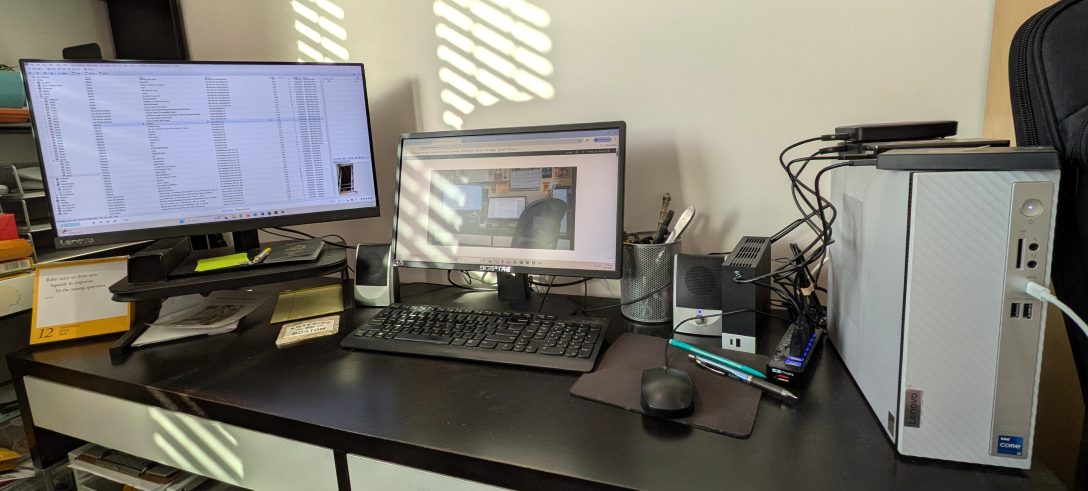
I’ve gotten pretty comfy writing back here in Spare Oom. I’ve got my PC for goofing off online research and music soundtracks. I’ve got our old love seat back here, which I’ve been using for my longhand writing. I keep the window slightly ajar and the blinds open to remind me there’s a world outside. I’m just down the hall from the living room so if A needs me, she only needs to call out.
But what about writing elsewhere?
I’ve worked elsewhere in the apartment over the years. I restarted the last chapters of The Process of Belief back when my computer was in the living room. I’d sit next to A on the couch and work on the Bridgetown Trilogy revision while we had something going on the TV. I’ve worked at the kitchen table while A and one of her friends watched a movie. And recently I’ve done some longhand out there as well.
Writing elsewhere can definitely be a great exercise, especially if you’re someone who doesn’t want to miss out on deadlines, self-imposed or otherwise.
During our trip to Manhattan a short while ago, I managed a few pages during the flights, and I got a few more at the end of the day in our hotel room. And over the years, I’ve written in all sorts of places. There’s a passage in A Division of Souls that was written in a cheap hotel where I decided to stay rather than drive home during a snowstorm. I’ve worked on the Bridgetown Trilogy revision in hotels in Portland, Cambridge, Seattle, and even Paris. A number of scenes, notes, and brainstorming ideas for all three Bridgetown books were written during SF cons. And I almost always get a good portion done during vacations.
It can definitely be done, if you’re willing to work. That’s not to say that you should abstain from having fun during your vacations. By all means, go out and see the world! Do some people-watching. Pick up on localisms, regional cultures, things otherwise mundane that would actually brighten up your characters. Listen to how they speak, check out what music they listen to. But at the same time, feel absolutely free to sit down at that sidewalk café, drink your coffee and eat your beignet, and think about nothing else but being in the moment and enjoying it.
We’ll be heading out to London in a few days, and I plan on getting a lot of writing done while we’re there. I have notebooks at the ready, my camera for reference shots, a shopping list of books and cds to look for. But this will also be a continuation of our previous trip there last fall for Worldcon. That trip turned into a long bucket list of music-related places to visit (Abbey Road, Baker Street, Berwick Street, Savile Row, etc.), historic museums (Tate Modern, Victoria & Albert, Portrait Gallery, etc.), and points of interest (St Paul’s, Waterstone’s, Whitehall/Westminster). This is going to be the Extended Remix, in which we’ll hit all those places again as well as those we missed the last time, this time at our leisure. [Yes, I just pronounced that as “lezh-err” instead of “lee-zhur” in my head. I’m totally ready for this trip.]
Point being: By all means, if you want to get some writing done while on vacation, even and especially if you don’t exactly need to, go nuts! Go for it! Write like the mad, crazed weirdo that you are! It’s well worth it if you decide to make it enjoyable. Don’t worry about perfection, just have fun with it! Play with a subplot. Come up with an outtake that you can share online with your blog followers. Play around with character development.
Just be sure to balance it with just having fun in the real world!
It’s a silly milestone, but a milestone nonetheless: I’ve been writing this new story in a wide-ruled three-subject spiral bound notebook, and a short time ago I just hit the first of two subject tabs, which means I’m a third of the way through the notebook already. With 120 pages in the notebook, this means I’ve used 40 of them so far, which means I’ve written at least 80 pages. Woo! Go me!
Still no title for it yet, either, which is totally not me. Usually I give a new project a temporary title soon after starting it — either a borrowed song title or a boring phrase as a placeholder — but at this point it’s still known as “New MU Story.” And you know what? I’m okay with that. It means I’m focusing on the right things.
At this time it’s still longhand as well…I haven’t started with the transcription to Word yet. I suppose I’ll do that soon, when the time comes for me to expand the initial first draft. From past experience, that usually ends up being somewhere around halfway through Act II, when things start to get complicated plot-wise. I do that for two reasons: one, by that time I have a firmer grasp of the story as a whole and what may need adjustment; and two, the revisiting of the Story So Far gives me a good idea of where I need to go from there. At this time I’m going to assume that I’ll start on the transcription sometime next month.
Is this going to be a single book, or will it be another trilogy? That’s a good question, and one I’m not going to answer right away, not even to myself. It’s definitely one of many in this universe, that’s for sure. I’m not even sure when I’ll be finished. I’m just happy that it’s still going strong, and that’s good enough for me right now.
You’ve heard me (and other writers) talk about being ‘in the mood’ or ‘in the right mindset’ to write whatever projects they’re working on. In the past it’s ended up being a crutch; I’d waste a good twenty minutes digging through my music collection trying to find the perfect album to listen to for a particular writing session. I used to be really bad with that, but I’ve gotten better. Most of the time now I listen to whatever newer release I happen to have close at hand, or if a specific album if I want to give that one another listen.
Actually, this post isn’t about that. It’s about something I was subconsciously aware of for years, but just recently started monitoring, and it’s kind of interesting. At least to me, anyway.
This one’s about where my mind is while working on whatever project I have in front of me. At present I’m letting my imagination run rampant within the confines of my created world for the new Mendaihu Universe story…I picture novels as one long story of character evolution, where the the only rules are that nothing remains static and that consequences just as important as the actions. I tend to let myself get well and truly lost in my created world; that is, ‘lost’ in the sense that if my brain suddenly and unexpectedly comes up with a doozy of a plot twist and I know it’ll work as part of the whole, I’ll let it take center stage and not hold back. I think of it as writing for an audience of myself, though with full expectation that others will want to read and understand it as well.
Writing nonfiction is somewhat similar, only the boundaries are much tighter…at least that’s been my experience with Walk in Silence. The focus is on the subject matter’s evolution within the confines of reality…thus imagination is reined in considerably, only given to the prose itself. This is also true with my blog posts. Not counting the more personal entries over at my LJ where my writing is more freestyle, I try to give my writing at least a little bit of professionalism. When I’m writing nonfiction, I’m writing for an audience other than myself.
Poetry and song lyrics are a different beast, where I tend to be more emotional with my style. I started writing poetry and songs back in my late teens as a release, but also as a playground for words, where I’d let myself come up with odd metaphors and weird imagery. There’s really no rules here…I just riff it from start to finish. This stuff is totally a personal indulgence, though I’ve been told by listeners that my Flying Bohemians and jeb! lyrics were pretty cool, so I’m fine with that.
The fascinating thing is that, now that I’m working on the new MU story, writing blog entries and (soon) working on Walk in Silence again, I find myself conscious of how my mind will shift from one style to another. It can be tricky, especially if you have a lot of disparate writing ideas milling about in your head, but after all these years I’ve managed to make it work. I think part of it is what I call the ‘going in’ phase of the session. For instance, if I’m about to write the MU story, even before I put pen to paper I’ll start thinking about the characters, get in their heads and emotions for a few minutes to remember where I was.
[Noted, this is where the writing session soundtrack often comes in, and why I’m often a sucker for a certain mood in the songs. The music helps me set the tone of the section I’m writing. This is also true for nonfiction, or at least with Walk in Silence; for that I’m actually listening to the music I’m writing about so I can connect with the subject more clearly and emotionally.]
I think now that I’ve made sense of how my creative mind shifts from project to project, I’ve become better at giving each project a tighter focus. I know how I’m doing it, so I’m less worried about whether or not I’m doing it right…as long as I’m doing it my own logical way, then that’s all that matters.
I’ll note this now: this is not necessarily a post on violent extremism, like the kind we often see in today’s news, but about how far a character will go to hold onto their beliefs, and why.
One of the themes that I’ve been thinking about for this new Mendaihu Universe is extremes. I used it to some degree in the Bridgetown Trilogy, wherein many characters have their beliefs and emotions tested. Is what they’ve always felt really the truth? Is the kind of peace they’re fighting for really what is needed? And what if what you perceive to be the truth actually is the truth, at least in your own reality? How far would you go to fight for what you believe to be the right thing to do for everyone? These were the universal questions, set upon a group of people. I wanted not only to show how they progressed as their own person, but also as a collective. Actions do affect everyone involved in one way or another. It’s not just about the action itself, however…it’s about the consequences.
For the new Mendaihu Universe book, I’m looking at the same themes again, but this time on a personal level. After the spiritual revolution that took place in the Bridgetown Trilogy, we now see its outcome, some generations down the line. Without going into too much detail (partly because I’m still pretty much at the beginning of the story anyway), I want to examine how the actions of the past affect the beliefs of the future. I want to see how these beliefs and rituals have changed, now that they’ve been commonplace for a significant amount of time.
The idea of extremes for this new project came to mind after watching a large number of historical documentaries about Britain, and a lot of Time Team episodes with my wife over the last few months. Specifically: today we have believers of various faiths, many of them reinterpretations or reimaginings or revolutionary versions of older ones. Some faiths raise imagery, idolatry and destination to holy statuses, for instance. I started pondering about something I’d thought of much earlier in my life, back when I was taking catechism classes. I started thinking about what life was like when these Biblical stories took place; not just what the stories tell us in description or what’s given to us over the years with tapestries and paintings and whatnot. This is where the Time Team episodes were coming in: while watching Phil and Mick and Raksha and all the other Time Teamers troweled their way into the past and tried to reconstruct what ancient buildings may have looked like, I started thinking about the Bridgetown Trilogy from the same point of view. What we see now, as we’re excavating the past, may be something completely alien from the original idea, changed and mutated by time and evolution. It’s only when we take the time to not just look but understand what that past moment was about, do we get closer to the truth of that point in history.
First thought of course being: how would Denni Johnson, awakened as the the deity, the One of All Sacred in its last iteration, be viewed by those who follow the One some fifty to a hundred years later? One of the first mentions of Denni in this new book is when a character sees an eight foot statue of her, complete with angelic wings, hands reaching down to all those who look up at it, near the same corner of the warehouse where she’d ascended to deity status in the first place. I followed up with a few other ideas: new characters taking the names of those in the trilogy, following in the footsteps of their ancestors. The human-alien relationship on Earth becoming closer in some respects and more tenuous in others. And so on.
This is what I think about now when I’m watching a documentary or reading a book about something historic. I’m not just being told a story about something that happened in the past; I’m also being given an idea of what thoughts, ideas and emotions may have been like as well. I’m being given context to go with the story. And this is what’s been going on with this new Mendaihu Universe story; I’m writing about a far future that’s trying to remember what the past was like, in order to learn from it and move forward in the right direction.



 Welcome to Bridgetown